What to budget for preparing your building site
By Housey · Last reviewed 1st of June 2026
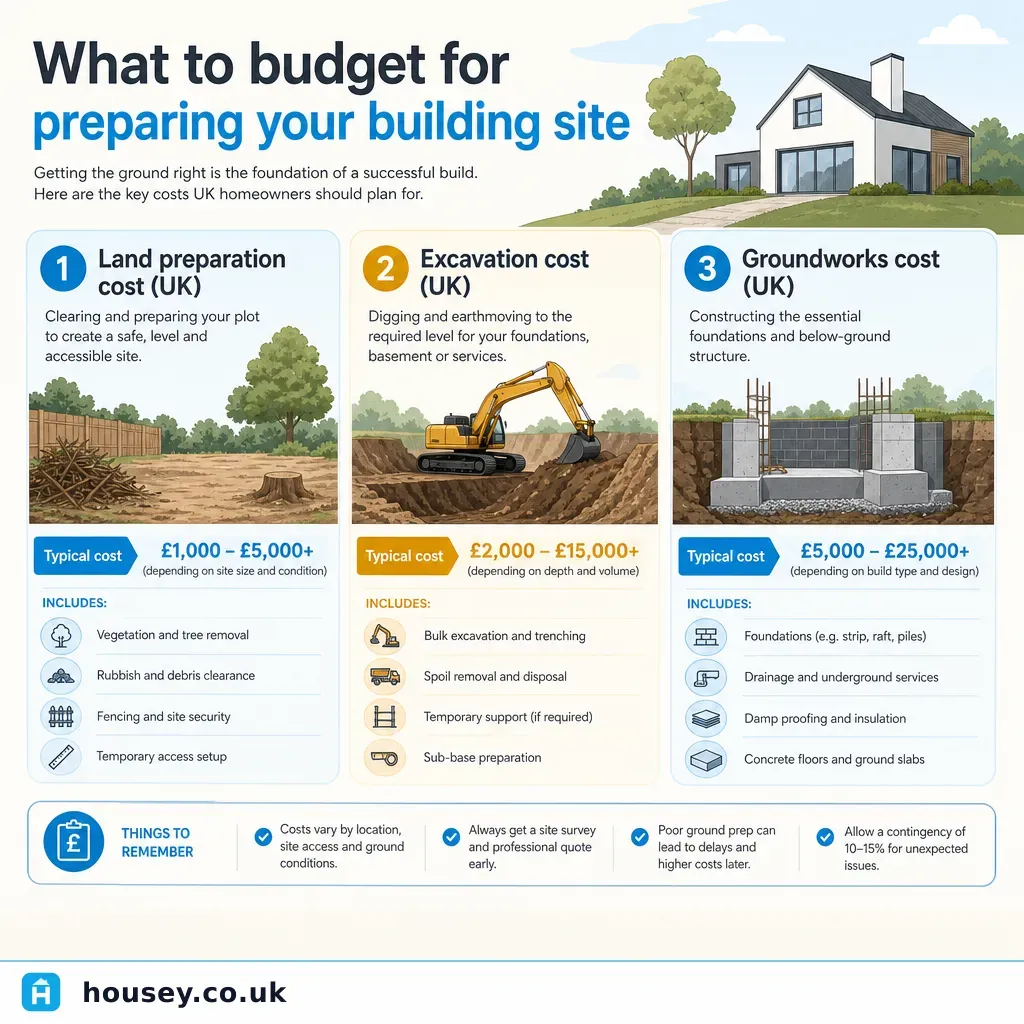
What to budget for preparing your building site
Site preparation is often the least glamorous line item in a self-build or development budget, yet it regularly accounts for 10–15% of total project cost and is the phase most likely to throw up unforeseen extras. Whether you are breaking ground on a fresh plot, clearing a garden for an extension, or readying brownfield land for new construction, the condition and complexity of your site will drive costs more than almost any other factor.
Key points
- Groundworks on a typical UK residential plot can range from £5,000 to £50,000+, depending on site conditions, soil type, slope, access, and contamination history.
- A geotechnical investigation (trial pits or borehole survey) costs roughly £1,500–£5,000 and can prevent far more expensive surprises once construction begins.
- Sites classed as brownfield, near watercourses, or with trees subject to Tree Preservation Orders (TPOs) typically require additional surveys before groundworks can begin.
- Contaminated land remediation is governed by Part IIA of the Environmental Protection Act 1990; remediation costs for modest residential sites can run from £10,000 to well over £100,000.
- Building Regulations Approved Document C (Site preparation and resistance to contaminants and moisture) sets the minimum standards for how a site must be prepared before foundations are laid.
What does site preparation typically include?
Site preparation is not a single task — it is a sequence of activities that may include some or all of the following, depending on your plot:
- Site clearance: removing vegetation, existing structures, rubble, and topsoil.
- Demolition: if existing buildings or outbuildings need to come down.
- Ground investigation: soil sampling, trial pits, or boreholes to assess bearing capacity and contamination risk.
- Earthworks and excavation: cutting, filling, and levelling to achieve the design formation level.
- Drainage and utilities: diverting or capping existing services; installing temporary or permanent drainage.
- Retaining structures: where the site is sloped, retaining walls or piling may be required.
- Contamination remediation: removal or treatment of contaminated material.
- Temporary access: forming a construction entrance, haul road, or welfare facilities.
Not every project needs all of these. A straightforward rear extension on a level garden may need no more than a topsoil strip and foundation excavation. A self-build on a sloped brownfield plot in an old industrial area may need almost all of them.
What drives site preparation costs?
Cost driver | Lower-cost scenario | Higher-cost scenario |
|---|---|---|
Soil type | Sandy or clay loam, stable bearing | Made ground, peat, running sand, or rock |
Slope | Flat or gently sloping | Steeply sloped — cut-and-fill or retaining required |
Contamination | Greenfield with no industrial history | Brownfield, former petrol station, or filled land |
Existing structures | Open plot | Demolition of buildings, basement, or deep foundations |
Tree constraints | No protected trees nearby | TPO trees or root protection zones requiring an arborist |
Utilities | No live services on site | Gas, water, electricity, or telecoms to divert |
Access | Good road frontage, large gate | Narrow lane, restricted height, or weight limits |
Disposal distance | Local skip hire and tip nearby | Long haul for contaminated spoil (Landfill Tax applies) |
Landfill Tax on non-inert waste was £103.70 per tonne in 2025–26, and contaminated soil is typically classified as non-inert. This alone can add significant sums when large volumes need disposing of.
Indicative cost ranges
The figures below are indicative only. Always obtain multiple quotes from suitably qualified contractors.
Indicative UK costs, last reviewed 2026-06-01. Costs vary by region, site conditions, and market.
Activity | Indicative range |
|---|---|
Topsoil strip and removal (per m²) | £3–£10 |
General excavation to formation level (per m³) | £20–£60 |
Rock breaking or specialist excavation (per m³) | £80–£200+ |
Trial pits / geotechnical investigation | £1,500–£5,000 |
Phase 1 environmental desk study | £800–£2,000 |
Phase 2 intrusive investigation | £3,000–£15,000+ |
Contamination remediation (modest residential site) | £10,000–£100,000+ |
Demolition of typical domestic outbuilding | £2,000–£8,000 |
Retaining wall (per linear metre, blockwork) | £250–£600 |
Site drainage (temporary or permanent connection) | £1,500–£8,000 |
Forming access track or hardstanding | £3,000–£15,000 |
These ranges are illustrative and do not replace professional estimates. Quotes must account for VAT (currently 20% on most groundworks).
Worked example: self-build on a sloped urban plot
Consider a 400 m² brownfield plot in the East Midlands, formerly used as a vehicle workshop, with a 1.5 m level change across the site:
- Phase 1 environmental desk study: £1,200
- Phase 2 intrusive soil investigation (6 trial pits): £4,500
- Contamination remediation (limited hydrocarbon hotspot, cut and cap): £22,000
- Demolition of single-storey workshop: £6,500
- Earthworks: cut-and-fill to level the plot, forming retaining wall: £18,000
- Drainage diversion and new connection: £5,500
- Site access and temporary welfare: £3,000
- Estimated total site preparation: approximately £60,700 + VAT
This total sits at roughly 12–15% of a modest new-build budget. Had the owner skipped the Phase 2 investigation and hit the hydrocarbon hotspot mid-construction, remediation costs at that stage are typically 2–4 times higher than if dealt with during site preparation.
What not to assume
Many homeowners and some small developers approach site preparation with assumptions that regularly cause cost overruns.
Do not assume a clean greenfield plot needs no investigation. Agricultural land can contain old drainage systems, tree roots, filled ditches, or made ground from earlier buildings. A geotechnical investigation is usually worth the fee.
Do not assume demolition waste can go to a standard skip. Asbestos-containing materials (ACMs) are commonly found in buildings constructed before 2000. Asbestos waste requires licensed disposal and raises overall demolition costs significantly.
Do not assume planning permission covers site preparation. Your planning consent may attach conditions — such as a Construction Management Plan, an archaeological watching brief, or ecological mitigation — that add time and cost before any ground is broken.
Do not assume your quoted groundworks price is fixed. Most groundworks contracts include provisional sums for unknown ground conditions. If conditions prove worse than anticipated, costs will increase.
Do not assume utilities shown on drawings are accurate. Always commission a utility search and CAT (cable-avoidance tool) scan before any excavation.
When to get professional help
Site preparation is not a phase to approach without qualified professionals. Seek specialist input if:
- Your plot has any history of industrial, commercial, or agricultural use.
- There are trees on or adjacent to the site with a trunk diameter above 75 mm, where TPO or conservation area constraints may apply.
- The site has a slope greater than roughly 1:10, or there is any uncertainty about the stability of adjacent land.
- Preliminary research suggests any made ground, old landfill, or filled features below the surface.
- Planning conditions require specific pre-commencement investigations.
- You are working near a watercourse, flood zone, or area of known contamination.
How Housey can help
Housey connects you with vetted specialists at every stage of site preparation. Use our groundworkers service to find experienced earthworks contractors, commission a geotechnical and soil investigation before you break ground, or arrange an environmental survey to identify contamination risks early. For complex drainage works, our drainage contractors can advise on connections and sustainable drainage compliance.
Frequently asked questions
Do I need planning permission for site preparation works?
Generally, site clearance and excavation do not require separate planning permission once outline or full consent is in place. However, conditions attached to your consent — such as pre-commencement surveys or a Construction Management Plan — must be formally discharged before works begin. Check your decision notice carefully and consult your local planning authority if uncertain.
Is contaminated land always obvious?
No. Contamination is frequently invisible and odourless at the surface. Former petrol station sites can appear clean but carry hydrocarbon contamination at depth. A Phase 1 desk study followed by a Phase 2 intrusive investigation is the standard approach for any site with a potentially contaminative history, as recommended under the National Planning Policy Framework.
Who is responsible for ensuring safe ground conditions on a self-build?
Under the Construction (Design and Management) Regulations 2015 (CDM 2015), the Principal Designer must ensure pre-construction information — including ground investigation data — is gathered and shared with contractors. On a self-build, the client (usually the homeowner) bears responsibility for commissioning appropriate investigations before works begin.
Can I save money by doing site clearance myself?
Light vegetation clearance on a simple domestic garden is often carried out by homeowners. However, any mechanical excavation, demolition, or work near utilities should be carried out by qualified contractors. Working near gas and electrical services without appropriate qualifications carries legal and safety risks, and any asbestos removal must be done by a licensed contractor.
Sources and further reading
- Building Regulations Approved Document C — GOV.UK
- Contaminated land: Part IIA of the Environmental Protection Act 1990 — GOV.UK
- Construction (Design and Management) Regulations 2015 — Health and Safety Executive
- Landfill Tax: general guide (Notice LFT1) — HMRC
- National Planning Policy Framework — GOV.UK
Useful next reads
 Planning & Pre-Build
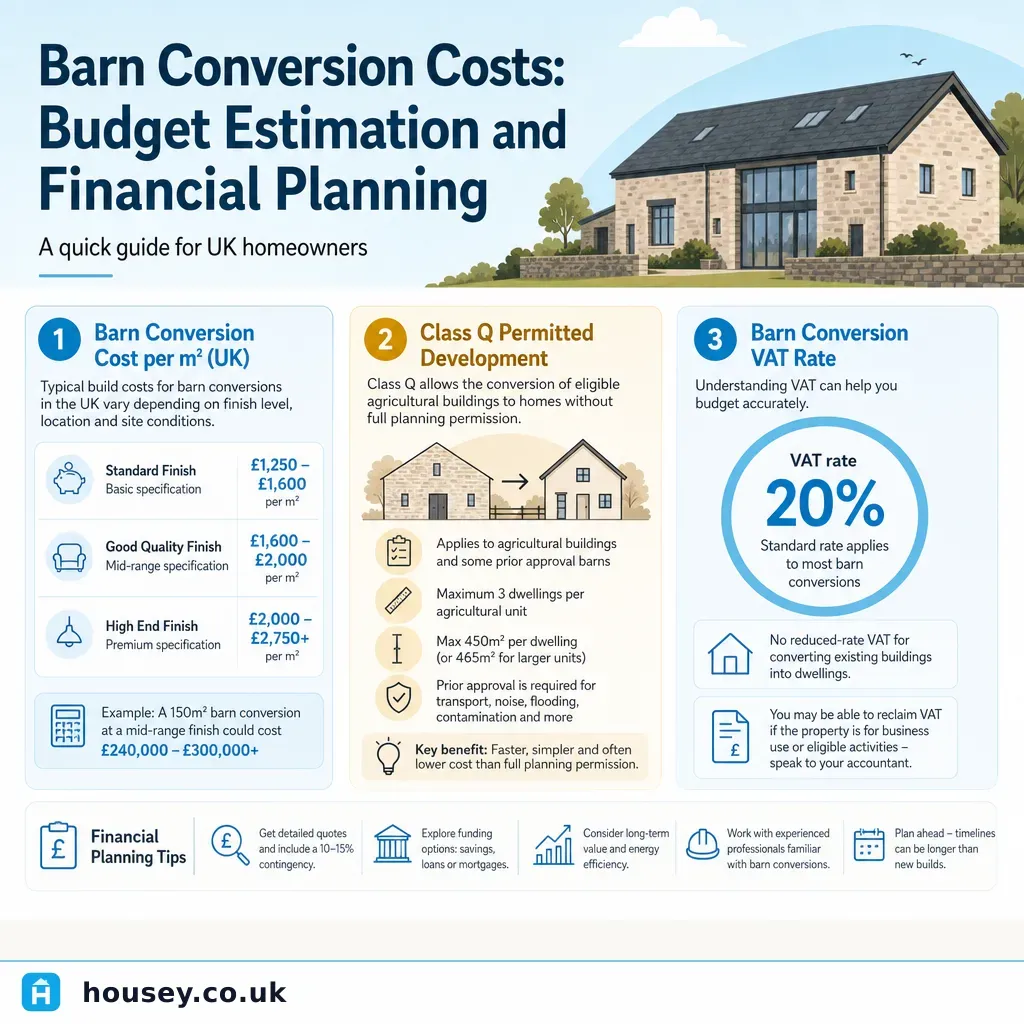
Barn Conversion Costs: Budget Estimation and Financial Planning
Barn conversions in the UK typically cost £1,500–£3,000 or more per square metre depending on structural condition, specification, and location.
 Planning & Pre-Build
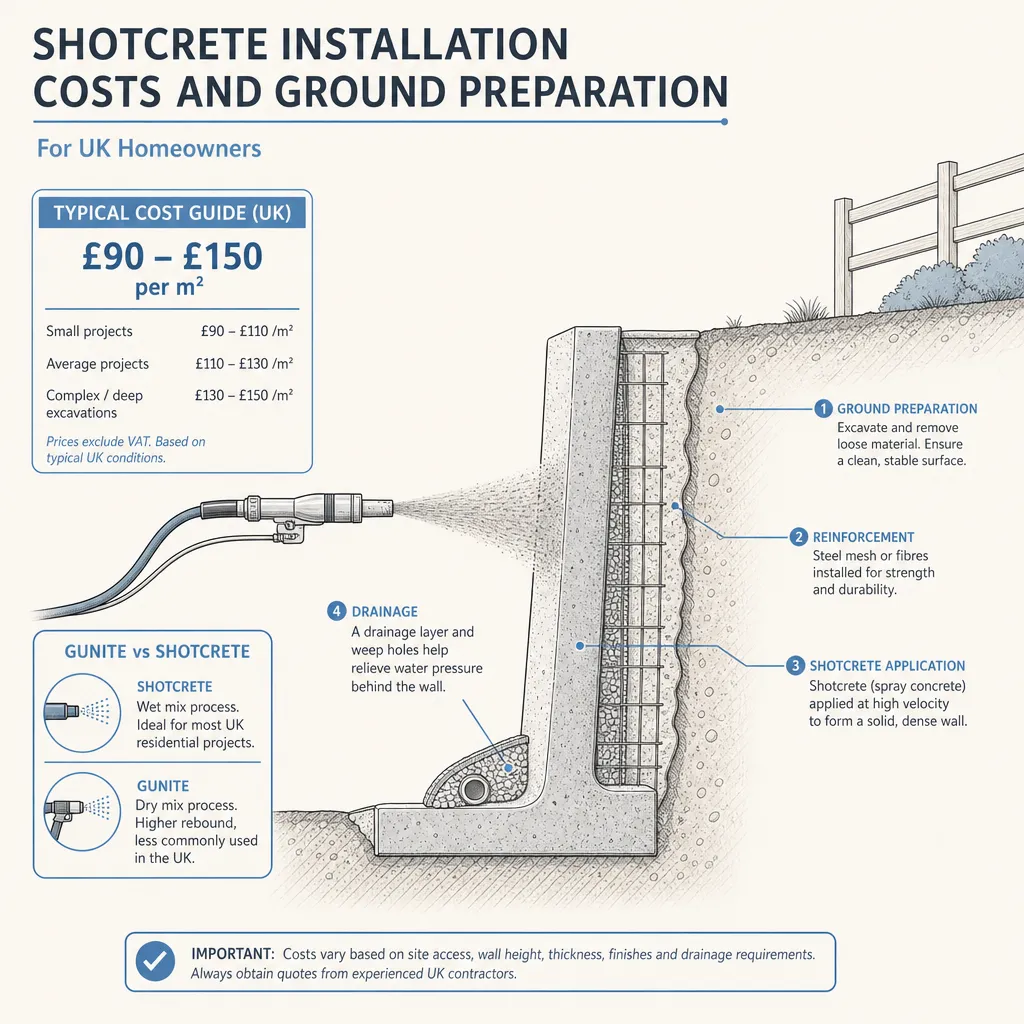
Shotcrete Installation Costs and Ground Preparation
Shotcrete (spray concrete) in the UK costs roughly £80–£200 per m² to supply and apply, depending on mix strength, layer thickness, access, and reinforcement.
 Planning & Pre-Build
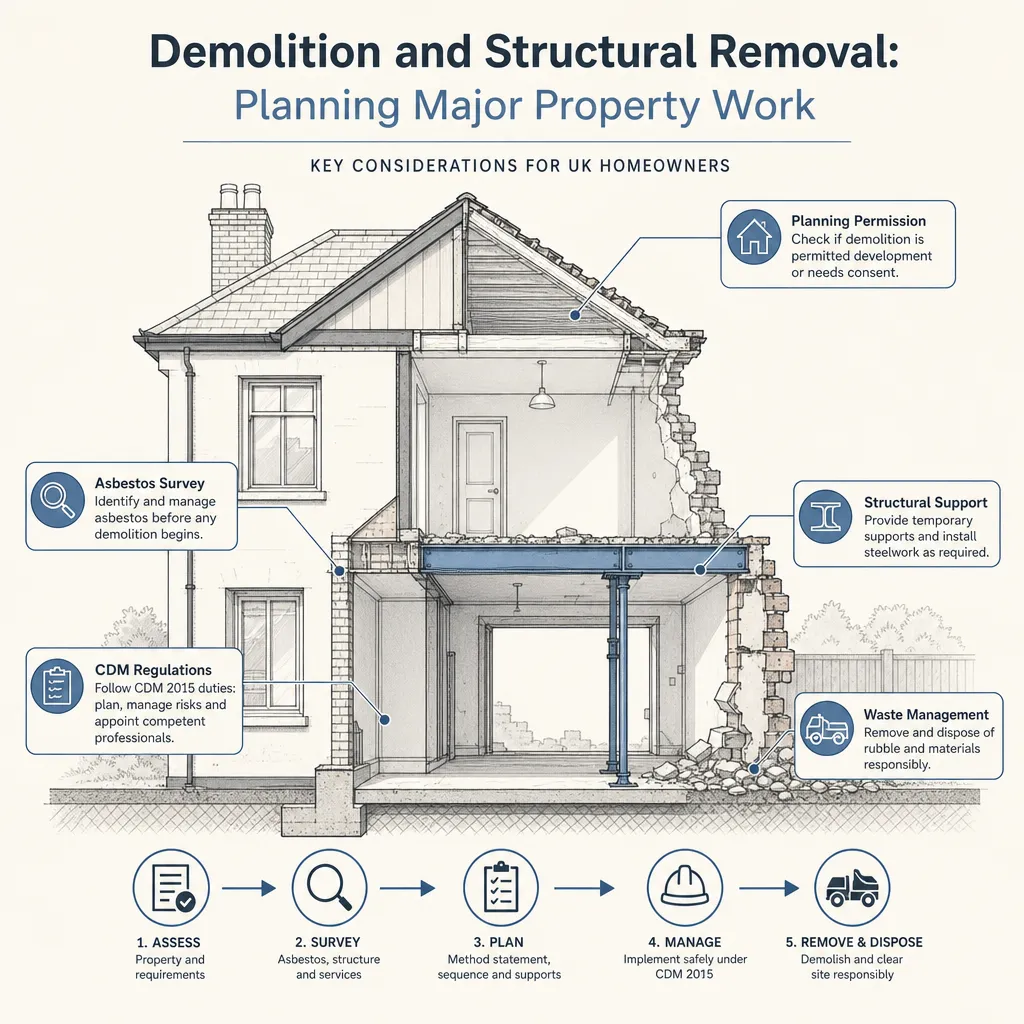
Demolition and Structural Removal: Planning Major Property Work
Demolition in the UK requires Section 80 notification to your local building control body at least six weeks before work begins.
 Planning & Pre-Build
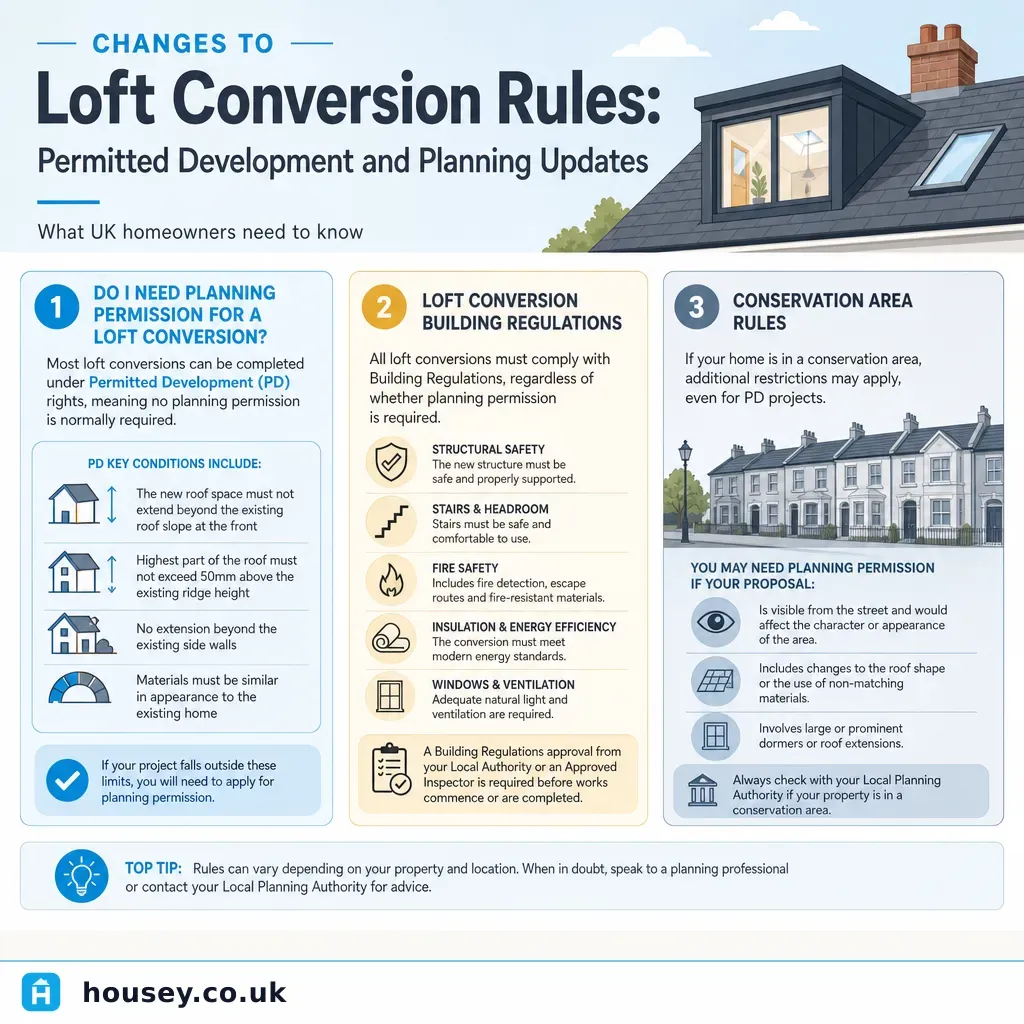
Changes to Loft Conversion Rules: Permitted Development and Planning Updates
In England, most loft conversions on standard houses qualify as Permitted Development under Class B of the GPDO 2015, allowing up to 40 cubic metres (terraced) or 50 cubic metres (detached or semi-detached) without a planning application — if conditions are met.
 Planning & Pre-Build
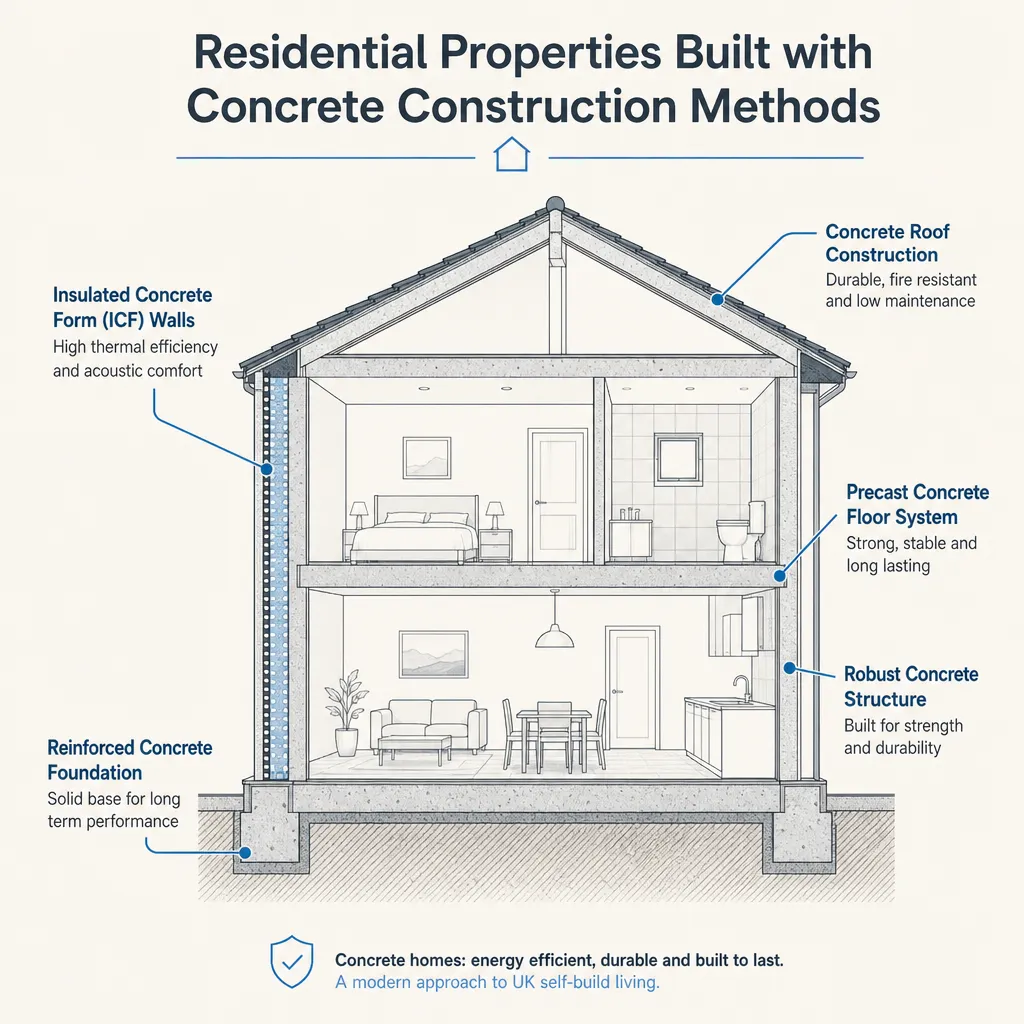
Residential Properties Built with Concrete Construction Methods
UK homes are built using several concrete methods: in-situ cast concrete, precast panel systems, insulating concrete formwork (ICF), and older non-traditional types such as Wimpey No-Fines and Laing Easiform.