What to Expect During a Home Survey
By Housey · Last reviewed 11th of May 2026
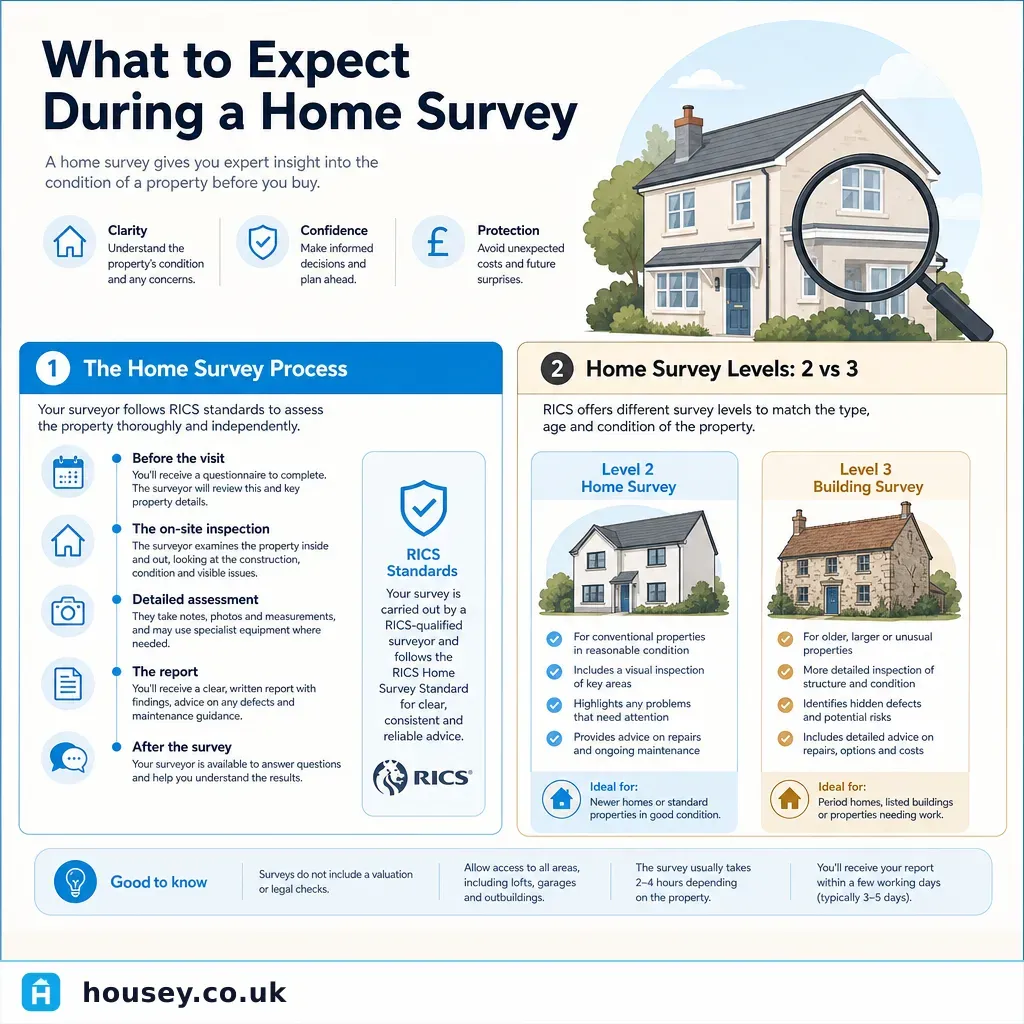
What to Expect During a Home Survey
A home survey is usually instructed between mortgage offer and exchange of contracts — the moment at which you find out whether the property you have agreed to buy is in the condition you expect. Many buyers instruct a survey without knowing what the surveyor will actually do on the day, what areas fall outside the scope, and how to interpret the report when it arrives. Understanding the process helps you prepare appropriately, ask better questions of your surveyor, and act on the findings before you are legally committed to the purchase.
Key points
- RICS introduced a standardised suite of home survey formats in 2021: the Level 1 Condition Report, Level 2 Home Survey, and Level 3 Building Survey, replacing the previous HomeBuyer Report branding.
- A RICS Level 2 survey typically takes 2–4 hours on site; a Level 3 Building Survey on a large, complex, or defective property may take a full day.
- Surveyors use a traffic-light condition rating system: Rating 1 (no repair action needed), Rating 2 (defects requiring attention but not urgent), and Rating 3 (serious defects requiring urgent attention or further investigation).
- A standard home survey does not cover the central heating system, electrical installation, drainage, or underground structures unless the scope is specifically extended — these require separate specialist reports.
- You are entitled to contact your RICS surveyor after receiving the report; most will discuss the findings with you by telephone at no additional charge.
What the surveyor actually does during the inspection
When the surveyor arrives, they carry out a methodical visual inspection. They do not carry out intrusive investigation — drilling, lifting floorboards, or removing fixtures — unless this has been specifically agreed in advance and reflected in the agreed fee.
A typical inspection follows this sequence:
- External inspection — roof covering, chimney stacks, guttering and downpipes, walls (pointing, cracks, and signs of movement), windows and doors, external drainage, and any outbuildings within scope.
- Internal inspection — each accessible room, covering ceilings, walls, floors, windows, and doors; roof space where accessible via a fixed hatch; basement or cellar where accessible.
- Services overview — a visual check of the boiler, meters, visible pipework, and visible electrical fittings. No system testing is carried out as part of a standard survey.
- Site and environment notes — garden, boundaries, drainage inspection covers, proximity to trees, and potential ground movement risks such as clay soils or former mining areas.
RICS survey levels compared
Survey level | Best for | What it covers | Typical report length | Indicative cost* |
|---|---|---|---|---|
Level 1 Condition Report | New-build or near-new property in good condition | Visual inspection, condition ratings | Short — a few pages | £250–£400 |
Level 2 Home Survey | Conventional homes in reasonable condition built post-1900 | Defect analysis; optional market valuation | Medium — 20–40 pages | £400–£900 |
Level 3 Building Survey | Older, larger, altered, unusual, or visibly defective properties | Detailed construction and defect analysis, maintenance advice | Long — 40–100+ pages | £600–£1,500+ |
*Indicative UK costs, last reviewed 2026-05-11. Quotes vary by property size, type, location, and surveyor firm.
What the surveyor will not do
RICS home surveys are non-invasive visual inspections. The surveyor will not:
- Lift carpets or floor coverings to inspect subfloor structure, unless specifically instructed and agreed beforehand.
- Move furniture, personal belongings, or stored items.
- Test the central heating, electrical installation, drainage, or appliances.
- Access areas that are locked, unsafe, or physically inaccessible on the day of inspection.
- Provide a legal opinion on title, boundaries, planning history, or rights of way.
- Test for asbestos, radon, or other environmental hazards, though areas of concern may be flagged with a recommendation for specialist investigation.
If any of these are relevant to your purchase decision, commission specialist reports alongside the survey: an Electrical Installation Condition Report (EICR), a gas boiler service, a drainage CCTV survey, or a structural engineer's report where movement is suspected.
What not to assume
Common misconceptions about home surveys in the UK:
- A mortgage valuation counts as a home survey. It does not. A mortgage valuation is for the lender's protection, not the buyer's. It may involve little or no physical inspection and provides no recourse against defects for the purchaser.
- A Condition Rating 2 means the problem is minor. Rating 2 means the defect needs attention but is not immediately dangerous — not that it can be ignored. Damp, failed flashings, or deteriorated pointing are typically rated 2 even when costly to address.
- The survey covers everything in the house. Boilers, electrics, drainage, and underground structures fall outside the standard scope and require separate specialist inspection.
- A survey will identify every defect. Concealed problems, areas inaccessible on the day, and faults hidden behind recent redecoration may not appear in the report.
- If defects are found, the seller must fix them. The survey has no binding legal effect on the seller. Findings can, however, support a renegotiation on price or a request for works before exchange.
Homeowner checklist: preparing your property for survey (if you are the seller)
If a buyer has instructed a survey on your property, you can help the inspection run smoothly:
When to get professional help
The survey report is a starting point, not a final verdict. Seek further specialist advice if:
- The report flags suspected movement, cracking, or subsidence and recommends referral to a structural engineer.
- Damp is noted in multiple locations or near chimney breasts — a CSRT/CSTDB-accredited damp and timber surveyor may be required.
- The property was built before 1970 and the roof space has not been inspected — asbestos-containing materials are common in pre-1970 construction and a licensed asbestos surveyor should assess before any work is planned.
- The report contains a Condition Rating 3 and recommends further investigation — do not proceed to exchange until that investigation is complete and its cost implications are understood.
How Housey can help
Whether you need help deciding which survey level is right for your purchase, or you have received a report and want to understand your next steps, Housey can connect you with independent RICS Home Survey professionals across the UK — without being tied to the surveyor recommended by your mortgage lender.
Frequently asked questions
Should I be present during the home survey?
You can attend, though many buyers are not present during the inspection. Some surveyors prefer unaccompanied access to work methodically. More useful is arranging a follow-up call after the report is issued — most RICS surveyors will explain the findings by telephone, and this is the right time to ask about any Condition Rating 2 or 3 items in detail.
How long after the inspection will I receive the survey report?
Most RICS surveyors issue reports within three to five working days of the inspection. Turnaround can be longer for complex Level 3 surveys or during busy periods. Confirm the expected timeframe when booking, particularly if you are working to a tight exchange deadline.
Can I use the survey findings to renegotiate the purchase price?
Yes — if the report identifies significant defects not disclosed by the seller, it is reasonable to submit a revised offer or request remedial works as a condition of proceeding. The survey has no binding legal effect on the seller, but it provides objective evidence to support your position. Your conveyancer can advise on how to approach this effectively.
What is the difference between a RICS surveyor and a structural engineer?
A RICS surveyor carries out a broad assessment of the whole property, identifying visible defects across all elements. A structural engineer specialises in calculating loads, assessing movement and foundation behaviour, and designing structural interventions. Where a survey flags suspected structural movement, the surveyor will typically recommend referral to a structural engineer for a detailed engineering assessment.
Sources and further reading
- RICS — Home surveys explained — RICS
- GOV.UK — Buying a home — GOV.UK
- Citizens Advice — Surveying your home before buying — Citizens Advice
- Electrical Safety First — EICR guidance — Electrical Safety First
Useful next reads
 Surveys & Inspections
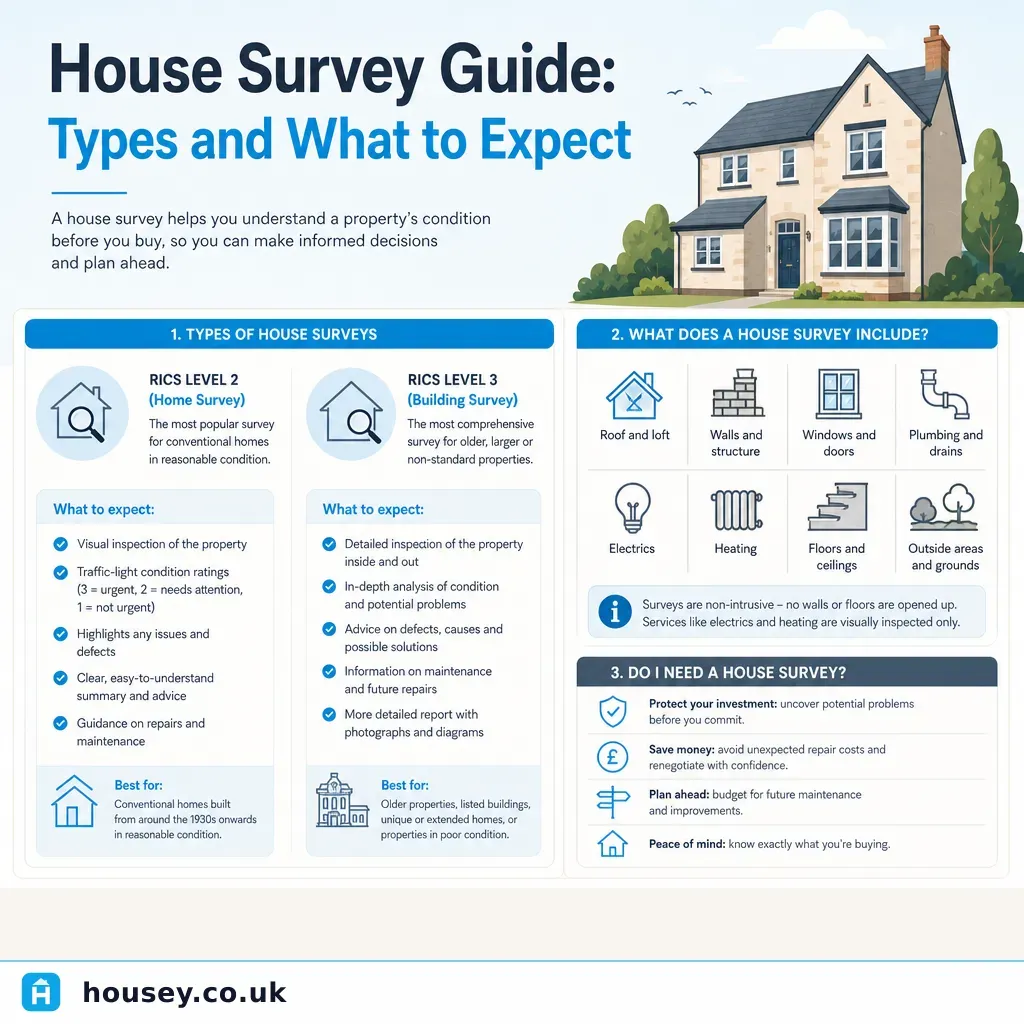
House Survey Guide: Types and What to Expect
UK house surveys come in three RICS-standardised levels: Level 1 (Condition Report) for new or near-new homes, Level 2 (Home Survey) for conventional post-war properties, and Level 3 (Building Survey) for older, altered, or defective properties.
 Surveys & Inspections
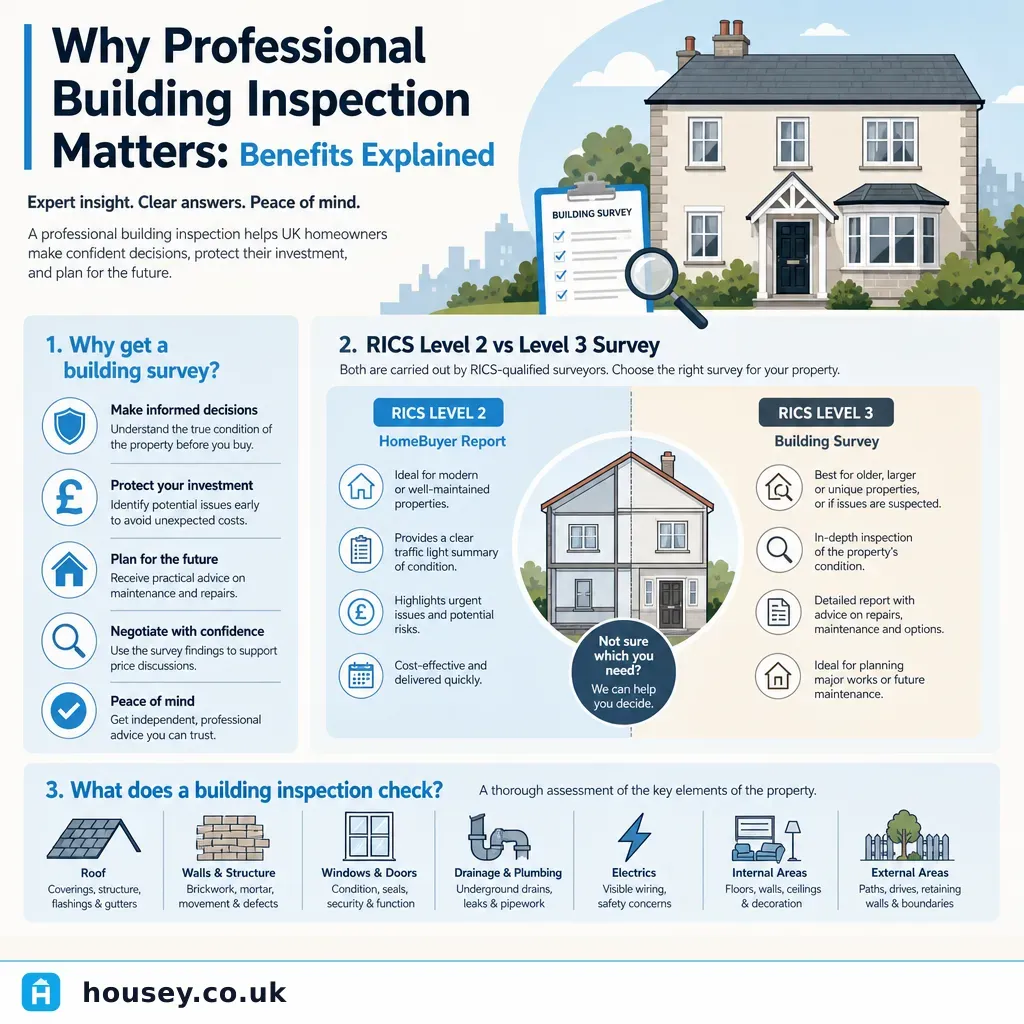
Why Professional Building Inspection Matters: Benefits Explained
Professional building inspection gives UK homeowners an independent, expert view of a property's condition and regulatory compliance.
 Surveys & Inspections
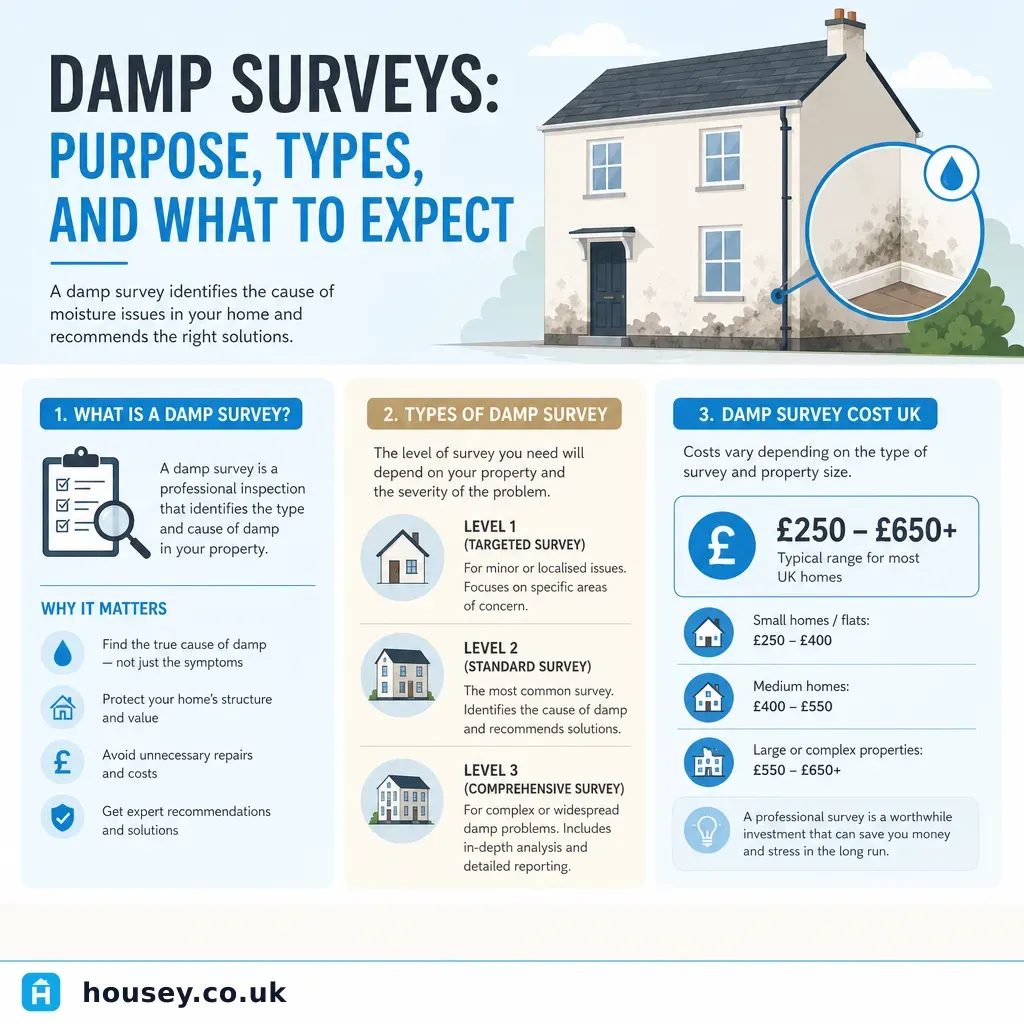
Damp Surveys: Purpose, Types, and What to Expect
A damp survey is a specialist inspection to identify the source, type, and extent of moisture in a property.
 Surveys & Inspections
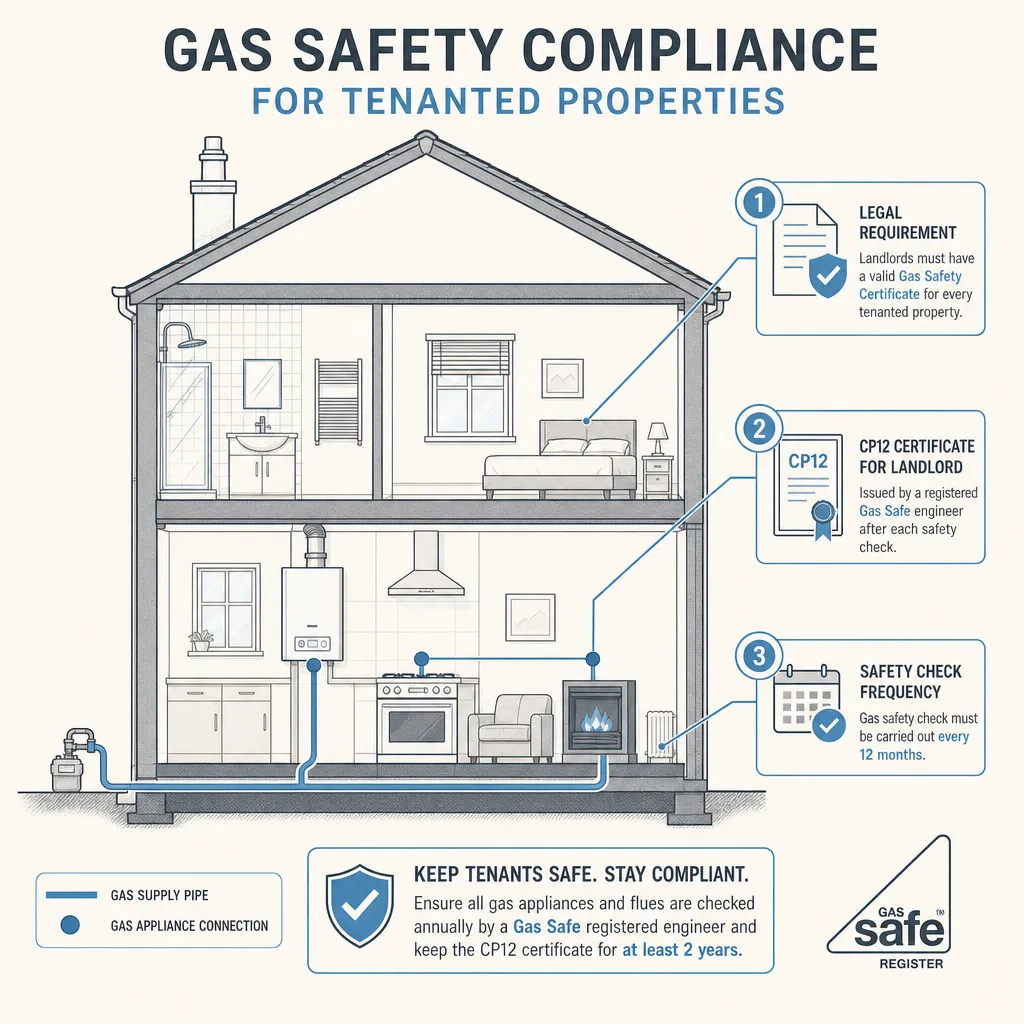
Gas Safety Compliance for Tenanted Properties
UK landlords are legally required to arrange an annual gas safety check by a Gas Safe registered engineer for every tenanted property with a gas appliance.
 Surveys & Inspections
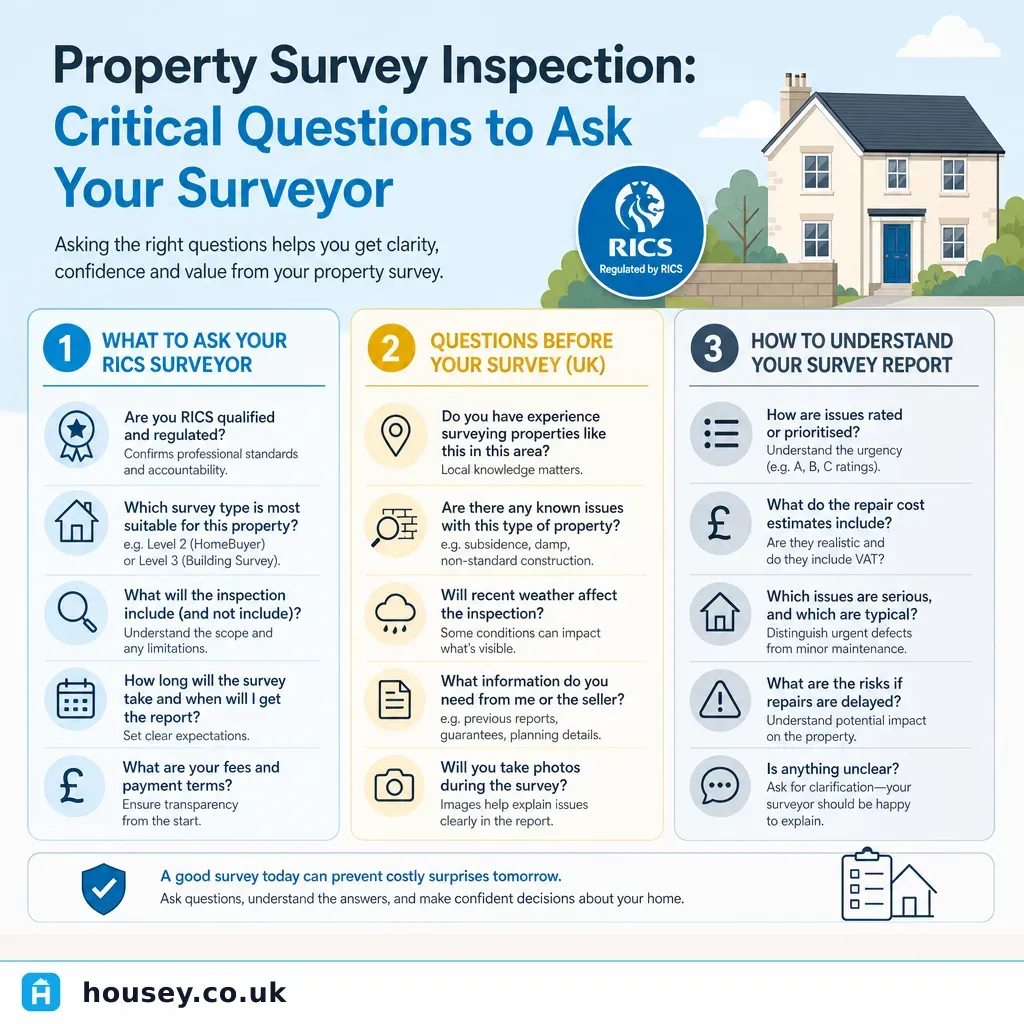
Property Survey Inspection: Critical Questions to Ask Your Surveyor
Before instructing a surveyor, ask which RICS level suits your property and what the report will and will not cover.