What to budget for building and installing wheelchair accessible ramps
By Housey · Last reviewed 6th of May 2026
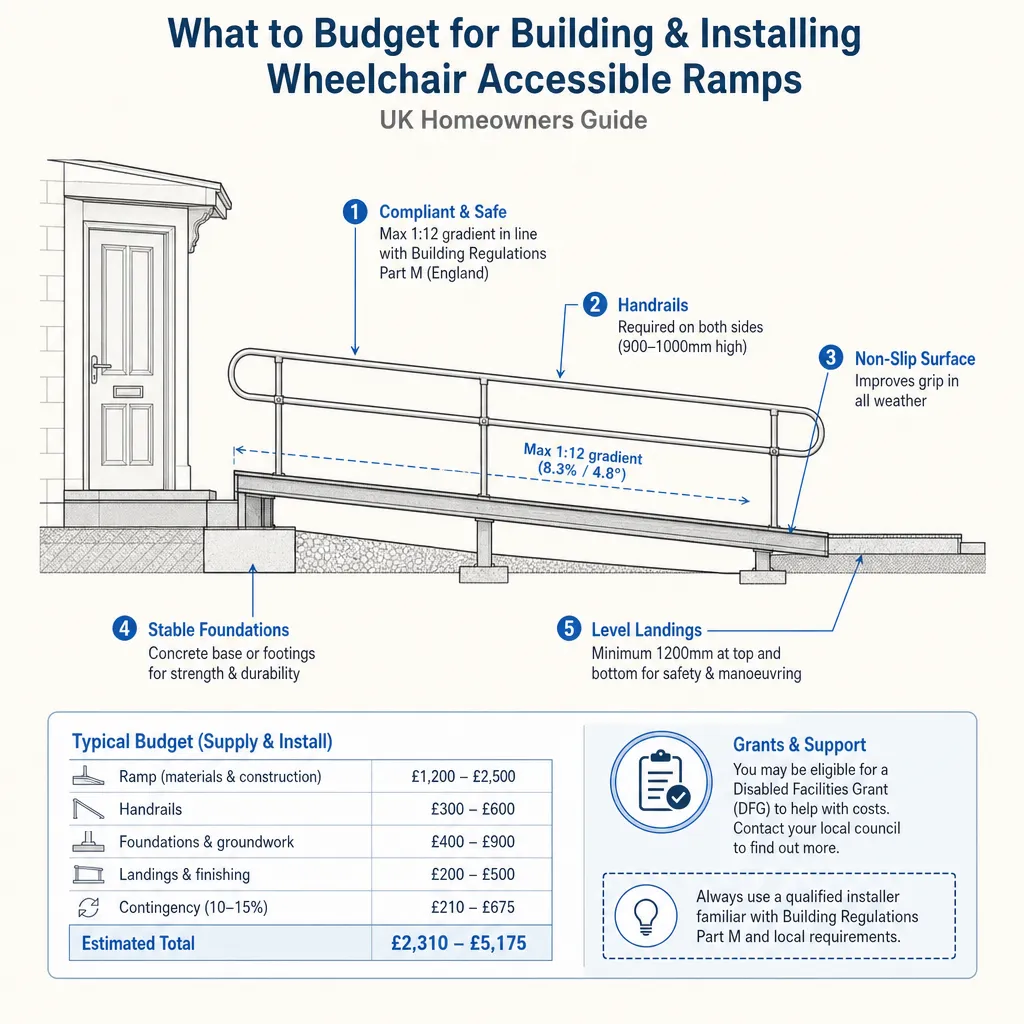
What to budget for building and installing wheelchair accessible ramps
Step-free access is one of the most life-changing adaptations a UK home can receive — whether for a wheelchair user, someone recovering from surgery, or a homeowner planning ahead for reduced mobility. The cost and complexity of a ramp varies considerably depending on the type chosen, site conditions, and whether public funding is available. Working through the options methodically before approaching contractors will save money and avoid unsuitable solutions.
Key points
- The Disabled Facilities Grant (DFG) provides up to £30,000 in England (£36,000 in Wales) towards home adaptations including ramps, administered by local councils under the Housing Grants, Construction and Regeneration Act 1996.
- BS 8300:2018 recommends a maximum gradient of 1:20 for independent wheelchair use; the absolute maximum for short assisted-use ramps is 1:12.
- Building Regulations Approved Document M may apply to permanent ramp installations, particularly those forming part of an extension or new build.
- Modular aluminium ramps are typically installed without planning permission as demountable structures; permanent masonry ramps may need a planning application depending on the property type and location.
- A local authority Occupational Therapist (OT) assessment is usually the first step towards DFG funding and the OT's written recommendation supports the formal application.
Types of wheelchair ramp and when each suits UK properties
Ramp type | Typical use case | Indicative installed cost | Planning permission usually needed? |
|---|---|---|---|
Portable/folding ramp | Occasional access, rental properties, small single steps | £100–£600 | No |
Modular aluminium (demountable) | Single or multi-step access, paths and gardens, where removal may be needed later | £500–£3,000 | Usually no |
Timber threshold ramp | Small step or door lip up to ~100mm, internal or external doorways | £200–£800 | Usually no |
Permanent concrete or block paving | Long-term adaptations, significant height differences | £2,000–£8,000+ | Sometimes |
Steel modular with handrails | Significant rises on larger properties | £1,500–£5,000+ | Sometimes |
Indicative UK costs, last reviewed 2026-05-06. Costs vary by region, access difficulty, groundworks required, and specification. Request at least three quotes.
Disabled Facilities Grant: explore funding before committing to costs
The DFG is a means-tested grant available to homeowners, private tenants, and social housing tenants in England. Wales offers up to £36,000; Scotland and Northern Ireland operate separate but broadly comparable schemes.
Who qualifies? The grant is for disabled people — or those applying on their behalf — whose home needs adapting. Ramps enabling access to the principal entrance or main living areas are among the most commonly funded adaptations.
How the process works:
- Contact your local council's DFG team or housing department, or ask your GP to refer you to an Occupational Therapist.
- An OT visits to assess the need and recommend suitable adaptations.
- A formal application is submitted to the council with supporting evidence.
- The council has six months to decide on a valid application.
- Approved grants are usually paid to the contractor on completion of works.
The DFG is means-tested for adults — income, savings, and the cost of works are all considered. Children's adaptations are not means-tested. Citizens Advice can explain the means test and help with disputes.
Key cost drivers for wheelchair ramps
Rise to overcome: A 150mm front door step needs a much shorter ramp than a property with 400mm of elevation change. At the 1:12 maximum gradient, every 100mm of rise requires at least 1,200mm of ramp run.
Available space: A narrow path or small front garden may force a switchback or platform landing design, adding complexity and cost.
Groundworks: Soft or uneven ground, tree roots, drainage runs, or existing hard landscaping may require preparation before a permanent ramp can be installed.
Handrails: BS 8300 recommends handrails on both sides for public use and at least one side for domestic use. Allow £200–£600 per run depending on material and length.
Contractor experience: A specialist access contractor familiar with DFG processes may cost differently from a general builder, but their knowledge of council requirements and gradient standards often prevents costly errors.
Planning permission and Building Regulations
Planning permission is not usually required for a temporary or modular ramp, or a modest permanent ramp that does not materially alter the property's appearance. Exceptions include:
- Listed buildings — may need listed building consent even for demountable structures.
- Conservation areas — any visible change to a front elevation may need consent.
- Larger permanent ramps that extend significantly or affect the public realm.
Always check with your local planning authority (LPA) before starting permanent works if you are uncertain. Building Regulations approval is not always required for a standalone domestic ramp on an existing house, but it is worth confirming with your local building control team, particularly for concrete or masonry structures. A specialist contractor or the council's DFG surveyor will usually advise on both as part of their service.
Worked example: single-step front door access in a 1950s semi-detached
A family in the East Midlands applied for a DFG on behalf of a parent who uses a powered wheelchair. The front door had a single 180mm step with a narrow path.
- The OT recommended a modular aluminium ramp with handrails on both sides and a level platform at the top.
- Required ramp run at 1:12 gradient: approximately 2,160mm.
- A specialist access contractor quoted £1,650 for supply, installation, handrails, and a non-slip surface.
- After means testing, the local council awarded a full DFG covering the entire cost.
- Installation took one day; no planning permission was required.
This scenario is illustrative. Costs, grant outcomes, and timescales vary by council, property, and individual circumstances.
What to ask before accepting a quote
- Is the ramp gradient compliant with BS 8300:2018 for the intended use — independent or assisted wheelchair operation?
- Does the price include handrails, a non-slip surface finish, and all groundworks?
- Is VAT included?
- What is the installation timeline, and will the entrance remain usable during the works?
- Does the contractor have experience with DFG-funded projects and local council approval processes?
- What maintenance is required, and what warranty is provided on materials and workmanship?
- Will a completion certificate be issued that the council can accept for grant release?
When to get professional help
An Occupational Therapist assessment is strongly recommended before committing to any ramp specification. Their recommendation is usually required for DFG funding and ensures the adaptation genuinely suits the user's mobility needs. Contact your local council's adult social care team or ask your GP for a referral.
For any permanent installation, use a contractor experienced in disabled access. If you encounter difficulties with a DFG application or a contractor dispute, Foundations — the national body for home improvement agencies — provides specialist support, as does Citizens Advice.
How Housey can help
Housey can connect you with contractors who specialise in disabled access adaptations, including wheelchair ramp installation. Use our quote request tool to describe your requirements — step height, available space, and whether you have an OT recommendation — and receive competitive quotes from local professionals familiar with DFG-funded work.
Frequently asked questions
How much does a wheelchair ramp cost in the UK?
Costs vary widely by type and complexity. A modular aluminium ramp for a single step typically costs £500–£1,500 installed; a permanent concrete ramp for significant height differences can reach £3,000–£8,000 or more. Indicative UK costs, last reviewed 2026-05-06. Many homeowners qualify for a Disabled Facilities Grant of up to £30,000 in England, which can cover the full cost of eligible works.
Do I need planning permission for a wheelchair ramp?
Not usually, for temporary or modular ramps. Permanent ramps may require planning permission for listed buildings, conservation area properties, or larger structures that materially alter the front elevation. Always check with your local planning authority before starting permanent works. Your council's DFG team or a specialist access contractor can advise on your specific property.
How steep can a wheelchair ramp be under UK standards?
BS 8300:2018 recommends a maximum gradient of 1:20 for independent wheelchair use where space allows. Up to 1:12 is permitted for short assisted-use ramps. In practice, every 100mm of rise requires at least 1,200mm of ramp run at the 1:12 maximum — so a 200mm step needs at least 2,400mm of ramp length.
What is the Disabled Facilities Grant and how do I apply?
The Disabled Facilities Grant is a means-tested government grant administered by local councils to help disabled people adapt their homes. In England the maximum is £30,000. To apply, contact your local council or request an Occupational Therapist assessment through your GP or adult social care team. The OT's written recommendation supports your formal application.
Can private tenants apply for a Disabled Facilities Grant?
Yes. Private tenants in England, Wales, Scotland, and Northern Ireland can apply for DFG funding, subject to the means test. In most cases you will need your landlord's written consent before works can proceed. The council or a local home improvement agency — find one via Foundations — can sometimes help obtain that consent.
Sources and further reading
- Disabled Facilities Grant — GOV.UK
- Approved Document M: Access to and use of buildings — GOV.UK
- Housing Grants, Construction and Regeneration Act 1996 — legislation.gov.uk
- Disabled Facilities Grants advice — Citizens Advice
- Foundations: home improvement agencies — Foundations
Useful next reads
 General property advice
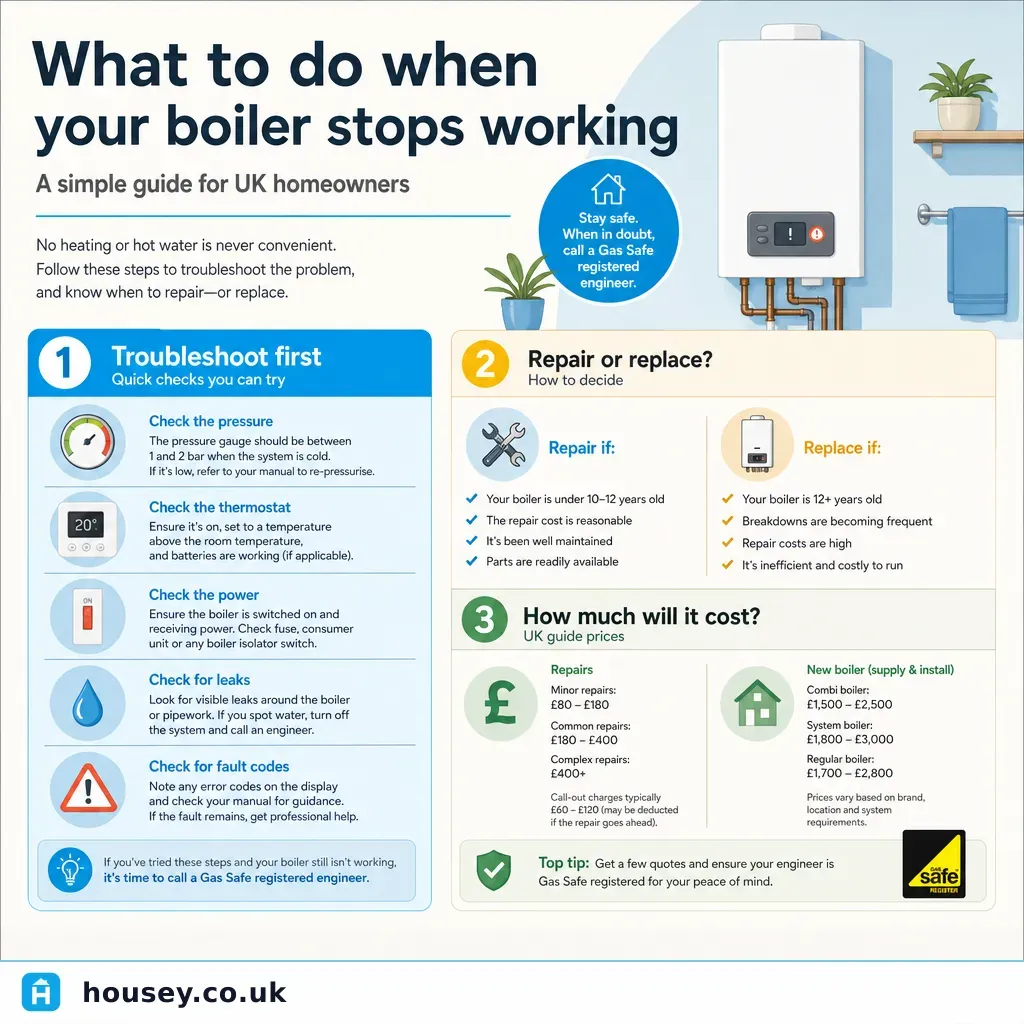
What to do when your boiler stops working
When your boiler stops working, check the pressure gauge (should read 1–1.
 General property advice
Property Market Trends: Activity Growth and Price Movements
UK property market activity is measured through completed sale registrations (HM Land Registry), lender mortgage data, and transaction volumes from HMRC.
 General property advice
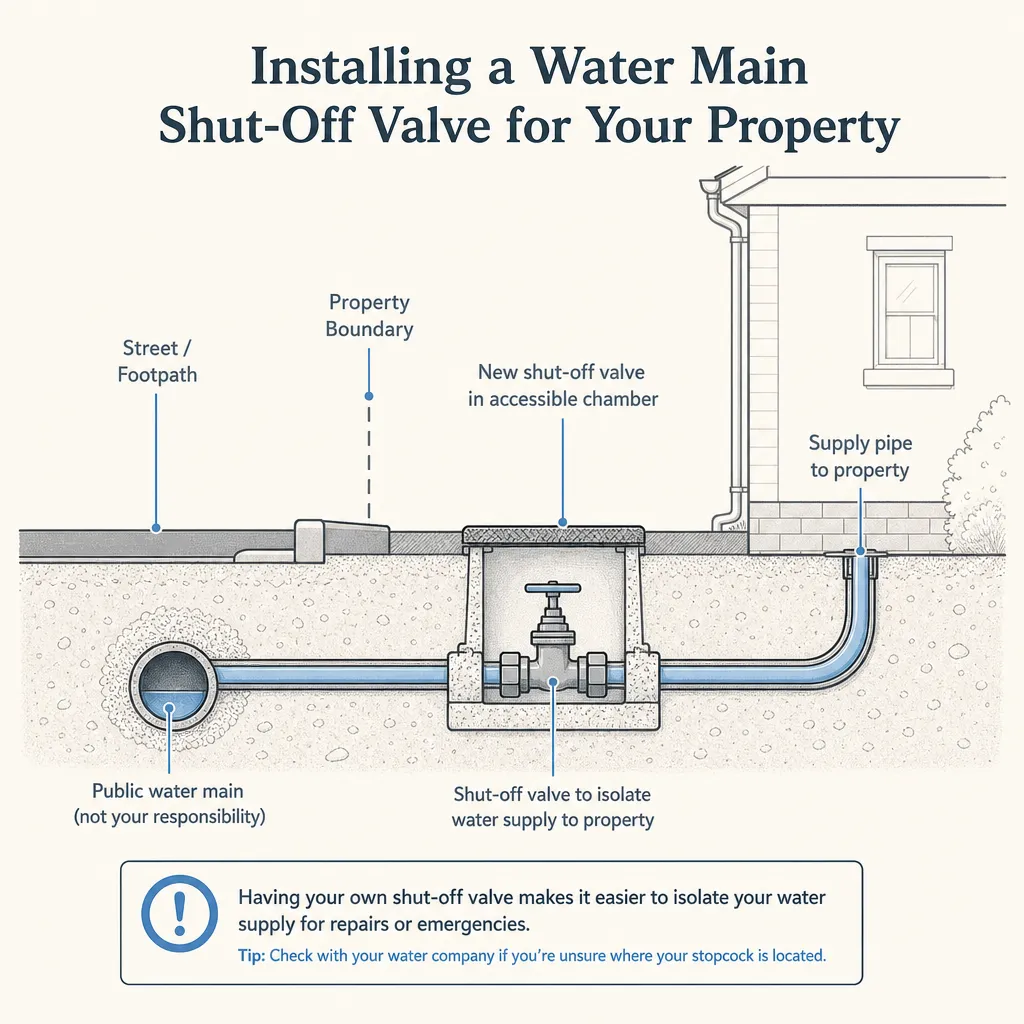
Installing a water main shut-off valve for your property
A water main shut-off valve — commonly called a stopcock — controls all water entering your home from the mains.
 General property advice
Monthly House Price Index: August Market Report and Analysis
The UK House Price Index is published monthly using completed Land Registry transaction data, meaning August figures typically reflect sales agreed months earlier.
 General property advice
Scottish Property Market: Activity and Regional Trends
Scotland's property market operates under distinct legal rules: sellers must provide a Home Report before marketing, transactions become legally binding at conclusion of missives rather than exchange of contracts, and Land and Buildings Transaction Tax replaces Stamp Duty.