When Professional Approval Is Required for Home Alterations and Renovations
By Housey · Last reviewed 30th of May 2026
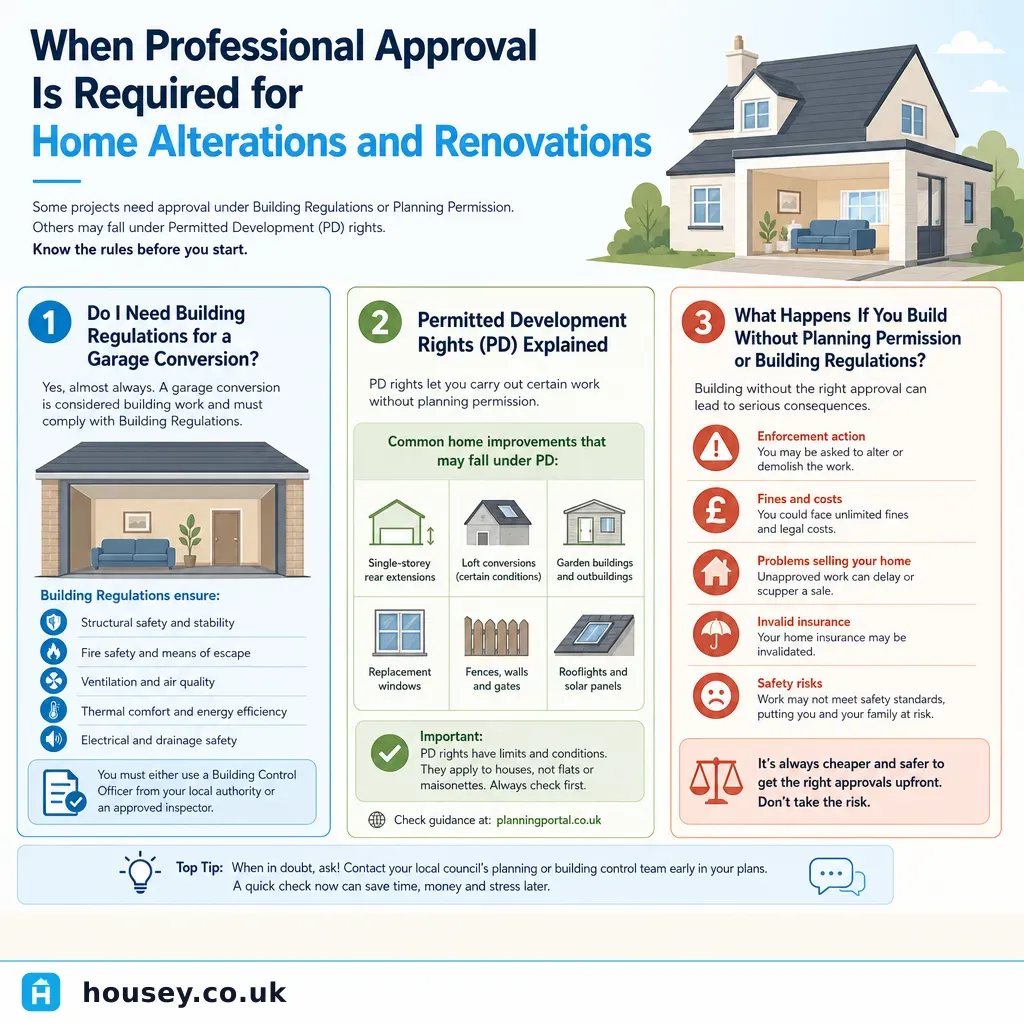
When Professional Approval Is Required for Home Alterations and Renovations
Undertaking work on your home without the correct approvals is one of the most common — and costly — mistakes UK homeowners make. From extending a Victorian terrace to converting a loft in a 1930s semi, different types of work trigger different regulatory obligations, and the rules depend on property type, location, and the nature of the work itself. Understanding which approvals apply before work begins is far safer and cheaper than dealing with enforcement notices or conveyancing complications when you come to sell.
Key points
- Planning permission and Building Regulations approval are entirely separate consents — you may need one, both, or neither depending on the work.
- Permitted Development Rights (PDR) allow many common alterations — such as rear extensions up to a defined depth — without a full planning application, but PDR can be removed by Article 4 Directions in certain areas.
- Building Regulations set standards for structure (Part A), fire safety (Part B), energy efficiency (Part L), ventilation (Part F), and drainage (Part H) — most structural or energy-related work triggers at least one of them.
- Properties in conservation areas, National Parks, Areas of Outstanding Natural Beauty (AONBs), and all listed buildings face additional restrictions; what is permitted development elsewhere may require express consent.
- Retrospective building regulations approval (a Regularisation Certificate) is possible but not guaranteed, and mortgage lenders may refuse to lend on properties with unexplained past works.
Two separate consent regimes
Most homeowners conflate planning permission with Building Regulations, but they operate independently and serve different purposes.
Planning permission (governed by the Town and Country Planning Act 1990 and the Town and Country Planning (General Permitted Development) (England) Order 2015) controls the size, appearance, and use of a building — what it looks like from the street and how it changes the character of an area. Many minor works fall within Permitted Development Rights and need no formal application.
Building Regulations (under the Building Act 1984 and the Building Regulations 2010) govern the safety, health, and energy performance of the work itself — whether the structure is sound, fire escape routes are adequate, and insulation meets current standards. Building Regulations approval is required regardless of whether planning permission was needed.
Which regime applies to common works?
Work type | Planning permission needed? | Building Regulations needed? |
|---|---|---|
Single-storey rear extension within PDR limits | No (if PDR applies) | Yes |
Loft conversion with dormer | Usually no (PDR), unless Article 4 area | Yes |
Garage conversion to habitable room | Usually no (PDR) | Yes |
New outbuilding over 15 m² | Depends on size and proximity to boundary | Yes (if habitable) |
Replacement windows like-for-like | Usually no | Yes — installer must be FENSA/Certass registered or work notified to building control |
Internal structural wall removal | No | Yes |
Two-storey extension | Usually yes | Yes |
Change of use (e.g., single dwelling to HMO) | Yes | Yes |
Rules vary by property, location, and local planning authority. Always verify with your local authority before starting work.
When Permitted Development Rights do not apply
Permitted Development Rights can be restricted or entirely removed in various circumstances:
- Article 4 Directions: Local planning authorities can withdraw PDR in specific areas to protect local character — common in conservation areas but also applied to some ordinary residential streets.
- Listed buildings: All listed buildings (Grade I, II*, or II in England) require Listed Building Consent for any works affecting their character, including internal alterations. Planning permission may also be required.
- Conservation areas: Permitted development for extensions is more limited; Article 4 Directions are frequently in force, and cladding or changes to roof materials may require consent.
- Flats and maisonettes: Most permitted development rights do not apply to flats — planning permission is typically required for extensions.
- New-build homes: Some estates have had PDR removed by planning condition, meaning further alterations require a full application even where the work would otherwise be permitted.
- Previous extensions: If a property has already used its permitted development allowance through a prior extension, additional works may require a full application.
Building Regulations consent routes
Once you have established that Building Regulations approval is needed, there are three main routes:
- Full Plans application: Detailed drawings submitted to building control (local authority building control or an Approved Inspector, now called a Registered Building Control Approver) before work starts. Best for larger or complex projects — you receive formal approval and can proceed with confidence.
- Building Notice: A simpler notice submitted before work starts, without detailed plans. The inspector visits during construction to check compliance. Higher risk if something needs to change on site.
- Regularisation Certificate: Applied for retrospectively for work already carried out without approval. An inspector will assess whether the work complies — some areas may need to be exposed or partially rebuilt. A Regularisation Certificate does not confer retrospective planning permission.
Decision tree: which approval do I need?
- Choose a Full Plans application to building control if the work is structural, involves new drainage, affects fire compartmentation, or is a significant extension — you benefit from formal sign-off before work starts.
- Choose a Building Notice if the project is smaller and the contractor is confident of compliance without pre-approved drawings, and the risk of on-site changes is low.
- Apply for a Certificate of Lawfulness (planning) if you want written confirmation that proposed works are lawful permitted development — this protects you at sale and removes ambiguity.
- Consult your local planning authority before starting if the property is listed, in a conservation area, or you are unsure whether PDR applies to your specific situation.
- Seek planning consultancy advice if previous works may have used up permitted development allowances, or if enforcement action has been threatened or is under consideration.
What happens if you proceed without approval?
Carrying out notifiable work without the required approvals creates several serious risks:
- Enforcement action: Local authorities can issue enforcement notices requiring work to be altered or removed. There is generally a four-year enforcement window for operational development and ten years for changes of use or breaches of condition.
- Conveyancing problems: Solicitors acting for a buyer will raise enquiries about works. The absence of a completion certificate or building control sign-off will typically trigger a requisition; indemnity insurance is sometimes used but is not a substitute for proper approval.
- Mortgage refusal: Lenders may decline or withdraw a mortgage offer if major works lack the required approvals.
- Insurance implications: Home insurers may reduce or refuse a claim if uninspected structural work contributed to the damage.
Important limitations
This article is general information only. Planning and Building Regulations rules depend on the specific property, its location, its planning history, and the precise nature of the works. Local planning authorities exercise discretion, and the rules evolve — the Permitted Development Order has been amended several times and may be subject to further change. Always check with your local planning authority or engage a qualified professional before starting work. Nothing in this article constitutes legal or planning advice.
What to ask a qualified professional
Before instructing a planning consultant or building control surveyor, ask:
- Does this specific work fall within Permitted Development Rights for this property, and can you confirm that in writing or via a Certificate of Lawfulness application?
- Which building control route — Full Plans or Building Notice — is more appropriate for this project, and why?
- Are there any conditions on the property's existing planning consents that would restrict or prevent this work?
- If the property is listed or in a conservation area, what additional consents are required and how long do they typically take?
- What drawings, structural calculations, or supporting documents will be needed for the application or notification?
- What is the realistic timeline for approval, and can the contractor mobilise before formal approval is issued?
When to get professional help
Seek professional advice before starting any work if:
- The property is listed, in a conservation area, a National Park, or an AONB
- You are unsure whether previous works had the correct approvals, particularly before exchange of contracts
- The work involves structural changes, new drainage, fire compartmentation, or changes to the external envelope
- You are buying a property and the vendor cannot produce completion certificates for past works
- You are planning a project that may have already used up the property's permitted development allowances
- An enforcement notice has been issued or threatened
How Housey can help
Housey connects homeowners with experienced building control consultants who can advise on compliance routes and manage the approval process from Full Plans through to final sign-off. If your project requires a planning application or you need written confirmation that works are lawful permitted development, our planning consultancy service can help you navigate both regimes with confidence.
Frequently asked questions
Do I need planning permission to convert my loft?
A loft conversion usually falls within Permitted Development Rights, provided it does not exceed 40 m³ for terraced houses or 50 m³ for detached and semi-detached homes, and does not involve side-facing windows or extend beyond the existing roof plane at the front. Building Regulations approval is always required for a loft conversion, covering structural integrity, fire escape routes, insulation standards, and means of escape.
What happens if I carry out work without building regulations approval?
Without building regulations approval you will not receive a completion certificate. This causes problems when selling, as solicitors and mortgage lenders will query its absence. You can apply retrospectively for a Regularisation Certificate, but this may require exposing completed work for inspection and is not guaranteed. Enforcement action by the local authority is also possible.
Can I rely on indemnity insurance instead of getting retrospective approval?
Indemnity insurance may satisfy some mortgage lenders and solicitors in straightforward cases, but it does not make the work compliant, does not provide a completion certificate, and does not protect against enforcement action by the local authority. It is a last resort when proper approval is no longer obtainable — not a planned substitute for it.
Sources and further reading
- Permitted Development Rights — Planning Portal
- Building Regulations: technical guidance — GOV.UK
- Town and Country Planning Act 1990 — legislation.gov.uk
- Building Act 1984 — legislation.gov.uk
- Do I need planning permission? — GOV.UK
Useful next reads
 Planning & Pre-Build
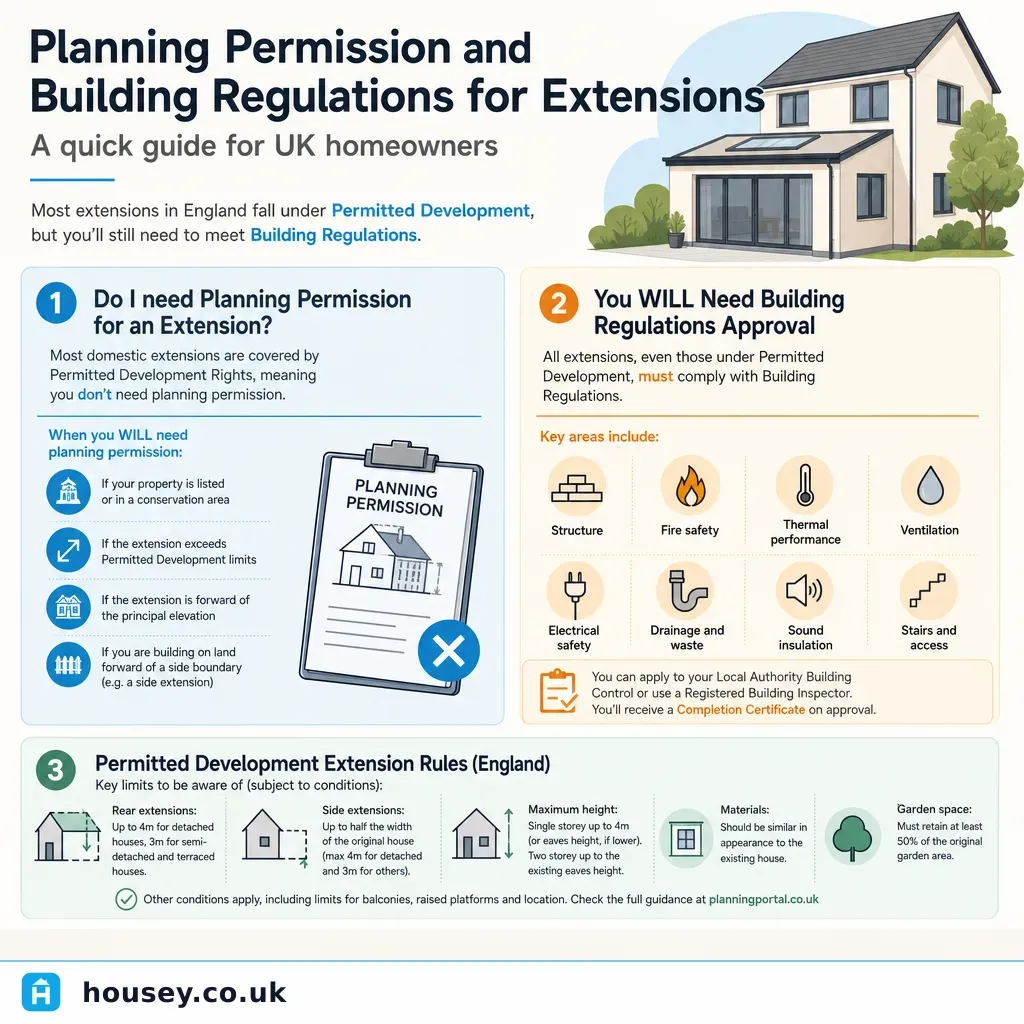
Planning Permission and Building Regulations for Extensions
UK home extensions usually require both planning permission and Building Regulations approval, though most smaller rear extensions qualify as Permitted Development under the GPDO 2015 and need no planning application.
 Planning & Pre-Build
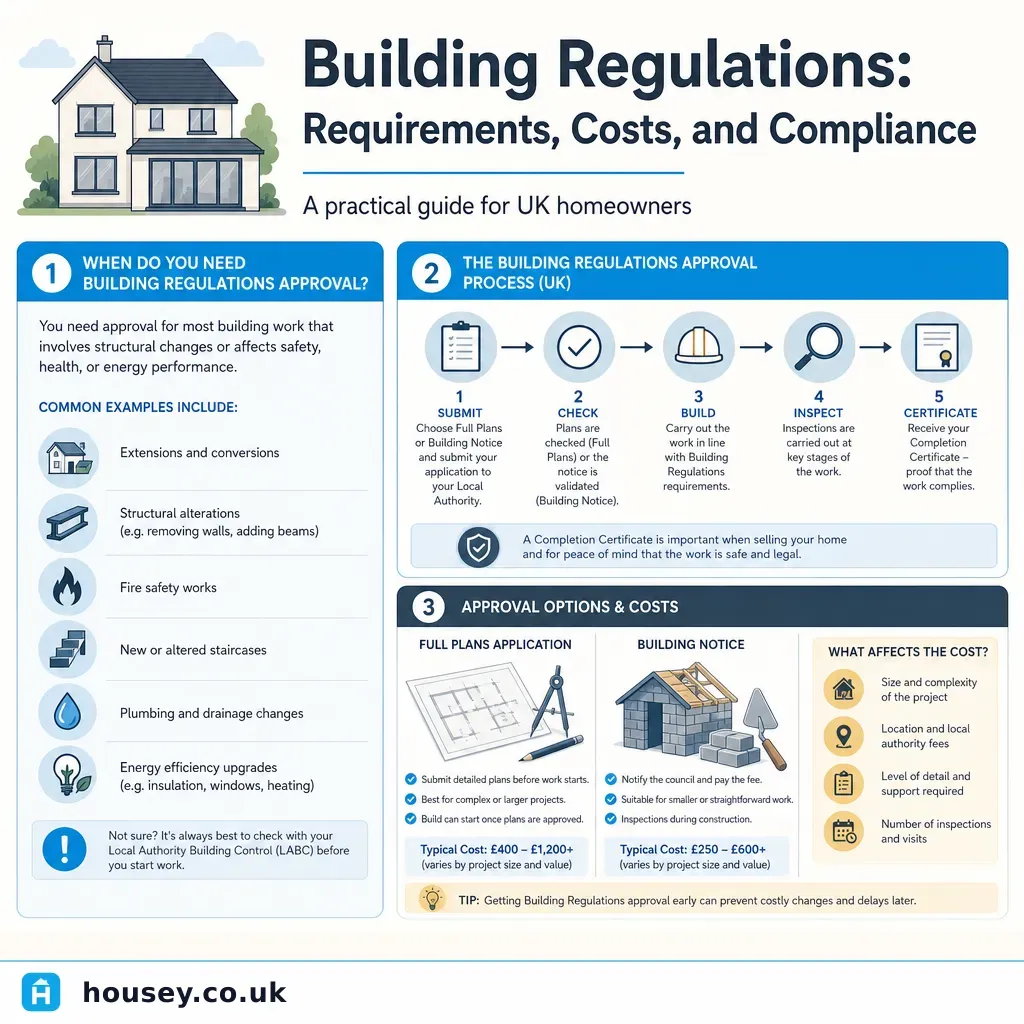
Building Regulations: Requirements, Costs, and Compliance
Building regulations set minimum standards for how construction work is carried out in the UK, covering structural stability, fire safety, energy efficiency, and ventilation.
 Planning & Pre-Build
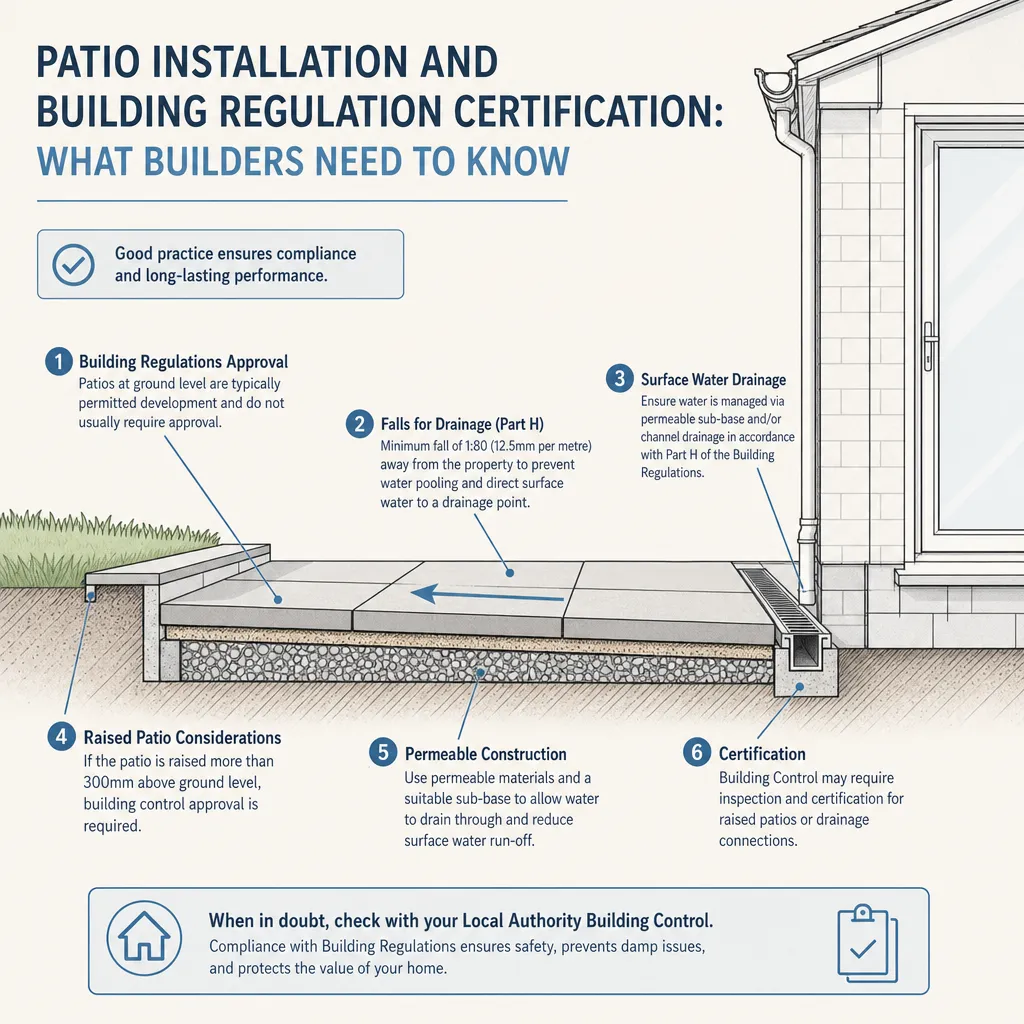
Patio Installation and Building Regulation Certification: What Builders Need to Know
Most ground-level patios in England do not require building regulations approval.
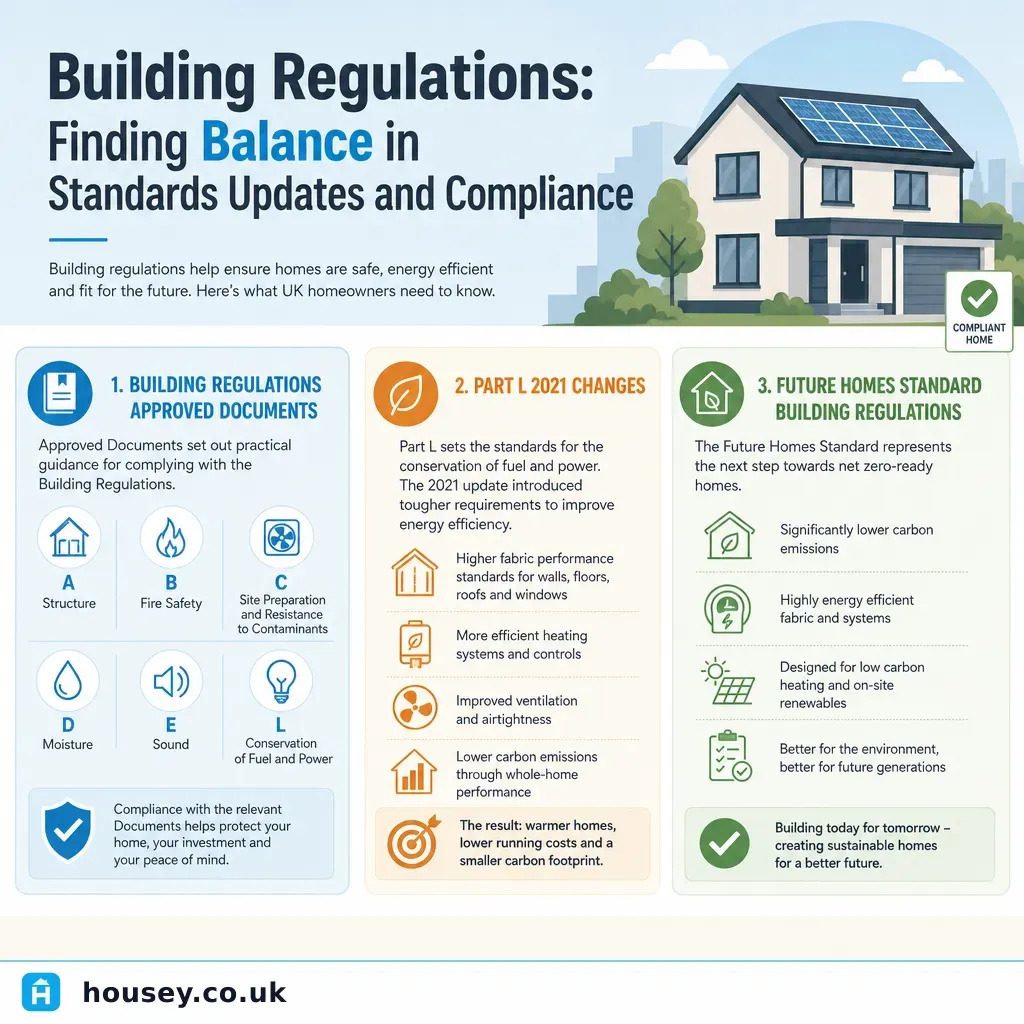 Planning & Pre-Build
Building Regulations: Finding Balance in Standards Updates and Compliance
Building regulations in England and Wales set minimum standards for construction, covering structure, fire safety, energy efficiency, and ventilation.
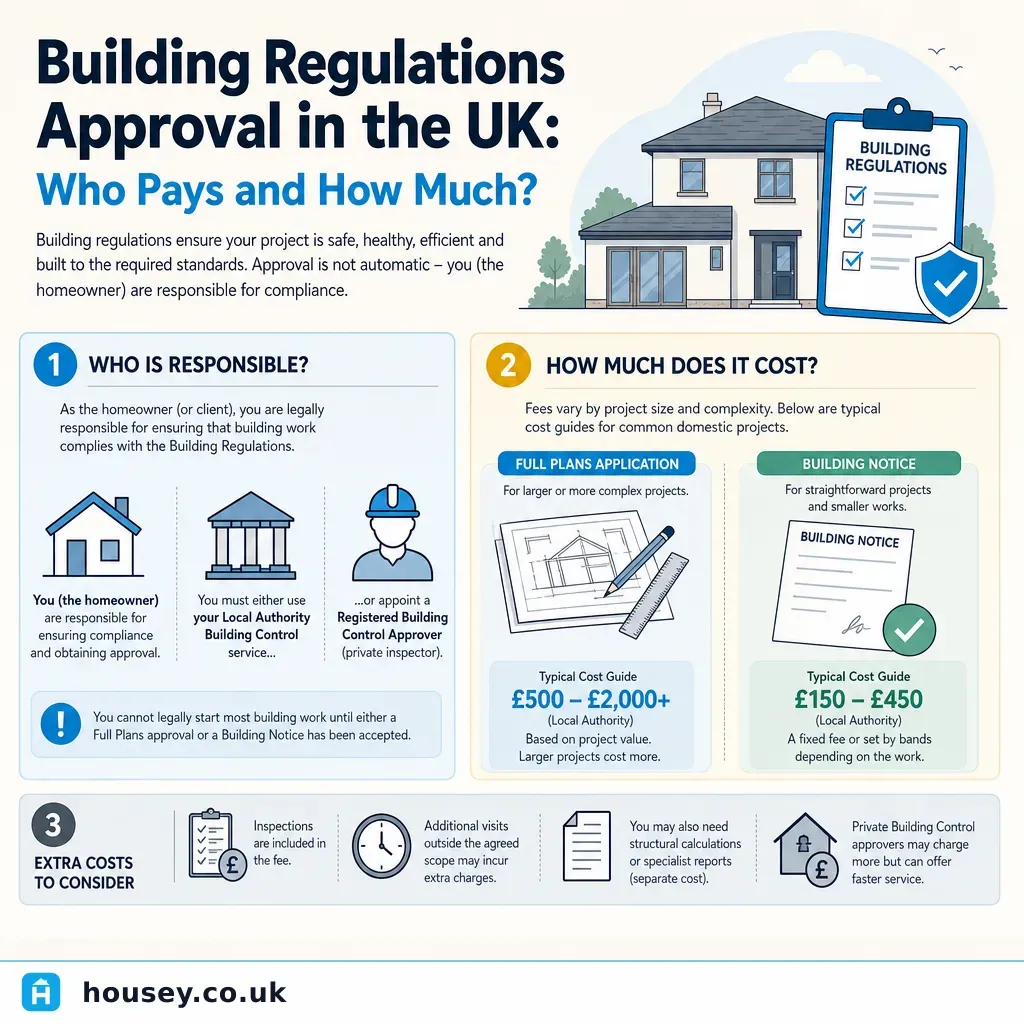 Planning & Pre-Build
Building Regulations Approval in the UK: Who Pays and How Much?
Building regulations approval fees are almost always paid by the homeowner or the person commissioning the work, not the contractor.