When to Hire an Architect: A Homeowner's Guide to Professional Design Services
By Housey · Last reviewed 30th of May 2026

When to Hire an Architect: A Homeowner's Guide to Professional Design Services
Deciding whether to hire an architect is one of the first questions homeowners face when planning a renovation, extension, or new build. The title "architect" is legally protected in the UK — only those registered with the Architects Registration Board (ARB) may use it — but a range of design professionals can legitimately handle different types of residential project. Knowing who does what, and when each is worth the fee, helps you avoid both under-investing on a complex brief and over-spending on a straightforward one.
Key points
- The title "architect" is legally protected under the Architects Act 1997; only ARB-registered individuals may use it, regardless of their experience or level of qualification.
- Architect fees for a full residential service (RIBA Stages 0–6, including contract administration) typically range from 8% to 15% of the construction cost; partial services are priced proportionally lower.
- Building Regulations approval is required for most structural works, extensions, loft conversions, and changes of use — an architect or architectural technologist can prepare the necessary drawings and calculations.
- Planning permission is required for extensions that exceed permitted development thresholds; a designer familiar with your local planning authority's policies can materially improve the likelihood of consent.
- RIBA Chartered Practices must carry professional indemnity insurance, maintain quality management standards, and comply with RIBA's Code of Professional Conduct.
What an architect actually does
Architects provide design services across a project's full lifecycle, from initial feasibility through to completion on site. The RIBA Plan of Work 2020 divides this into eight stages (0–7), and most homeowners commission services covering only some of them.
Common partial-service commissions for residential projects include:
- Feasibility study (Stage 1): Assessing what is possible on the site, within planning policy and budget constraints — useful before purchasing a property or committing to a detailed brief.
- Concept design and planning (Stages 2–3): Developing the design to planning permission stage, including preparing and submitting a planning application.
- Technical design (Stage 4): Producing detailed drawings for Building Regulations and contractor tender — what builders price from.
- Construction (Stages 5–6): Administering the building contract, inspecting the works at agreed intervals, and certifying payments to the contractor.
Not all projects need all stages. Many homeowners manage the construction phase themselves with a trusted builder; for complex or high-value projects, full contract administration can reduce cost overruns and disputes significantly.
Decision tree: do you need a full architect?
- Choose a full architectural service if your project involves planning permission in a conservation area or for a listed building, if it is a new build, or if the estimated build value exceeds roughly £150,000.
- Consider an architectural designer or technologist if your project is a straightforward single-storey extension or garage conversion with standard planning and building regulations requirements.
- Appoint a structural engineer alongside a designer if your primary need is a structural calculation or steel beam specification rather than spatial or aesthetic design.
- Check CDM Regulations 2015 obligations — for projects with more than one contractor working simultaneously, a principal designer must be appointed; a suitably qualified architect can fill this role.
- Ask your local planning authority first if your permitted development rights may have been removed by an Article 4 Direction, or if the property is in a conservation area where standard householder permitted development rules do not fully apply.
Architect vs architectural designer vs architectural technologist
Professional | Regulated title? | Typical residential projects | Professional body | PI insurance required? |
|---|---|---|---|---|
Architect (ARB-registered) | Yes — Architects Act 1997 | Full range: new build, listed buildings, complex planning, contract administration | ARB (mandatory); RIBA (voluntary) | Yes for RIBA Chartered Practices |
Architectural designer or consultant | No | Extensions, loft conversions, planning-stage services | No mandatory body — check individual qualifications | Not mandatory; always ask |
Architectural technologist | No (MCIAT is voluntary) | Technical design, building regulations drawings, detail design | CIAT (voluntary membership) | Required for practising CIAT members |
Structural engineer | No for title; CEng or MIStructE are accreditations | Structural design, beam calculations, foundation design | IStructE, ICE | Yes for IStructE members |
An architectural designer without ARB registration may be highly capable and meaningfully cheaper than a registered architect for straightforward projects. The critical practical difference is regulatory accountability and mandatory insurance coverage. Always confirm that any design professional carries adequate professional indemnity (PI) insurance, regardless of title.
When is hiring an architect worth the fee?
Architect fees represent real cost — typically 8–15% of build cost (indicative UK costs, last reviewed 2026-05-30) — and whether they deliver value depends on project complexity, planning risk, and the homeowner's own capacity to manage a project.
Projects where the fee typically pays for itself:
- Conservation area extensions or alterations to listed buildings, where planning consent is uncertain and design quality directly influences outcomes.
- New-build homes, where poor design decisions are embedded in the building fabric for generations.
- Complex loft conversions or basement conversions with structural, acoustic, and party wall implications.
- Projects combining planning permission, Building Regulations, and contract administration, where errors in co-ordination are expensive to resolve on site.
- Any project where independent oversight of contractor performance and payment certification matters to the homeowner.
Projects where a partial or lower-cost service may be adequate:
- Simple single-storey rear extensions within permitted development thresholds using standard construction methods.
- Garage conversions with no structural alterations and standard planning requirements.
- Internal reconfigurations not involving load-bearing walls.
What to ask before appointing a design professional
- Are you registered with the ARB? If you are using the title architect, this is a legal requirement.
- Do you hold current professional indemnity insurance, and at what level of cover?
- Can you show examples of similar projects in this area or of this property type?
- What services are included and excluded in your proposed fee?
- Who will carry out the day-to-day work — the named architect or a junior team member?
- How do you handle planning refusals — is a revised submission or appeal included in the fee?
- What assumptions does your fee make about contractor procurement?
- Do you carry out site inspections during construction, and at what frequency?
When to get professional help
For any project requiring planning permission, building regulations approval, or structural alterations, commissioning professional design drawings is strongly advisable. DIY planning submissions are legally permitted but frequently result in refusal or protracted amendment. Seek professional input promptly if:
- You have begun works and discover they required planning permission that was not obtained.
- A contractor has identified a structural concern mid-project and there are no engineer's drawings to refer to.
- The property is on the Historic England Heritage at Risk Register or is subject to a local authority enforcement notice.
- You are purchasing a property with a history of unauthorised works and need a retrospective regularisation application.
How Housey can help
Housey connects homeowners with ARB-registered and RIBA-affiliated architectural practices across the UK. Whether you need a feasibility study, planning drawings, or full contract administration, our architecture services page lets you outline your project and receive competitive quotes from local practices.
Frequently asked questions
Do I need an architect for a loft conversion?
You are not legally required to use an architect. Most loft conversions can be designed by an architectural designer or technologist at lower cost. For complex hip-to-gable conversions, party wall implications, or properties in conservation areas, a registered architect with relevant local experience is usually worth the additional fee for the planning and technical design stages.
How much do architect fees cost in the UK?
Architect fees for residential projects typically range from 8% to 15% of the construction cost for a full RIBA Stages 0–6 service. A partial service covering planning drawings only can be a fixed fee of £1,500–£5,000 for straightforward projects. Indicative UK costs, last reviewed 2026-05-30. Costs vary by location, complexity, and practice size; obtain at least three quotes before appointing.
What is the ARB and why does registration matter?
The Architects Registration Board (ARB) is the statutory regulator for architects in the UK under the Architects Act 1997. Only ARB-registered individuals may legally use the title architect. The ARB maintains a public register and handles complaints about registered architects. Checking the register at arb.org.uk before appointment is a straightforward way to verify a minimum level of qualification.
Can I submit a planning application without using an architect?
Yes. Planning applications are open to anyone and there is no legal requirement to use a professional. However, planning officers assess submissions against local policy, design guides, and the National Planning Policy Framework. Applications without professional drawings are often refused or require significant amendment, making professional input cost-effective for anything beyond a simple householder application.
Sources and further reading
- ARB Architects Register — Architects Registration Board
- RIBA Plan of Work 2020 — Royal Institute of British Architects
- Planning permission: when you need it — GOV.UK
- Building Regulations Approved Documents — GOV.UK
- CDM Regulations 2015 — Health and Safety Executive
Useful next reads
 Planning & Pre-Build
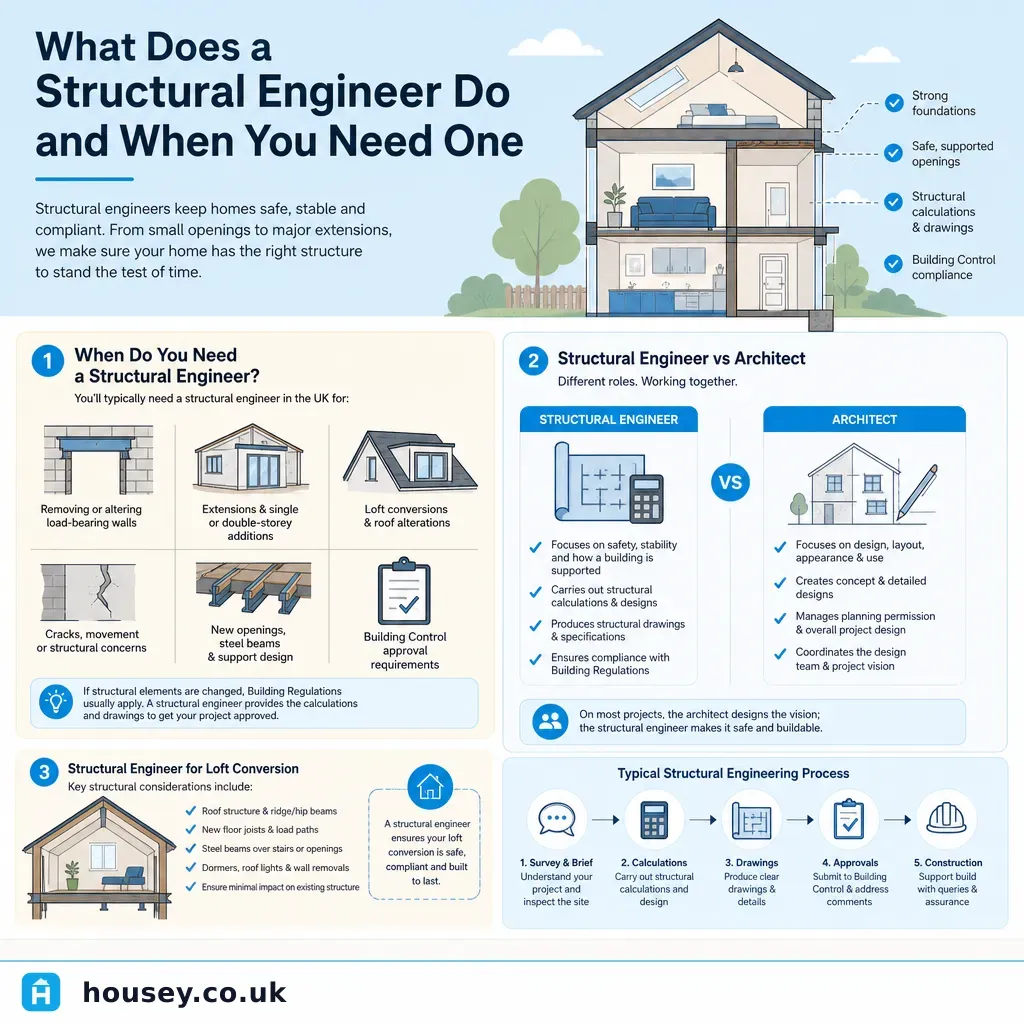
What Does a Structural Engineer Do and When You Need One
A structural engineer analyses and designs the load-bearing elements of a building — foundations, beams, columns, walls, and floors.
 Planning & Pre-Build
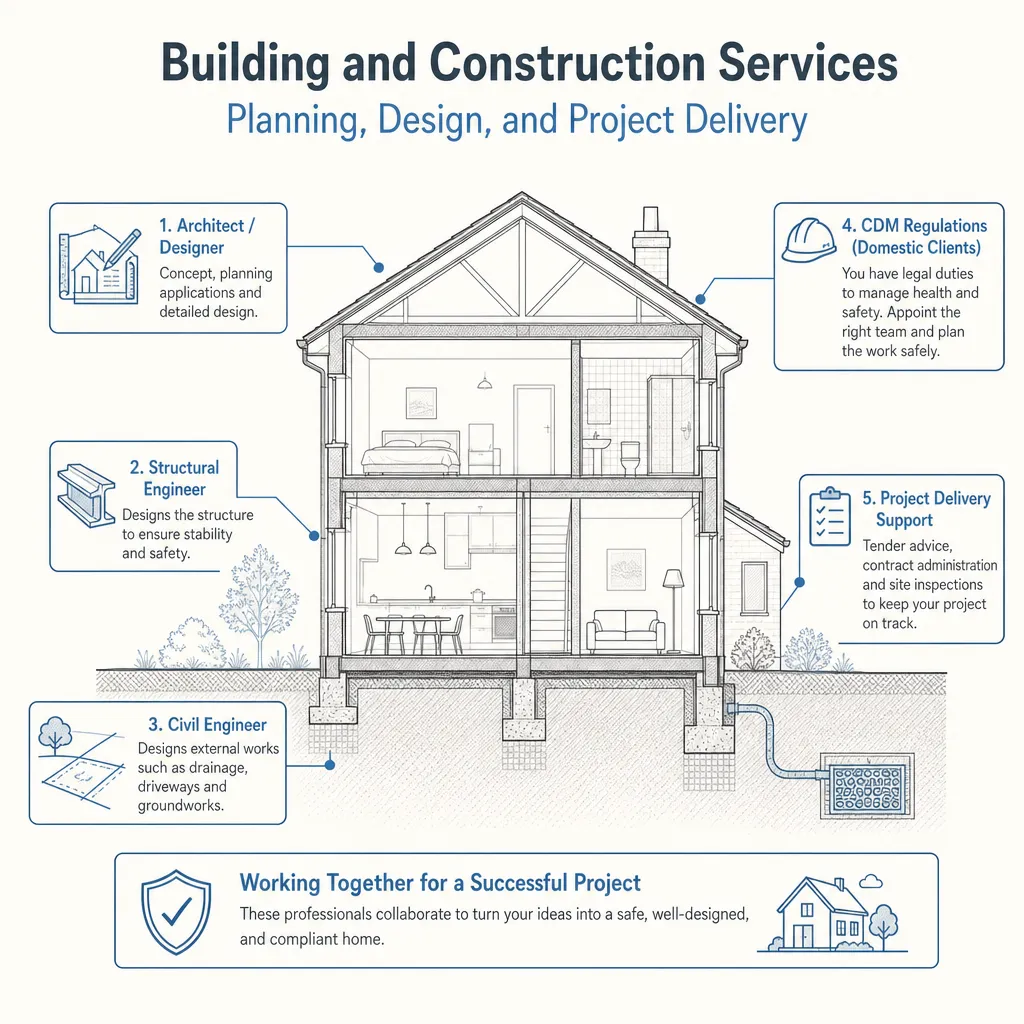
Building and Construction Services: Planning, Design, and Project Delivery
Construction projects in the UK typically involve architects, structural engineers, civil engineers, project managers, and quantity surveyors — each with a distinct role at different stages.
 Planning & Pre-Build
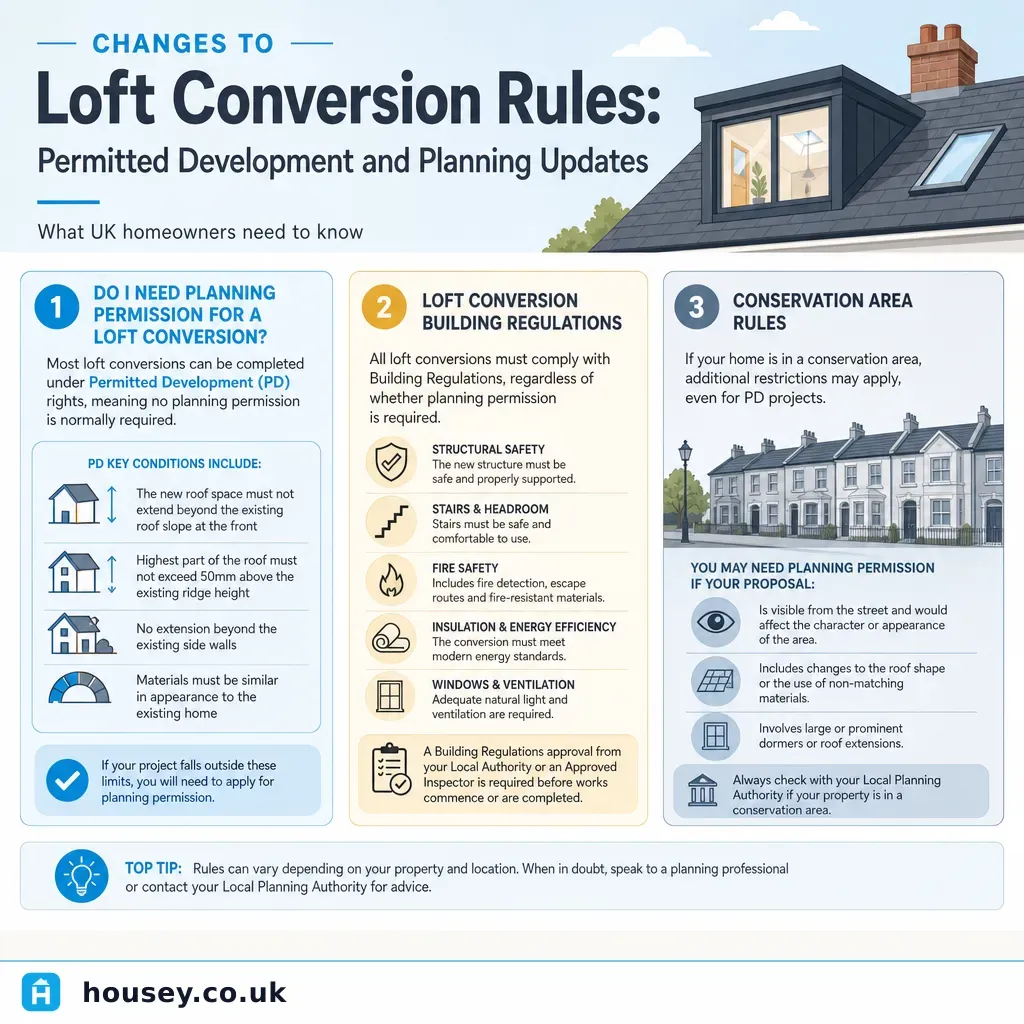
Changes to Loft Conversion Rules: Permitted Development and Planning Updates
In England, most loft conversions on standard houses qualify as Permitted Development under Class B of the GPDO 2015, allowing up to 40 cubic metres (terraced) or 50 cubic metres (detached or semi-detached) without a planning application — if conditions are met.
 Planning & Pre-Build
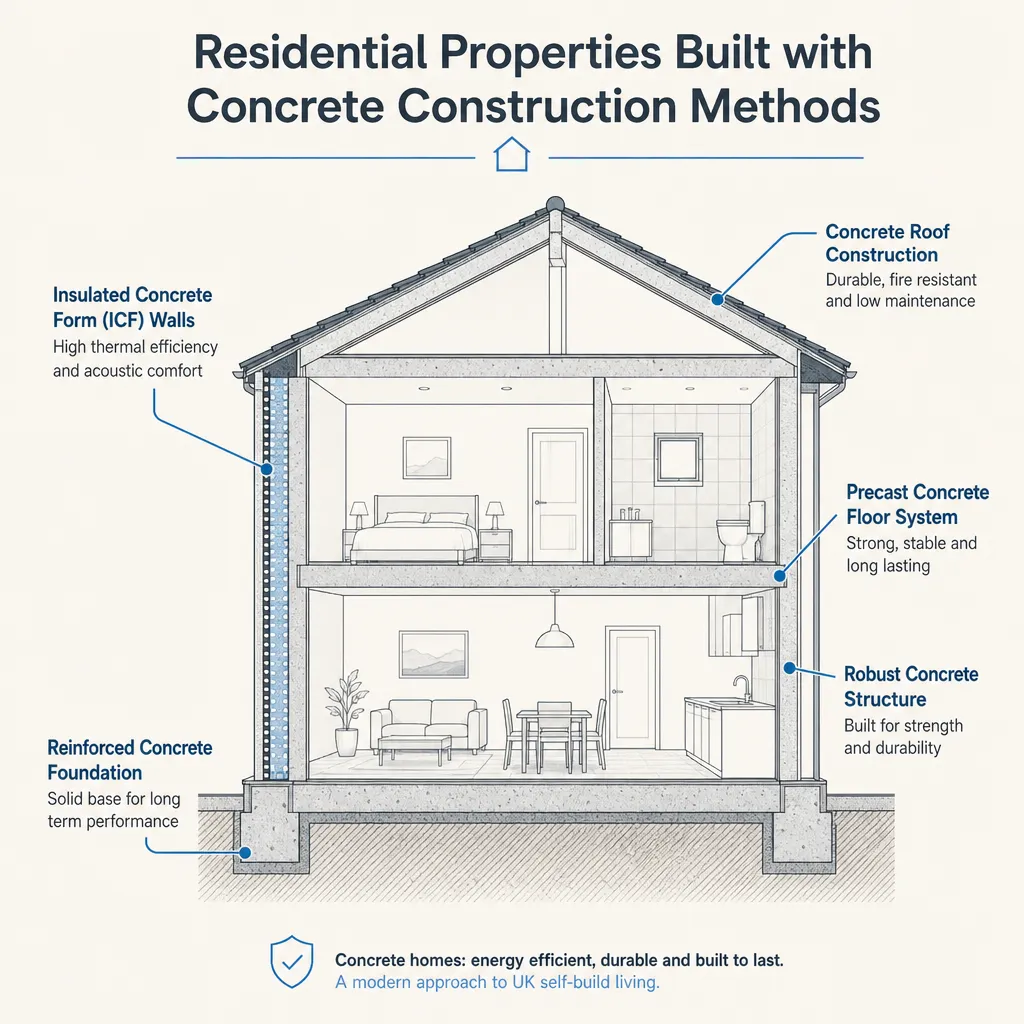
Residential Properties Built with Concrete Construction Methods
UK homes are built using several concrete methods: in-situ cast concrete, precast panel systems, insulating concrete formwork (ICF), and older non-traditional types such as Wimpey No-Fines and Laing Easiform.
 Planning & Pre-Build
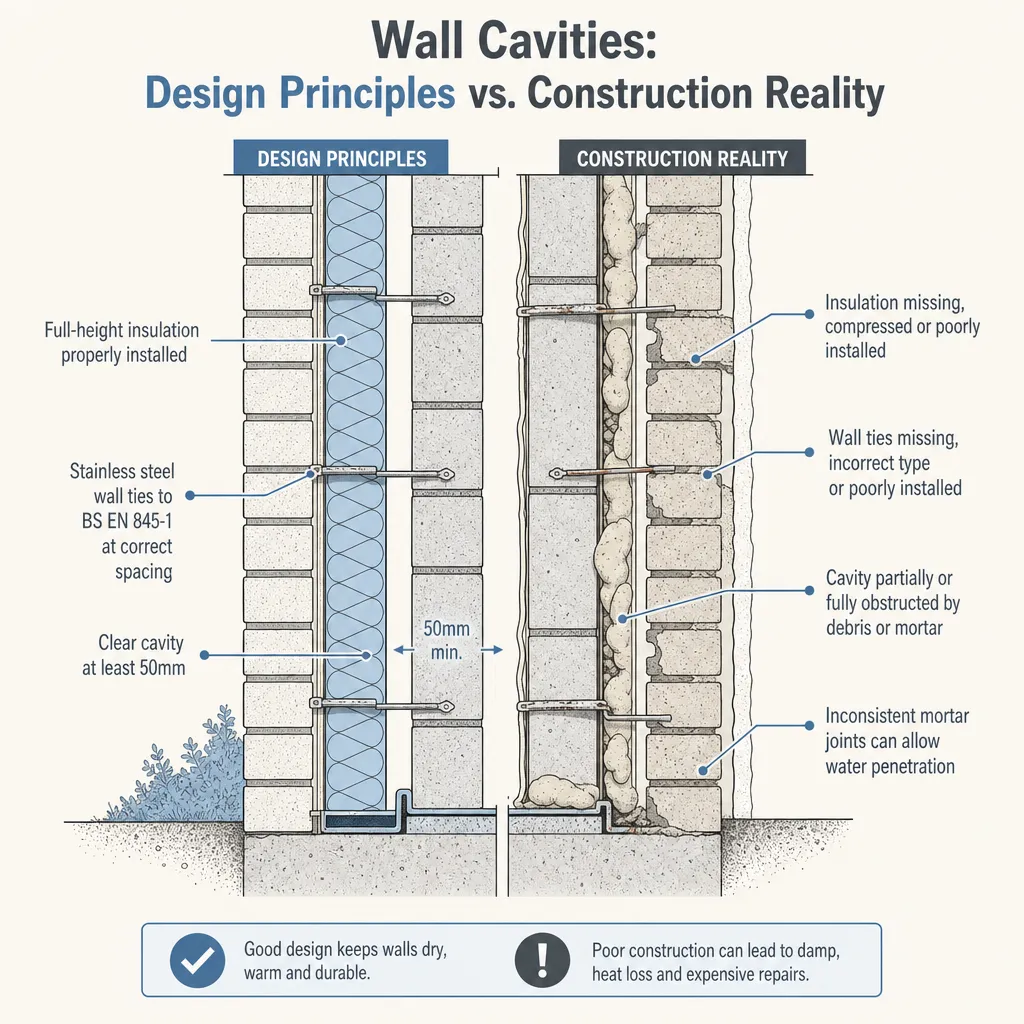
Wall Cavities: Design Principles vs. Construction Reality
A UK cavity wall is designed to resist weather, control heat loss, and structurally link two masonry leaves.