When Your Home May Need Electrical Rewiring and Assessment
By Housey · Last reviewed 10th of May 2026
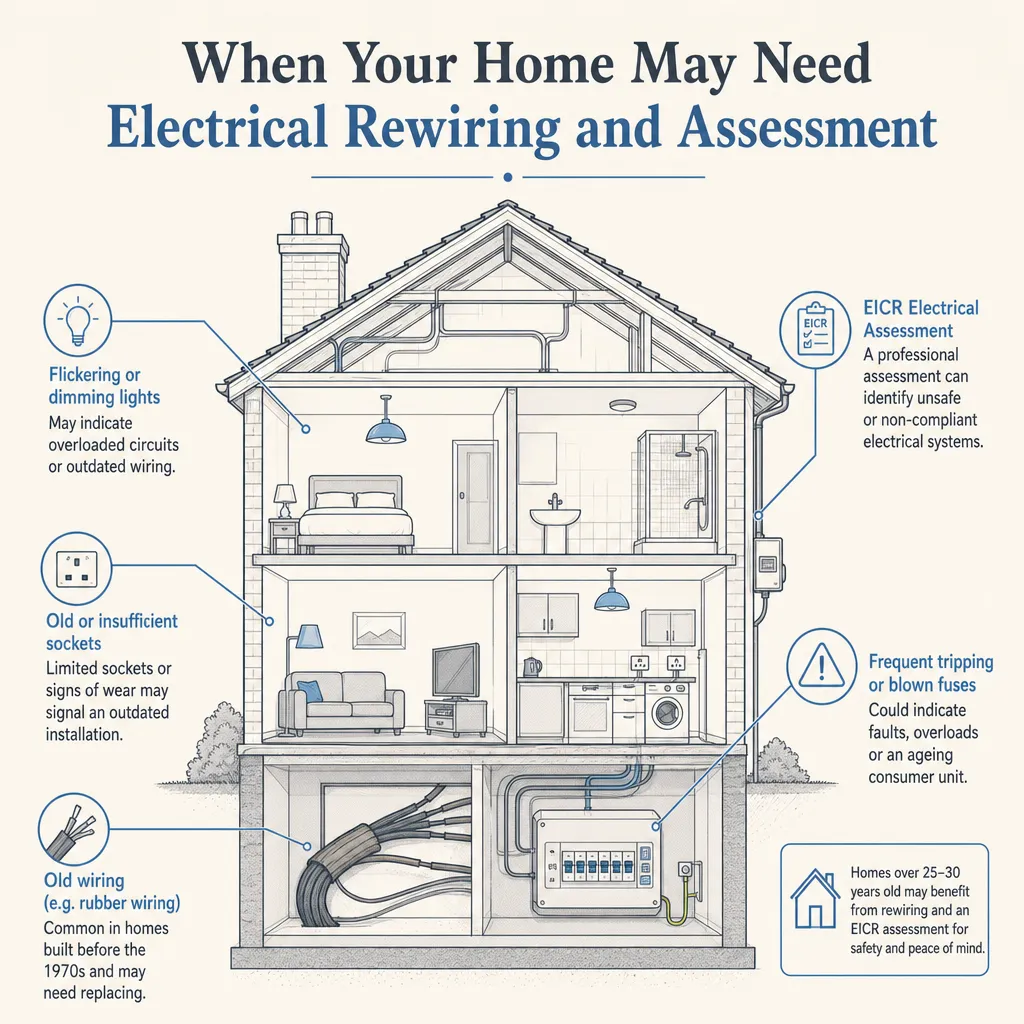
When Your Home May Need Electrical Rewiring and Assessment
Electrical safety is one of the less visible but more serious concerns in UK residential property. Wiring that was adequate when installed 40 or 50 years ago may no longer meet current safety standards — and unlike a leaking roof, a deteriorating electrical installation is not always easy to spot without specialist testing. The question of whether a home needs rewiring most commonly arises when purchasing an older property, when undertaking significant renovation works, or when an Electrical Installation Condition Report (EICR) flags defects that require attention.
Key points
- Properties built before approximately 1966 may contain rubber-insulated wiring, which degrades with age and can become a fire risk — rubber insulation has a service life of roughly 25–30 years and many installations of this type have far exceeded that.
- Single-core aluminium wiring, common in some properties built between the late 1960s and mid-1970s, can corrode at connection points and is considered a safety concern under BS 7671 (IET Wiring Regulations, 18th Edition).
- An EICR grades individual defects as C1 (danger present — immediate action required), C2 (potentially dangerous — urgent remedial work needed), C3 (improvement recommended), or FI (further investigation required before a determination can be made).
- Private landlords in England are legally required under The Electrical Safety Standards in the Private Rented Sector (England) Regulations 2020 to have an EICR carried out at least every five years or at the start of each new tenancy.
- A full rewire of a typical 3-bedroom semi-detached house costs roughly £3,000–£6,000 depending on property size, access, and location (indicative UK cost, last reviewed 2026-05-10; always obtain at least three written quotes).
Signs your home may need rewiring
None of the following signs individually confirms that a full rewire is necessary — only a qualified, registered electrician can make that determination after an inspection. However, any of these indicators means that an EICR should be arranged without delay.
Red flags: signs of outdated or potentially unsafe wiring
- Rubber-insulated cables — black or brown rubber-sheathed cables rather than modern white or grey PVC; sometimes visible at the consumer unit, in the loft, or where cables enter ceiling roses
- Lead-sheathed cables — older still, found in some pre-war and early post-war properties; lead sheathing has a very limited remaining service life and is prone to cracking
- Braided fabric wiring — cream or brown fabric-covered wires indicate a pre-war or very early post-war installation that almost certainly needs replacing
- Round-pin sockets — a clear visual sign of a pre-1960s installation that has not been updated to modern standards
- Cast-iron or Bakelite fuseboard — older than a modern consumer unit and very likely to lack residual current device (RCD) protection required by current regulations
- No RCD protection on circuits — modern BS 7671 requires RCD protection for most circuits; its absence on an existing consumer unit is typically flagged on an EICR
- No earth wire on older circuits — some pre-1966 installations used two-core cable without an earth, rendering modern protective devices ineffective
- Regularly tripping fuses or circuit breakers — may indicate circuits that are overloaded or not designed for the load demands of modern appliances
- Burning smell, scorch marks, or warm sockets or switches — stop using the affected circuit immediately and contact a registered electrician; do not wait
How an EICR works
An Electrical Installation Condition Report is carried out by a qualified electrician registered with a Government-approved competent persons scheme such as NICEIC or NAPIT. The process involves a visual inspection of the consumer unit, accessible cables, sockets, switches, and light fittings, followed by circuit testing covering insulation resistance, earth continuity, polarity, and RCD operation. The installation is assessed against BS 7671 (18th Edition Wiring Regulations) and each defect is assigned a classification code.
EICR code | Meaning | Action required |
|---|---|---|
C1 | Danger present — risk of injury | Immediate remedial action; do not use the affected circuit |
C2 | Potentially dangerous | Urgent remedial work required before the installation is safe |
C3 | Improvement recommended | No immediate safety issue; consider upgrading when practical |
FI | Further investigation required | A determination cannot be made without additional inspection |
An EICR typically costs £150–£350 for a standard house depending on property size, location, and the number of circuits tested (indicative UK cost, last reviewed 2026-05-10). The report should clearly state the overall outcome — Satisfactory or Unsatisfactory — and give a recommended date for the next inspection.
Decision tree: does your home need a full rewire?
- Does your property have rubber-insulated, lead-sheathed, or fabric-covered wiring? Arrange an EICR immediately — a rewire is very likely to be required and the installation should be treated with caution until assessed.
- Does your property have a cast-iron or Bakelite fuseboard, or round-pin sockets? The installation is likely pre-1966; an EICR is essential before any conclusions can be drawn on the extent of work needed.
- Has the installation never been tested, or not tested within the last 10 years (owner-occupied) or 5 years (rented)? An EICR should be your starting point; the need for rewiring will depend on what the report finds.
- Has an EICR returned C1 or C2 codes? Remedial work is required; the scope may range from targeted repairs to a full rewire depending on the nature and extent of the defects identified.
- Has an EICR returned only C3 codes or an overall Satisfactory result? No immediate rewiring is required, but consider acting on C3 recommendations and schedule the next periodic inspection within the period stated on the report.
- Are you undertaking a major renovation such as a loft conversion, extension, or full refurbishment? Use the opportunity to upgrade the consumer unit and any circuits affected by works; a full rewire may be more cost-effective alongside other trades than as a standalone future project.
Partial rewire versus full rewire
A full rewire replaces all fixed wiring, the consumer unit, sockets, switches, and light fittings throughout the property. A partial rewire addresses specific circuits, rooms, or defects identified during an EICR.
Partial rewires are appropriate where defects are confined to one area of the property, where a specific circuit has been damaged, or where budget is constrained and risk must be prioritised in a phased sequence. However, if an inspection reveals widespread defects across multiple circuits in different parts of the property, a full rewire is usually more cost-effective than a series of partial interventions over time — and avoids the disruption of returning multiple times.
Important limitations
This article provides general information only and cannot substitute for a qualified inspection of your specific property. Electrical installation condition varies with the property's age, construction type, any works carried out since original installation, how the property has been used, and what modifications have been made over the decades. A qualified, NICEIC or NAPIT-registered electrician must inspect and test the installation before any conclusions about safety or the need for remedial work are drawn. Do not use this guide alone to decide whether a property is safe to occupy or whether rewiring is or is not required.
What to ask a qualified professional
Before instructing an electrician for an EICR or rewiring work, ask:
- Are you registered with NICEIC, NAPIT, or another Government-approved competent persons scheme, and can you show your registration certificate?
- Will you carry out all the work personally, or will any be sub-contracted to another electrician?
- What does the EICR cover — all circuits, or only those that are accessible without disturbing the fabric of the building?
- If a full rewire is recommended following the EICR, will you provide a written schedule of works with itemised pricing before I commit?
- Will all notifiable electrical work be submitted under Part P of the Building Regulations, and what completion certificates will I receive?
- How will the certificates be registered, and can I verify registration independently?
- Is making good — plaster repairs after chasing and floorboard reinstatement — included in your quote, or should I budget for a separate plasterer and decorator?
When to get professional help
All fixed electrical installation work must be carried out by a competent, registered electrician. Seek professional help without delay if:
- You notice burning smells, warm sockets or switches, flickering lights, or any scorch marks around outlets or at the consumer unit
- Circuit breakers trip repeatedly without an obvious cause such as a faulty appliance
- You are buying a property and the vendor cannot produce an EICR or any electrical completion certificates
- You are a landlord and your last EICR is more than five years old, or you are about to let the property to a new tenant
- You are planning any renovation that will disturb, extend, or modify existing wiring
How Housey can help
An Electrical Installation Condition Report (EICR) through Housey connects you with NICEIC and NAPIT-registered electricians in your area who can assess your installation, advise on any remedial work or rewiring required, and issue the relevant Part P certificates — all in one place.
Frequently asked questions
How often should a home's electrical installation be inspected?
The recommended periods are every 10 years for owner-occupied homes and every 5 years — or between tenancies — for privately rented properties. These are minimum guidelines; older installations or those with a history of modifications may need more frequent checks. Your electrician should record the recommended next inspection date on the EICR certificate itself.
Does rewiring a house require building regulations approval?
Yes. Electrical work in dwellings is controlled under Part P of the Building Regulations 2010. Most significant electrical work, including a full rewire, must be carried out by a registered competent person who self-certifies the work, or notified to building control before work begins. Ask your electrician which route they will follow and what documentation you will receive on completion.
Can I live in my home during a rewire?
This depends on the extent of works and how many circuits are affected at any one time. For a full rewire, parts of the house may be without power during working hours. Some homeowners remain in the property and manage with reduced facilities; others prefer to vacate. Discuss the daily programme and likely duration with your electrician before work starts.
Will rewiring cause significant damage to walls and ceilings?
A rewire typically requires chasing channels into plasterwork to route new cables and lifting floorboards to access circuits. The extent of disruption depends on the property's construction. Before accepting a quote, confirm in writing what making good is included — some electricians include plaster patching; others quote for the electrical work only and expect a separate plasterer and decorator to follow.
Sources and further reading
- Electrical Safety Standards in the Private Rented Sector (England) Regulations 2020 — legislation.gov.uk
- Part P of the Building Regulations — electrical safety in dwellings — GOV.UK
- NICEIC — find a registered electrician — NICEIC
- Electrical Safety First — guidance for homeowners — Electrical Safety First
- IET Wiring Regulations BS 7671 — Institution of Engineering and Technology
Useful next reads
 Surveys & Inspections
Why Property Boundaries Matter: Surveying and Dispute Prevention
Property boundaries in England and Wales are recorded as general boundaries by HM Land Registry — not precise measurements.
 Surveys & Inspections
Safe Property Viewing Practices: Protecting Yourself During Inspections
When viewing a property in the UK, always tell someone where you are going and share the full address before you leave.
 Surveys & Inspections
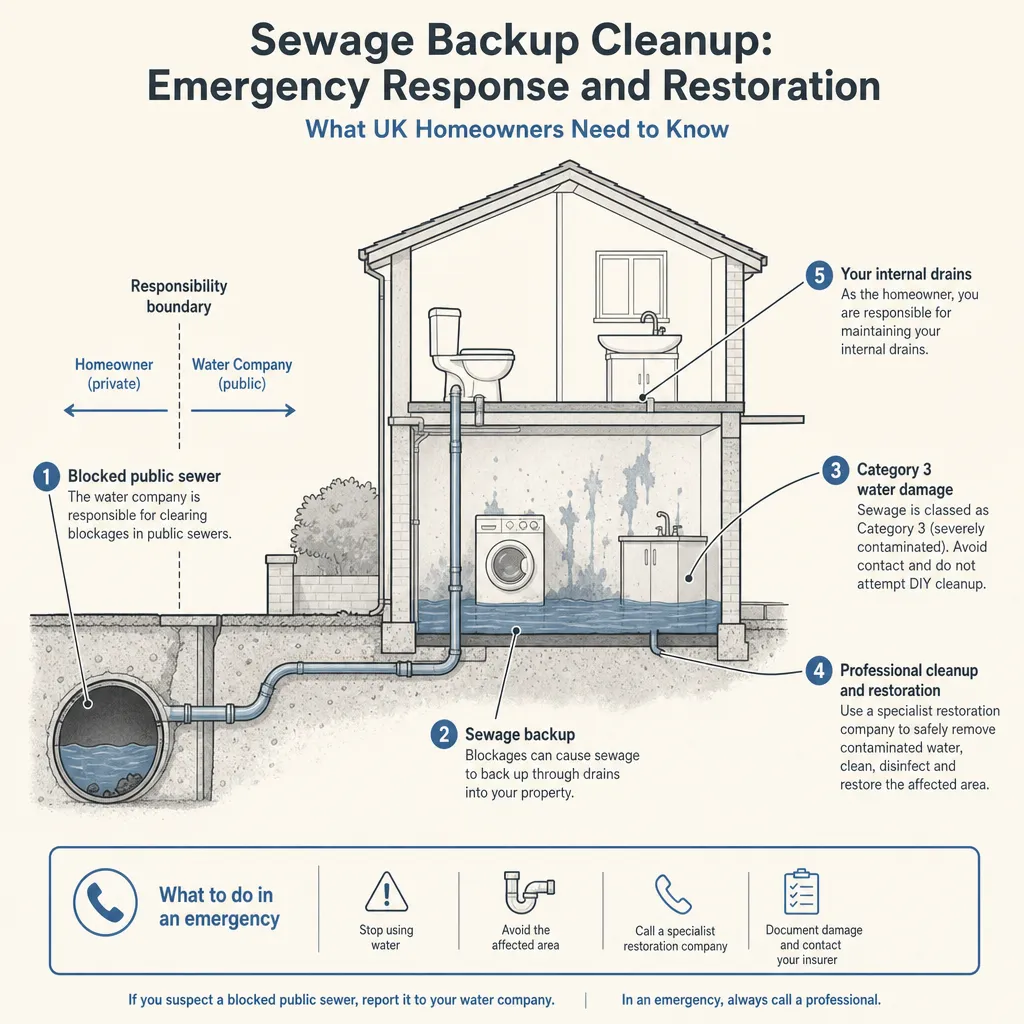
Sewage Backup Cleanup: Emergency Response and Restoration
A sewage backup should be treated as a Category 3 contamination event.
 Surveys & Inspections
Identifying Asbestos Insulation: What You Need to Know for Your Property
Asbestos insulation was widely used in UK properties built before 2000, commonly found in pipe lagging, ceiling tiles, loose-fill loft insulation, and around boilers.
 Surveys & Inspections
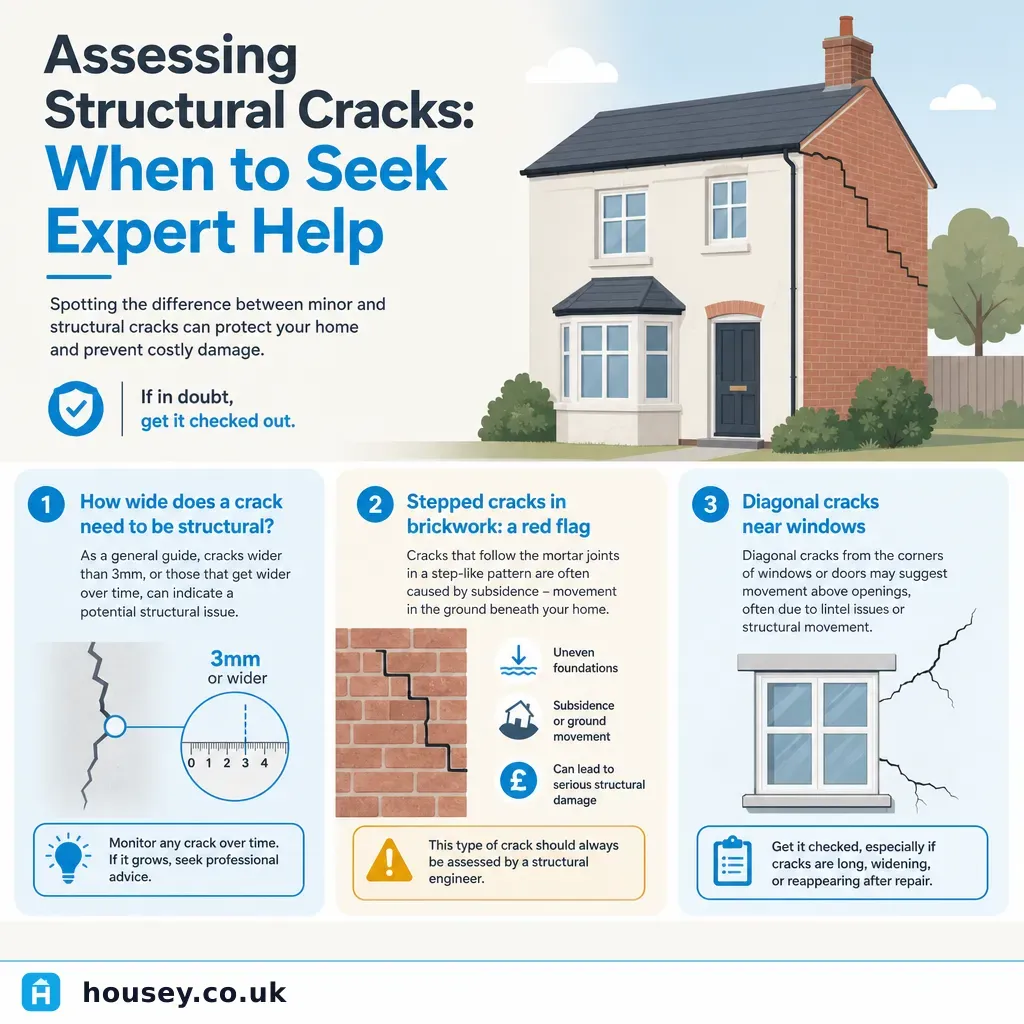
Assessing Structural Cracks: When to Seek Expert Help
Structural cracks range from harmless shrinkage hairlines to signs of subsidence or foundation movement.