Which Heat Pump System Is Right for Your Home: Selection Guide
By Housey · Last reviewed 31st of May 2026
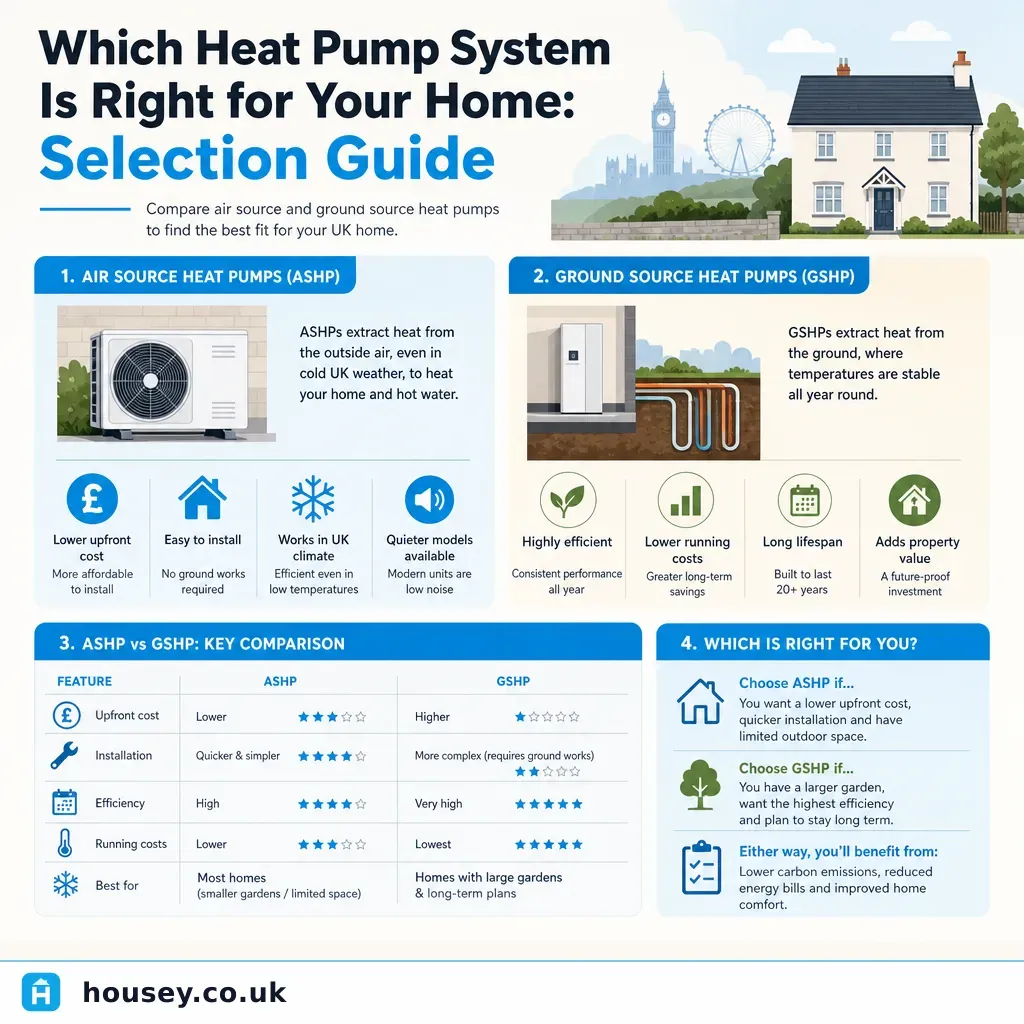
Which Heat Pump System Is Right for Your Home: Selection Guide
Heat pumps are moving from niche to mainstream in UK homes, driven by the Boiler Upgrade Scheme and rising gas prices — but the choice between system types, and the question of whether your home is genuinely suitable, is far from straightforward. For homeowners approaching a boiler replacement or undertaking a deep retrofit, selecting the wrong heat pump type — or one that is incorrectly sized — can lead to high running costs, inadequate warmth, and potential condensation problems. The decision depends on your property's construction, insulation levels, available outdoor space, and budget, and it requires professional assessment to get right.
Key points
- Air source heat pumps (ASHPs) extract heat from outdoor air and account for the majority of UK residential installations; ground source heat pumps (GSHPs) use buried ground loops and typically achieve higher efficiency but at significantly greater installation cost.
- The Boiler Upgrade Scheme (BUS) currently offers a £7,500 grant for both ASHPs and GSHPs installed by MCS-certified contractors in England and Wales — check GOV.UK for the current amount as rates can change between scheme years.
- A heat loss calculation to BS EN 12831 must be carried out before a heat pump is sized; this is a requirement for MCS-certified installations and a prerequisite for the BUS grant.
- Heat pumps typically operate at flow temperatures of 35–55°C, meaning existing radiators may need to be upgraded to larger models or replaced with underfloor heating to deliver adequate warmth at lower water temperatures.
- Ground source systems require significant outdoor land: horizontal loop fields need roughly 1.5–2× the home's floor area, while vertical boreholes (50–150 m deep) suit smaller plots but cost substantially more to drill.
Air source vs ground source: which system suits which home?
The two main residential heat pump types work on the same refrigeration-cycle principle but draw heat from different sources. Understanding the trade-offs is the starting point for any decision.
Feature | Air Source Heat Pump (ASHP) | Ground Source Heat Pump (GSHP) |
|---|---|---|
Heat source | Outdoor air | Ground via horizontal loops or vertical boreholes |
Typical CoP | 2.5–3.5 (varies with air temperature) | 3.5–4.5 (more stable year-round) |
Indicative installation cost | £8,000–£18,000 | £15,000–£35,000+ |
Land requirement | External wall space and clearance zone | Large garden (horizontal) or borehole access (vertical) |
Best for | Most homes with adequate insulation | Homes with large plots or strong efficiency goals |
Noise | Low fan noise (must meet permitted development limits) | Essentially silent once installed |
BUS grant available? | Yes — £7,500 (England and Wales) | Yes — £7,500 (England and Wales) |
Indicative UK costs, last reviewed 2026-05-31. Actual costs vary by property, location, system size, and installer. Always obtain multiple quotes.
Which homes are heat pump-ready?
Heat pumps are most effective in well-insulated homes. Before installation, an MCS-certified assessor or retrofit coordinator will examine insulation levels, the existing heating distribution system, and the building's overall heat loss.
Homes that typically suit a heat pump without major preparatory works:
- Detached or semi-detached homes built from the 1980s onwards with cavity wall and loft insulation in place.
- Properties that have already had external or internal wall insulation installed.
- Homes with existing underfloor heating or large-format radiators.
- New-build or recently renovated homes designed to Part L of the Building Regulations.
Homes that may need significant preparation before a heat pump is cost-effective:
- Pre-1920 solid-wall properties where insulation is expensive to retrofit and the building fabric is complex.
- Homes with very high heat loss where the system would need to run at elevated flow temperatures, reducing efficiency significantly.
- Properties with no suitable outdoor space for an ASHP unit, or insufficient land for GSHP loops.
Decision tree: choosing your heat pump type
Use the following to guide initial thinking — a qualified MCS-certified assessor must confirm any recommendation for your specific property:
- Choose an ASHP if your home has an external wall location for the unit, reasonable insulation, and you want a lower upfront cost.
- Choose a GSHP (horizontal loops) if you have a large, accessible garden and can justify a higher upfront investment for maximum long-term efficiency.
- Choose a GSHP (vertical borehole) if you have a smaller plot but can justify the significantly higher drilling cost.
- Consider a hybrid system (heat pump combined with a gas boiler) if your home's fabric cannot easily be improved and you want to reduce gas use without full electrification — note that hybrids do not qualify for the BUS grant.
- Improve insulation first if your home has an EPC rating of E, F, or G, or if a heat loss calculation shows demand that a heat pump cannot meet efficiently at low flow temperatures.
- Consult an MCS-certified retrofit assessor if your home is listed, in a conservation area, has solid walls, or has had recurring damp problems.
What the installation process involves
Understanding the typical process helps you prepare and know what to expect from a reputable installer:
- Heat loss calculation — a qualified installer calculates your home's heat demand in kilowatts, room by room, to BS EN 12831.
- System design — the correct output, flow temperature, and emitter configuration are specified before any equipment is ordered.
- MCS pre-installation checks — your MCS-certified installer must follow the MCS 020 Heat Pump Standard, including checking for any planning or permitted development constraints.
- Electrical supply assessment — heat pumps require a dedicated electrical circuit; your fuse board and incoming supply capacity are checked.
- Hot water cylinder — most installations include a new unvented or vented cylinder sized for the system.
- Commissioning and handover — the system is commissioned and performance data recorded for MCS compliance and BUS grant purposes.
Important limitations
This guide provides general information about heat pump types and selection factors. It does not constitute a design recommendation for any individual property. Heat pump sizing, system design, and fabric suitability vary significantly by property age, construction type, insulation levels, occupancy, and local ground conditions. An incorrectly sized or specified heat pump can result in inadequate heating, high running costs, or moisture problems. Always commission a full heat loss survey and system design from a qualified, MCS-certified professional before proceeding with any installation.
When this becomes urgent
- If you have already had a heat pump installed that does not heat your home adequately or is producing condensation on internal walls, contact an MCS-certified engineer or a PAS 2035 retrofit coordinator promptly.
- If your existing boiler is beyond repair and you are considering an emergency heat pump installation, resist specifying a system without a proper heat loss calculation — temporary heating is safer than a poorly specified permanent installation.
What to ask a qualified professional
Before instructing an MCS-certified heat pump installer or retrofit assessor, ask:
- Are you MCS-certified, and can you provide your certificate number?
- Will you carry out a full heat loss calculation to BS EN 12831 before specifying the system?
- Which system type do you recommend for my property, and why?
- Will my existing radiators need to be upgraded, and what is the cost of doing so?
- What flow temperature will the system operate at, and what seasonal CoP can I expect?
- Is my home's insulation adequate, or should fabric improvements be made first?
- Will I qualify for the Boiler Upgrade Scheme grant, and will you handle the application?
- What noise levels will the unit produce, and does it comply with permitted development limits?
- What warranty and maintenance plan comes with the system?
Red flags when choosing a heat pump installer
- No MCS certification — you will not be able to access the Boiler Upgrade Scheme grant, and quality standards cannot be independently verified.
- No heat loss calculation offered — correctly sizing a heat pump without one is not possible.
- Pressure to sign quickly — reputable installers allow time to compare quotes and ask questions.
- A quote that does not itemise radiator upgrades or cylinder replacement — these are common additional costs that must be stated upfront.
- Claims that any home is suitable without an assessment — some properties are not cost-effective for heat pump installation without major fabric works first.
When to get professional help
If you are seriously considering a heat pump, engaging a professional is part of the process — not a last resort. Commission an MCS-certified assessor or, for more complex properties, a retrofit coordinator qualified under PAS 2035 before committing to any system or accepting a grant application. If your home is listed, unusually constructed (for example, timber frame, cob, or pre-cast concrete panels), or has a history of condensation or damp, specialist advice is essential before proceeding.
Contact a professional promptly if:
- Damp or mould appears following a recent heat pump installation.
- Your heat pump frequently trips out or fails to reach target temperatures.
- Electricity bills are unexpectedly high after installation.
How Housey can help
Housey connects UK homeowners with qualified professionals for heat pump surveys and assessments — helping you get an independent view of your home's suitability before committing to a system or grant application.
Frequently asked questions
Does my home need to be insulated before a heat pump is installed?
Not necessarily to a specific standard, but poor insulation significantly reduces a heat pump's efficiency and may mean the system cannot meet your heating demand at reasonable flow temperatures. Most MCS-certified installers will advise on any insulation improvements needed as part of the design process. In some cases, improving insulation before installation is the more cost-effective approach.
Can I get a grant for a heat pump in 2025–26?
The Boiler Upgrade Scheme (BUS) offers £7,500 for air source and ground source heat pumps installed by MCS-certified contractors in England and Wales. Check GOV.UK for current eligibility rules and grant amounts, as these can be updated between scheme years. Scotland and Northern Ireland have separate grant schemes.
Will a heat pump work in a Victorian terrace?
Possibly, but it depends on how the property has been improved. Solid-wall Victorian terraces typically have high heat loss, which can mean a larger, more costly system running at higher flow temperatures and reduced efficiency. Fabric improvements — external or internal wall insulation, draught-proofing, secondary glazing — often make financial sense before or alongside a heat pump. A heat loss survey gives a clear picture of suitability and likely running costs.
How noisy is an air source heat pump?
Modern ASHPs typically operate at 40–60 dB(A) at one metre — comparable to a quiet conversation or refrigerator hum. Under permitted development rules in England, they must not exceed 42 dB(A) at one metre from a neighbour's window or door. Installation quality, casing design, and siting all affect noise levels in practice.
Do I need planning permission for a heat pump?
Most domestic ASHP installations qualify as permitted development in England under the Town and Country Planning (General Permitted Development) (England) Order 2015 (as amended), subject to conditions including noise limits and not applying to flats or listed buildings. Ground source horizontal loops are also usually permitted development. Borehole drilling may require separate Environment Agency consents. Always check with your local planning authority if your property is in any way restricted.
Sources and further reading
- Boiler Upgrade Scheme guidance — GOV.UK
- Heat pumps explained — Energy Saving Trust
- MCS 020 Heat Pump Standard — Microgeneration Certification Scheme
- PAS 2035: Retrofitting dwellings for improved energy efficiency — BSI
- Air source heat pumps permitted development rights — GOV.UK
Useful next reads
 Energy & Retrofit
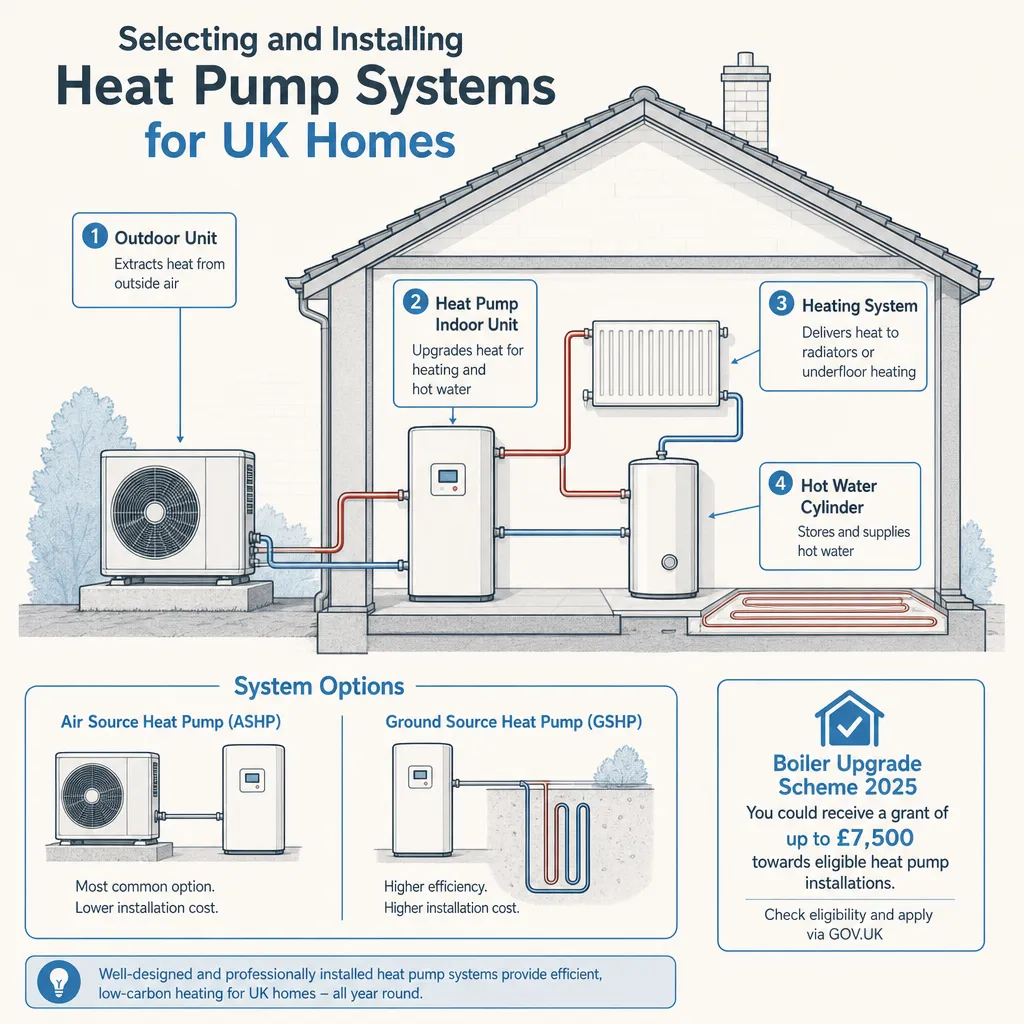
Selecting and Installing Heat Pump Systems for UK Homes
Selecting a heat pump for a UK home requires a site-specific heat loss calculation, an assessment of existing heat emitters, and a check on fabric insulation before any system is chosen.
 Energy & Retrofit
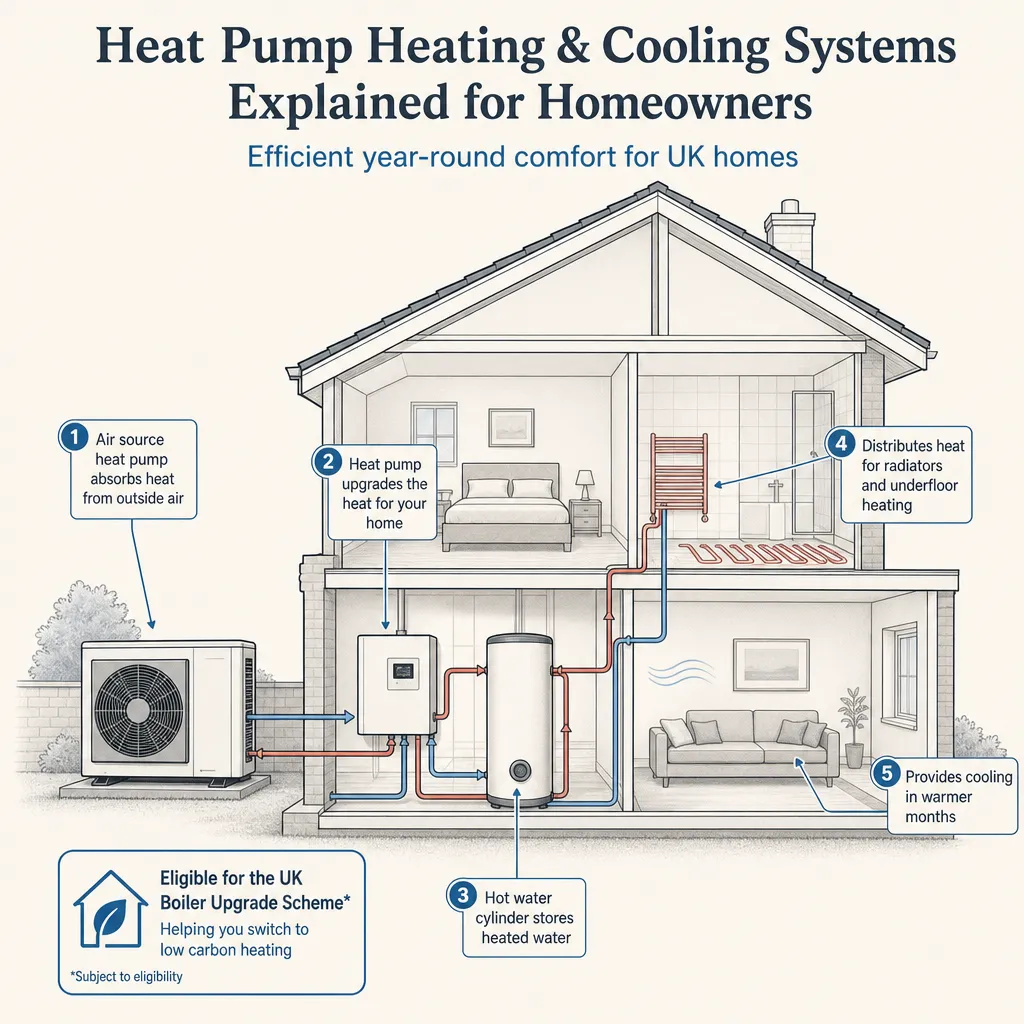
Heat pump heating and cooling systems explained for homeowners
A heat pump extracts heat from air or ground and transfers it indoors for heating, and can reverse the process for cooling.
 Energy & Retrofit
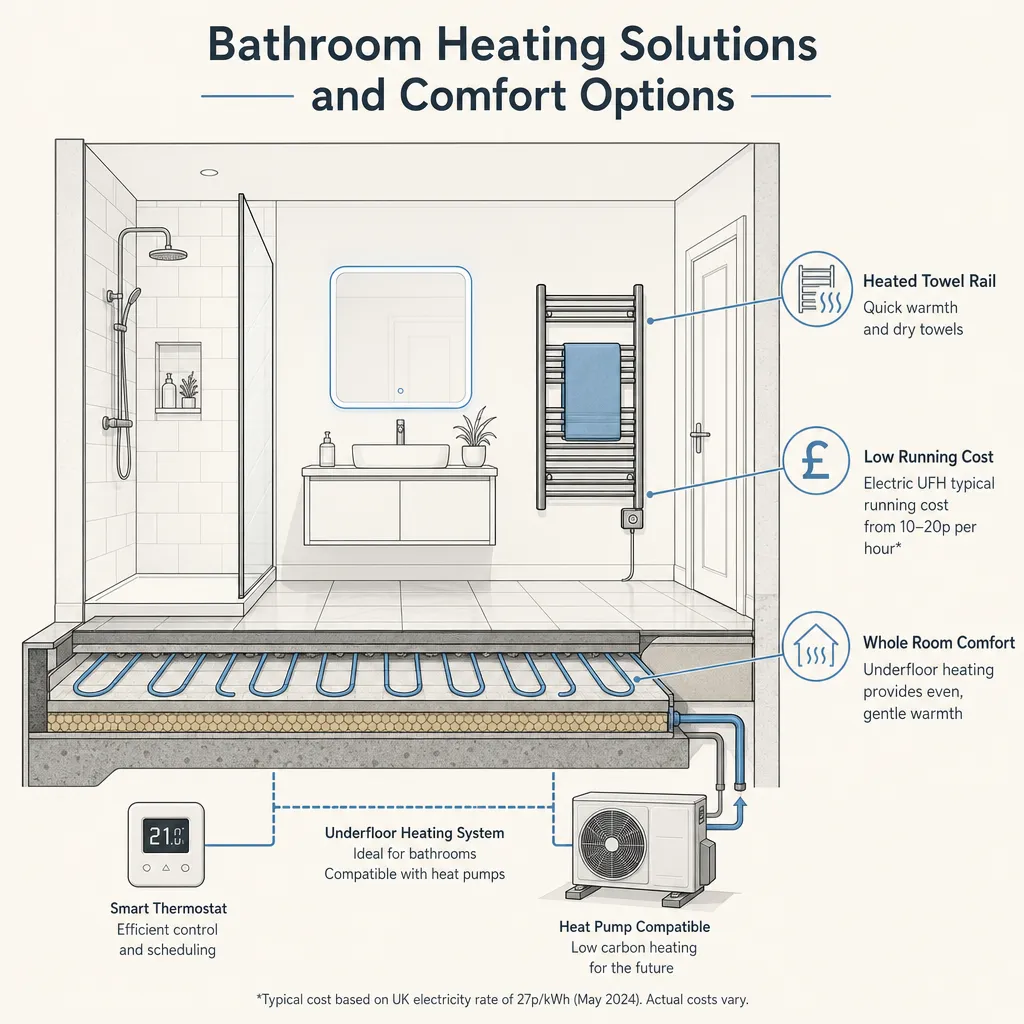
Bathroom Heating Solutions and Comfort Options
UK bathrooms can be heated using electric towel rails, wet radiators on the central heating circuit, electric or wet underfloor heating, or infrared panels.
 Energy & Retrofit
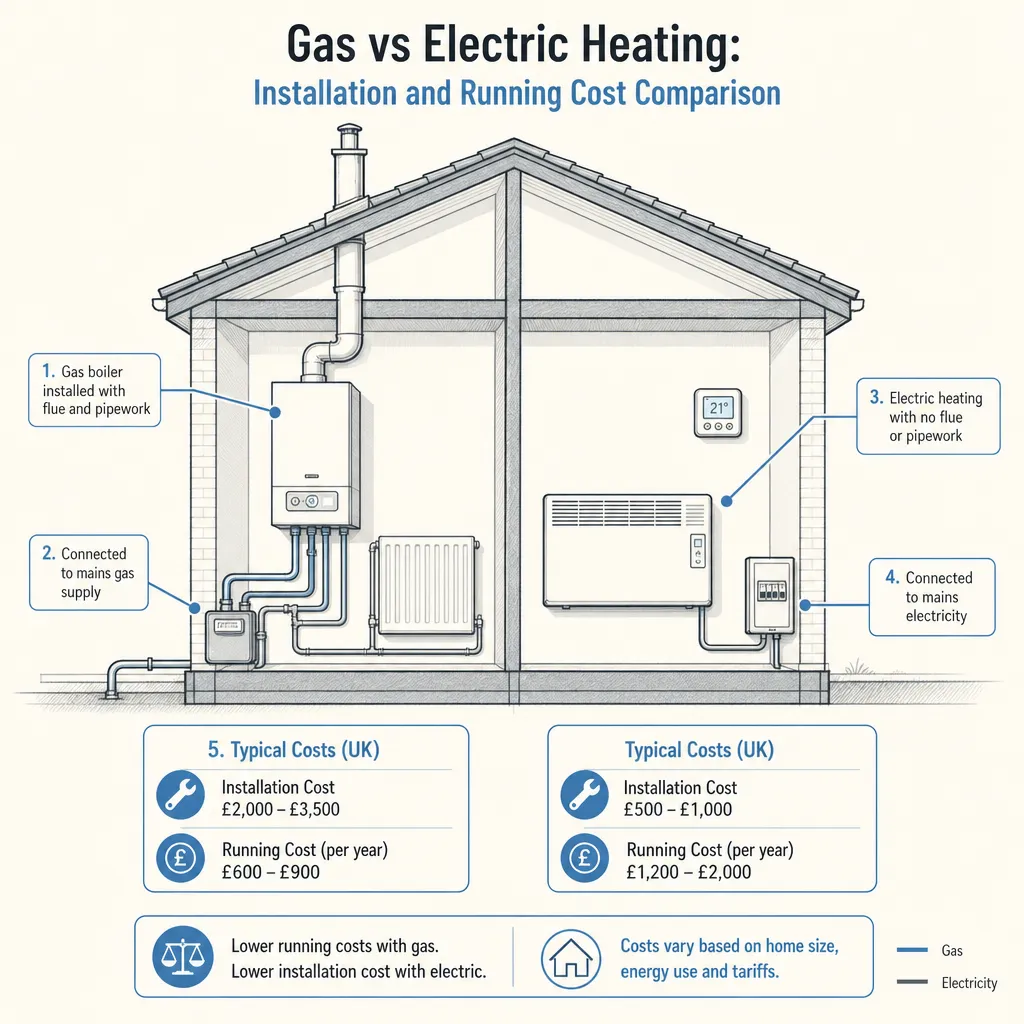
Gas vs Electric Heating: Installation and Running Cost Comparison
Gas central heating usually has lower running costs per kWh than direct electric heating in the UK, though heat pumps can change that equation.
 Energy & Retrofit
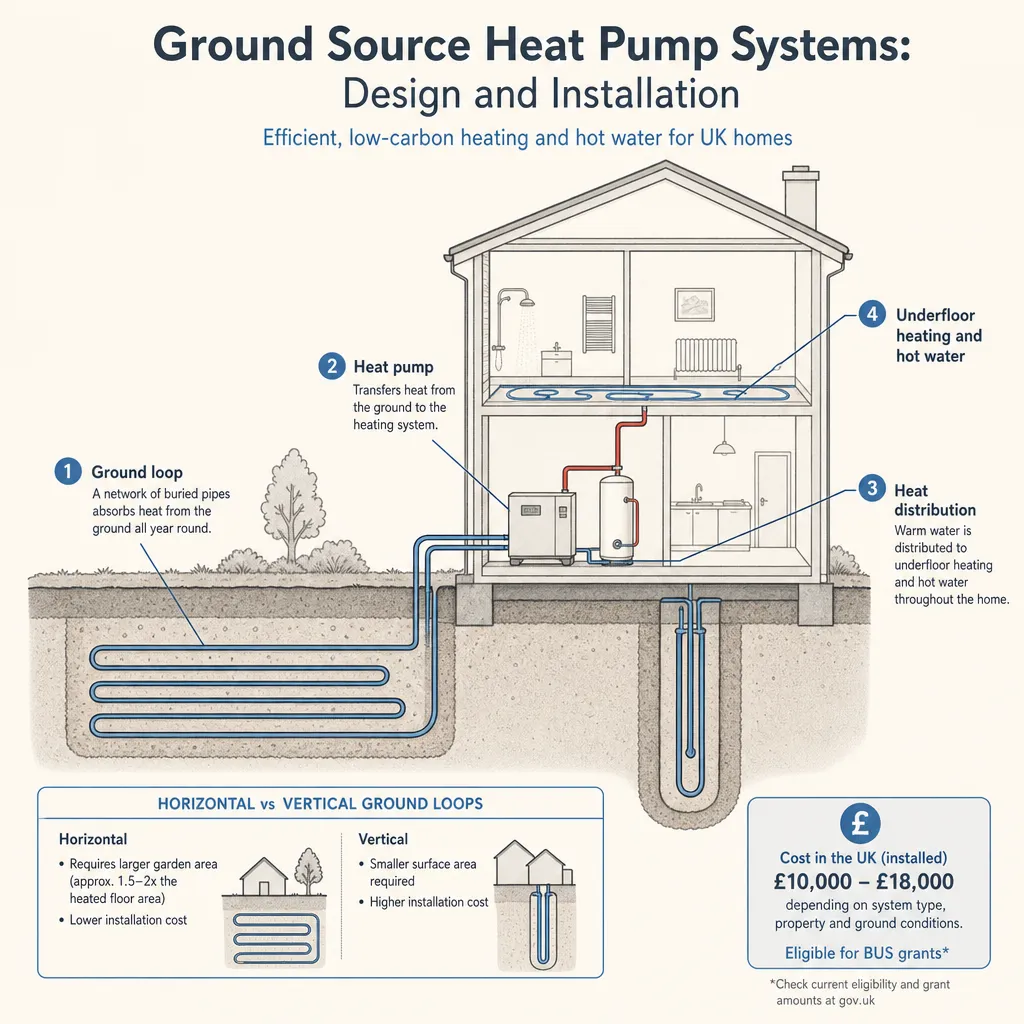
Ground Source Heat Pump Systems: Design and Installation
Ground source heat pumps extract heat from the earth through buried loops or boreholes, then upgrade it for space heating and hot water.