White-Topped Driveway Performance: Durability and Maintenance
By Housey · Last reviewed 11th of May 2026
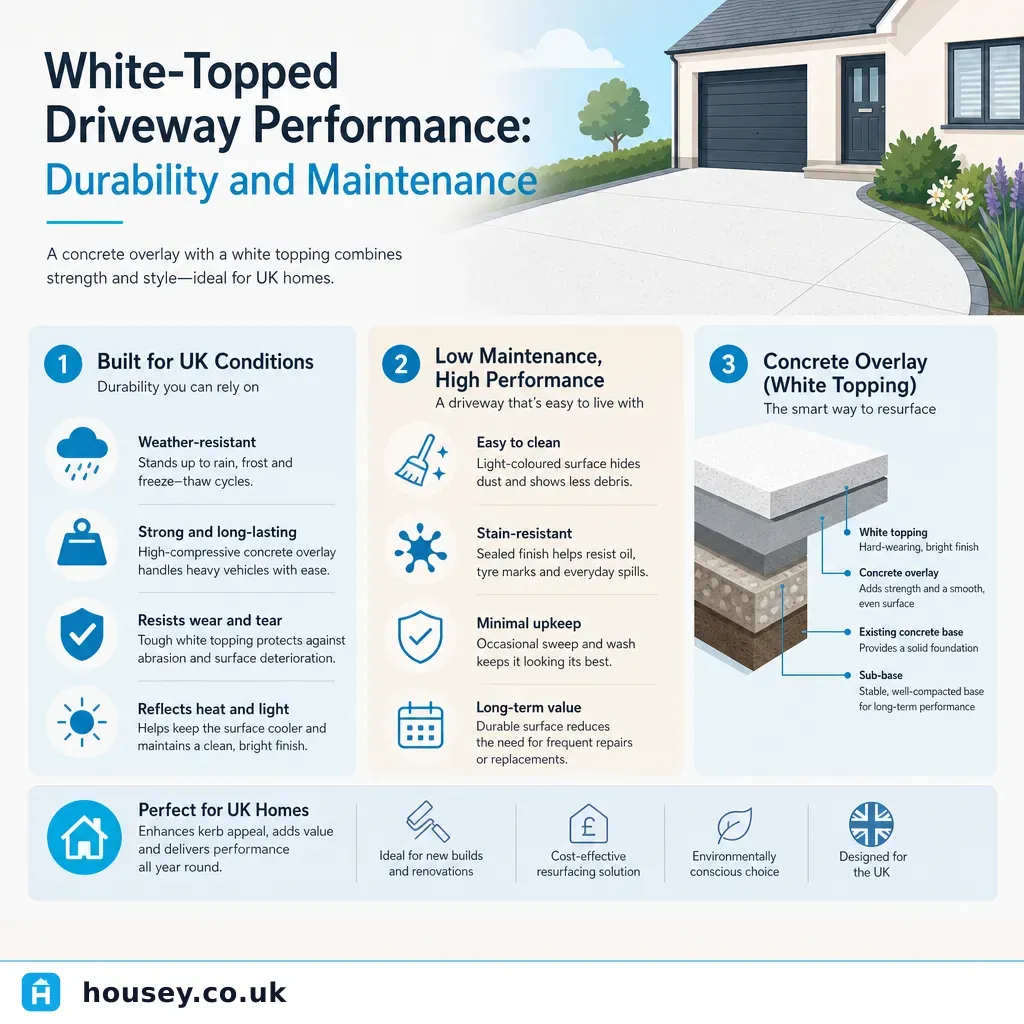
White-Topped Driveway Performance: Durability and Maintenance
Many UK homeowners with ageing tarmac driveways face a familiar crossroads: excavate fully and start again, or resurface over the existing base. White-topping — placing a concrete overlay on an existing asphalt surface — offers a middle path that can extend driveway life significantly without the cost and disruption of full excavation. Understanding what drives performance and where the technique has limits helps homeowners make a more confident decision before committing to a quote.
Key points
- White-topping places a concrete layer (typically 75–150 mm thick for domestic applications) directly onto a sound existing asphalt sub-base, bonding mechanically once cured.
- The technique is viable only when the existing asphalt is structurally sound — significant cracking, rutting deeper than 20 mm, or visible sub-base failure typically means full excavation is the better option.
- Control joints (saw-cut into the concrete within 24 hours of pouring) must be spaced at no more than 1.5–2 times the slab thickness in each direction to manage shrinkage cracking; omitting joints is the single most common cause of surface failure on domestic white-topped driveways.
- A solid concrete front driveway larger than 5 m² in England must manage run-off so it does not discharge to the highway — directing water to a lawn, border, or soakaway usually keeps the work within permitted development.
- A correctly installed white-topped driveway can be expected to last 25–40 years with routine maintenance — significantly longer than a standard tarmac resurfacing, which typically offers 10–20 years.
What white-topping involves
The process begins with an assessment of the existing asphalt. Any localised failures — potholes, heavily cracked areas, sections with visible sub-base movement — must be patched or removed before the concrete overlay is applied. Cracks that exist in the asphalt can reflectively telegraph through to the new concrete surface if not addressed beforehand.
Once the base is prepared:
- The asphalt surface is cleaned and, for bonded white-topping, may be milled or scarified to improve mechanical key.
- A concrete mix (typically C25/30 or stronger, often with polypropylene fibres to control early-age cracking) is poured and screeded to a consistent level.
- A brushed or exposed aggregate finish may be applied for grip and aesthetics.
- Control joints are saw-cut within 24 hours to pre-determine where shrinkage cracking will occur — contained within the joints rather than randomly across the surface.
- The concrete is protected during curing for a minimum of 7 days before light traffic; full strength is typically reached at 28 days.
Comparing white-topping with alternative driveway options
Option | Suitable existing surface | Indicative lifespan | Disruption level | Indicative cost per m² | Drainage implications |
|---|---|---|---|---|---|
White-topping (concrete overlay) | Sound asphalt | 25–40 years | Low–medium | £55–£95 | Non-permeable — direct run-off to border or soakaway |
Full concrete replacement | Any (after excavation) | 30–50 years | High | £80–£130 | Non-permeable — as above |
Tarmac resurfacing | Existing asphalt | 10–20 years | Low | £25–£55 | Non-permeable |
Resin-bound overlay | Sound concrete or asphalt | 15–25 years | Low | £70–£130 | Permeable if correctly specified |
Permeable block paving | After excavation | 25–40 years | High | £60–£120 | Permeable — typically avoids planning drainage requirement |
Indicative UK costs, last reviewed 2026-05-11. Prices vary by region, thickness, finish, and site conditions. Obtain at least three itemised quotes.
Maintenance requirements over time
Concrete driveways require far less attention than tarmac but are not maintenance-free. Understanding what to expect at each stage helps homeowners budget and protect their investment.
Years 1–5: Concrete reaches full strength and minor surface shrinkage cracks may appear, typically within control joints as intended. Inspect annually. Remove oil spills promptly using a degreaser — prolonged exposure can stain and slightly soften the surface binder.
Years 5–15: Monitor control joints for weed ingress. Flexible joint sealant (polyurethane or silicone) applied at years 5–7 prevents vegetation growth and water infiltration that can cause freeze-thaw spalling at joint edges. Re-seal as needed, typically every 5–8 years.
Years 15–30+: Surface carbonation and minor spalling may appear in exposed areas, particularly at control joint edges. A penetrating concrete sealant or surface coating can extend useful life at this stage. Thin overlays under 75 mm are more vulnerable to edge deterioration.
White-topped driveway maintenance checklist
When to get professional help
White-topping is straightforward when the existing asphalt is sound, but professional advice is worth seeking if:
- The existing tarmac shows rutting, alligator cracking, or sections that flex or depress underfoot — these are signs of sub-base failure that an overlay will not resolve.
- The driveway is expected to carry heavy vehicles regularly, such as vans, motorhomes, or skip lorries — overlay thickness and mix specification need to be matched to the load.
- Drainage from the driveway currently discharges to a highway drain or public gully — replacing a permeable surface with solid concrete may require a drainage redesign, and a planning check is advisable in England.
- The driveway is close to a large tree — root surveys or tree protection advice may be needed to assess heave risk before pouring concrete.
- Cracks appear in the white-topping within 12 months of installation — this may indicate a defect in the existing base, the mix design, or the control joint spacing, and the installer should be asked to assess under any workmanship warranty.
How Housey can help
Getting an accurate assessment of whether your existing asphalt is suitable for white-topping — and finding a contractor who specifies the correct slab thickness, mix strength, and control joint layout — is the most important step in ensuring a driveway that lasts decades rather than years. Housey connects homeowners with experienced driveway installers who can carry out a condition assessment and provide detailed written quotes for comparison.
Frequently asked questions
How thick should a white-topped driveway be?
For domestic car use, a concrete overlay of 75–100 mm is generally specified over a sound asphalt base. This provides adequate structural strength for a family car without requiring full-depth excavation. Areas expected to carry heavier loads — vans, motorhomes — may need 125–150 mm, and the concrete mix strength should be reviewed accordingly with your installer.
Can white-topping be applied over existing block paving or concrete?
Concrete overlays work best on asphalt, which provides flexibility and a reasonable mechanical bond. Laying concrete over existing concrete is less straightforward — differential shrinkage can cause delamination without bonding agents and thorough surface preparation. Concrete over block paving is generally not recommended due to the uneven base and point loading at joints; full removal usually gives a more reliable result.
Does a white-topped driveway need planning permission?
A solid concrete front driveway is not permeable. In England, if it is larger than 5 m², surface water must not run to the highway — directing it to a lawn, border, or soakaway usually keeps the work within permitted development without a planning application. Properties in conservation areas or listed buildings should always check with the local planning authority before starting work.
How soon after installation can a white-topped driveway be used?
Light foot traffic can typically resume after 24–48 hours, and a standard family car can usually use the surface after 7 days. Full structural strength is not reached until 28 days from pouring. Your installer should advise on curing conditions — cold or wet weather extends this period and may require additional protection such as polythene sheeting or curing compound.
Sources and further reading
- Driveways and dropped kerbs: planning permission — Planning Portal
- Town and Country Planning (General Permitted Development) (England) Order 2015 — legislation.gov.uk
- Concrete guidance for pavements and roads — The Concrete Society
- Sustainable drainage systems guidance — GOV.UK / Environment Agency
- The SuDS Manual C753 — CIRIA
Useful next reads
 Improvement & Build
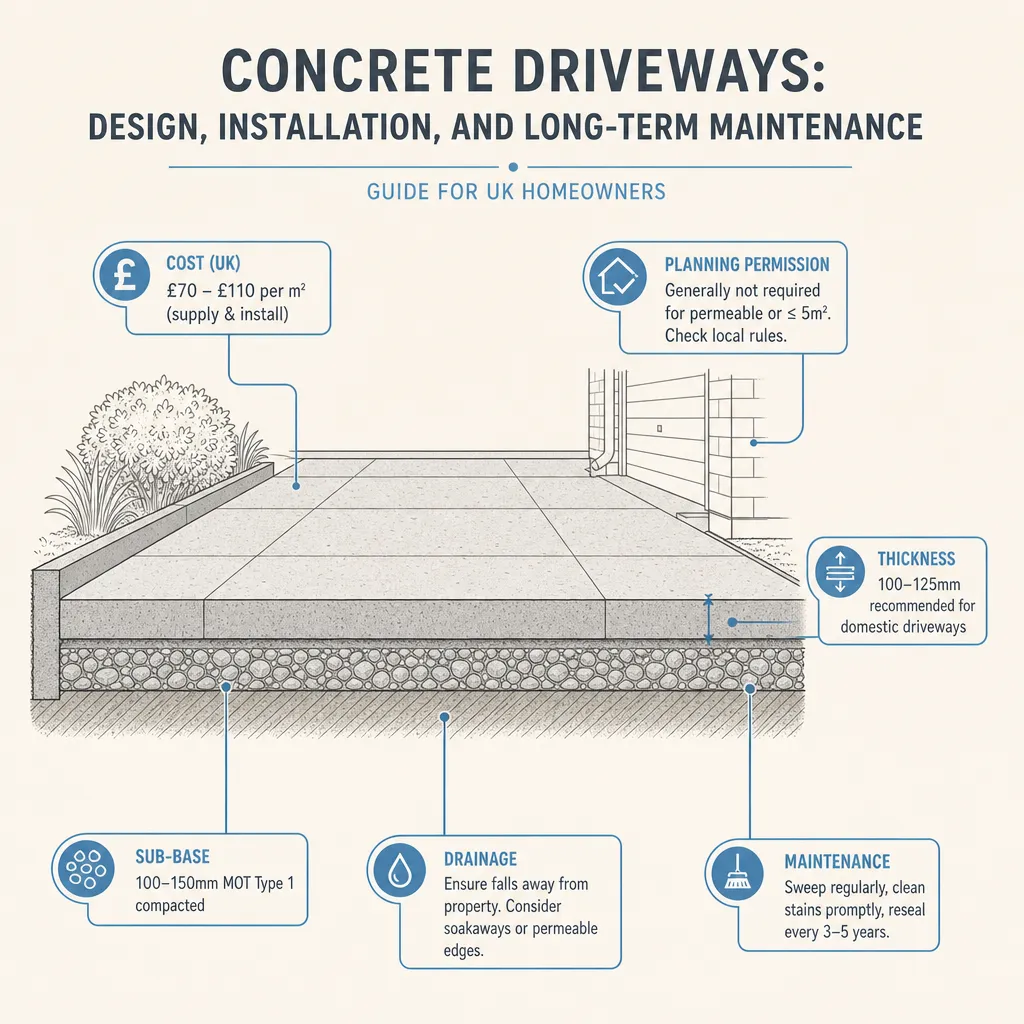
Concrete Driveways: Design, Installation, and Long-Term Maintenance
A concrete driveway requires a compacted sub-base of at least 150mm and a concrete slab of at least 100mm for domestic use.
 Improvement & Build
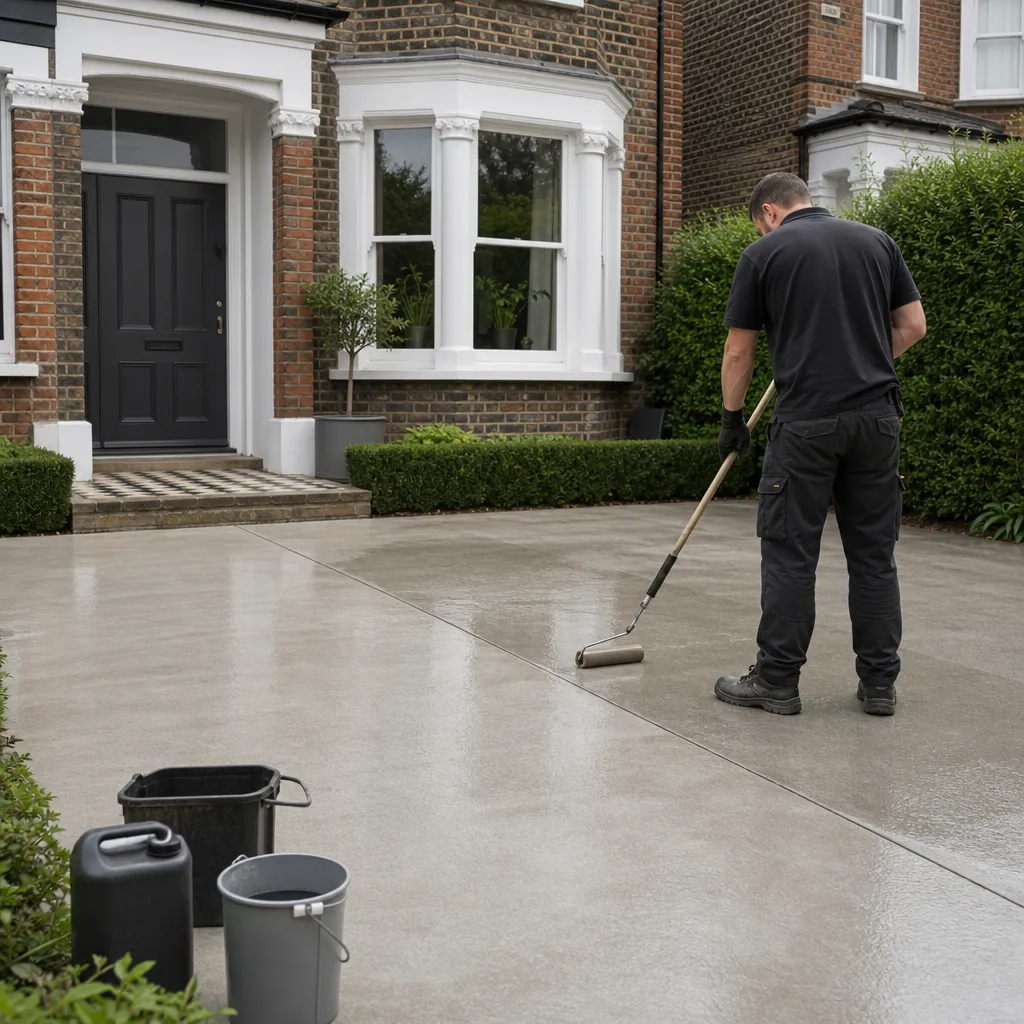
Which products to use for sealing your concrete driveway
Concrete driveway sealers divide into two types: penetrating sealers that absorb into the concrete without changing its look, and film-forming sealers that coat the surface.
 Improvement & Build
Wooden Garage Doors: Aesthetic and Performance Advantages
Timber garage doors offer a traditional appearance, strong repairability, and good planning acceptance — particularly for period homes, listed buildings, and conservation areas.
 Improvement & Build
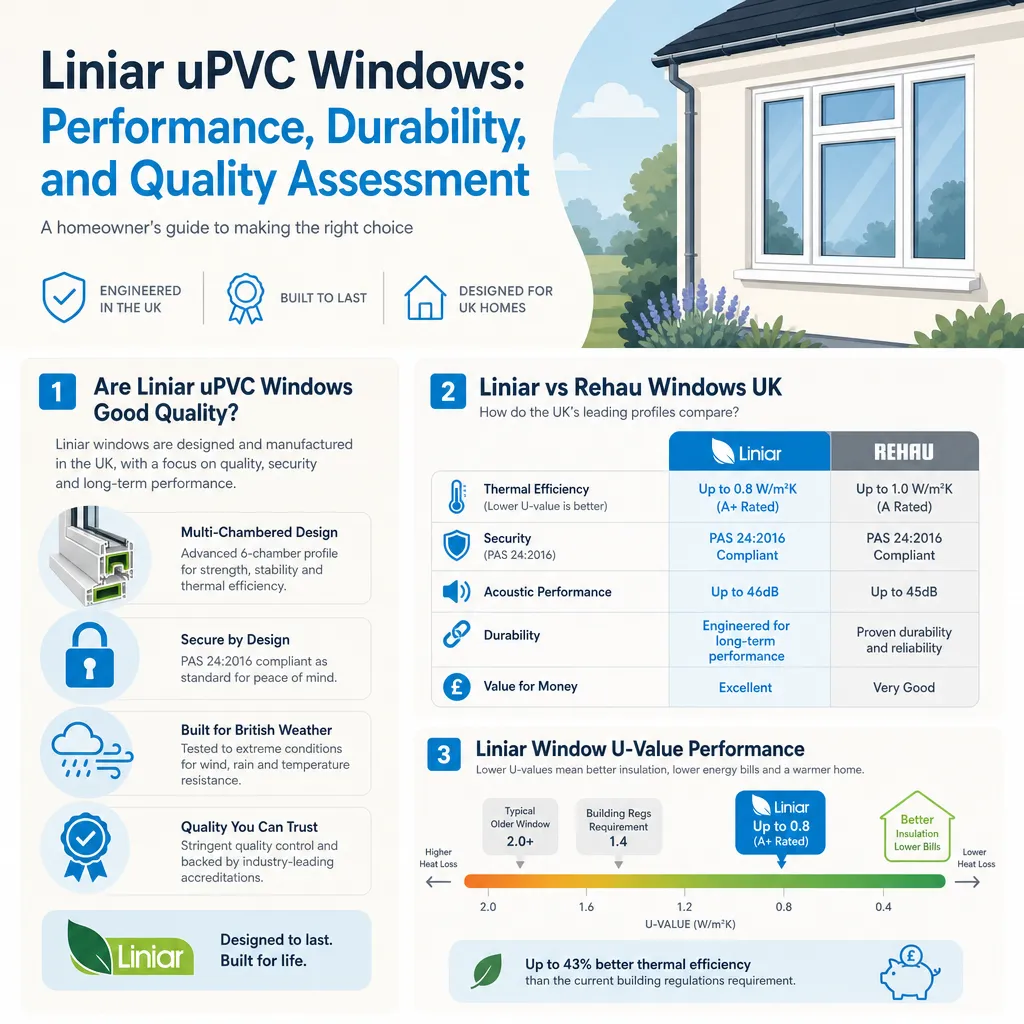
Liniar uPVC Windows: Performance, Durability, and Quality Assessment
Liniar uPVC window profiles are manufactured in the UK using multi-chambered, foamed frames.
 Improvement & Build
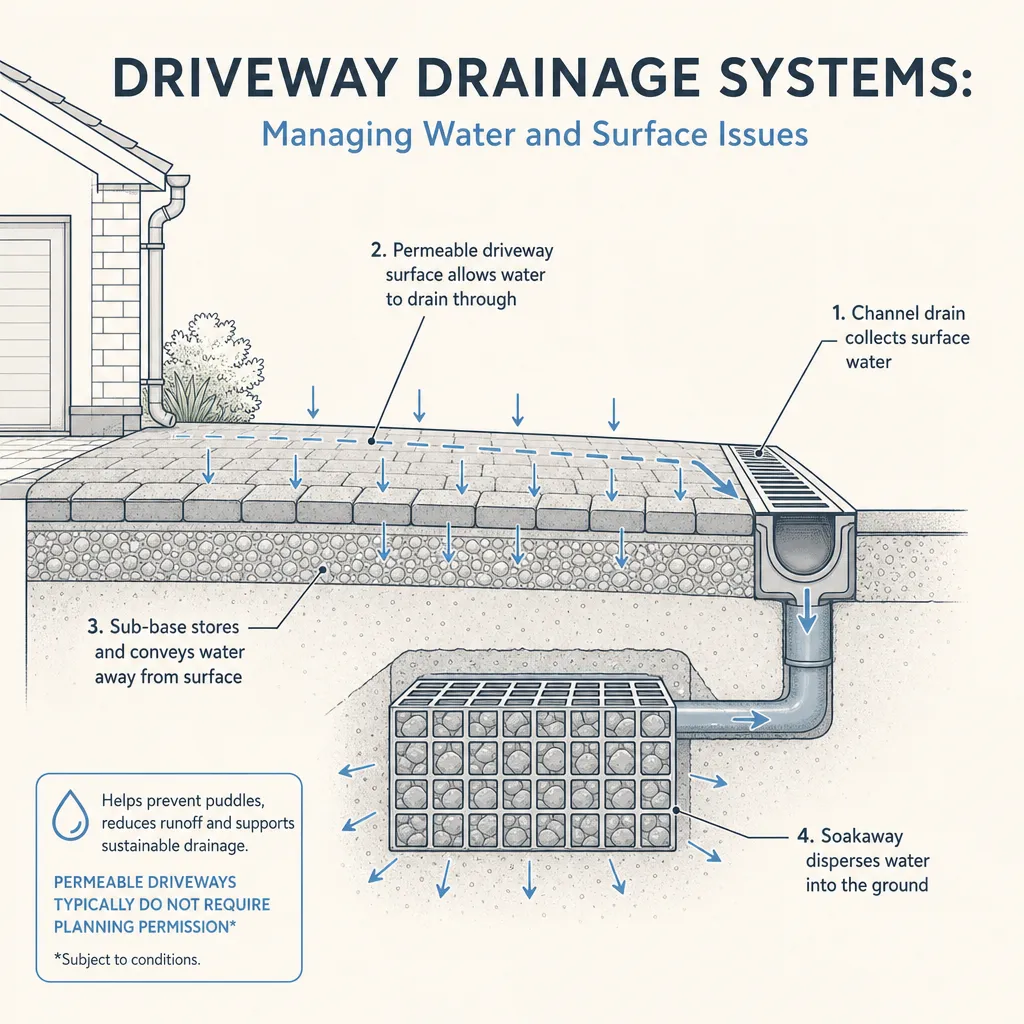
Driveway Drainage Systems: Managing Water and Surface Issues
The right driveway drainage system depends on your surface type, soil permeability, and local flood risk.