Wooden Garage Doors: Aesthetic and Performance Advantages
By Housey · Last reviewed 11th of May 2026
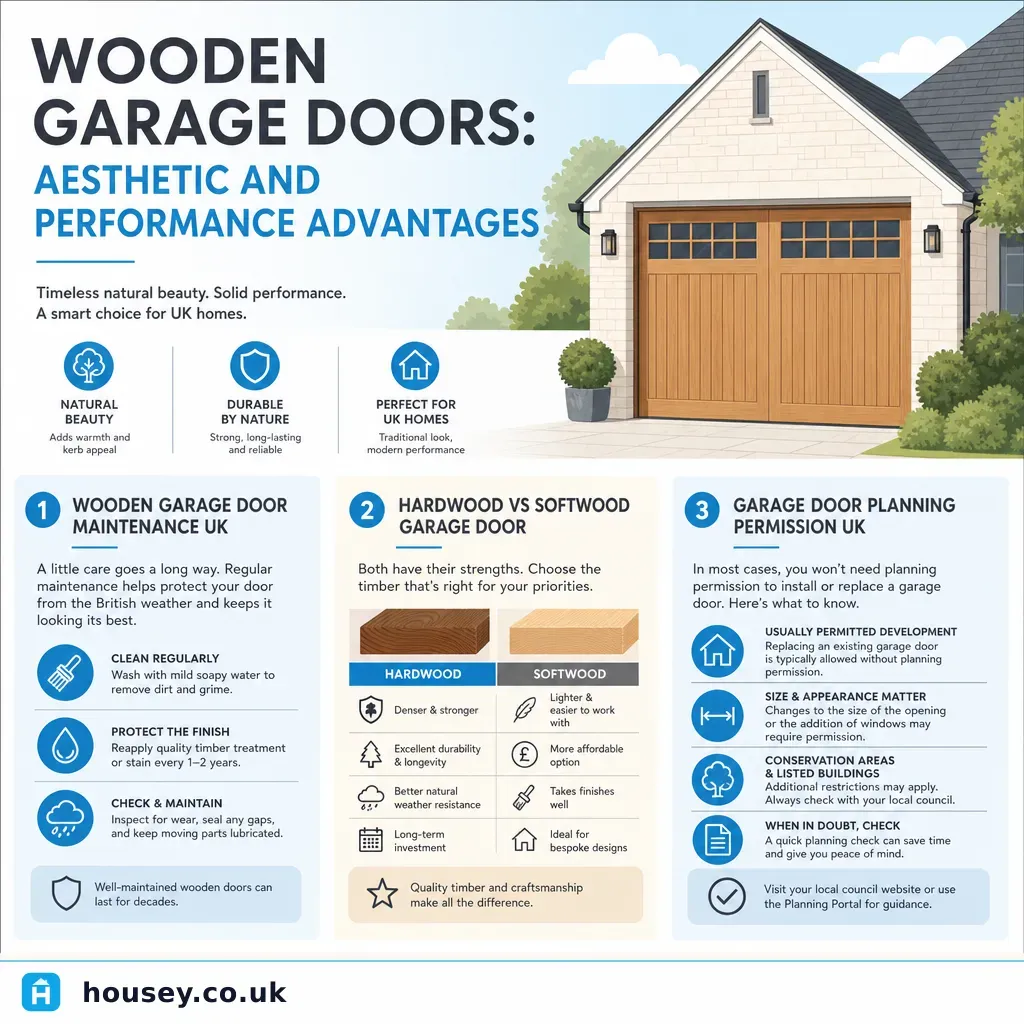
Wooden Garage Doors: Aesthetic and Performance Advantages
The garage door is one of the most prominent features of a home's front elevation, and the choice of material — timber versus steel, aluminium, or GRP (glass-reinforced plastic) — has lasting consequences for maintenance commitments, security performance, and planning compliance. Homeowners typically revisit this decision when an existing door is failing, when a garage is being brought back into active use, or when a renovation is aimed at improving kerb appeal. For properties in conservation areas or with listed building status, the question may not be purely aesthetic: timber is frequently the only material a local planning authority will accept.
Key points
- Timber garage doors require repainting or re-staining every 3–5 years in the UK climate to maintain their weatherproofing and prevent rot or delamination at panel edges and base rails.
- For listed buildings and properties in conservation areas, replacing a garage door with a non-traditional material may require listed building consent or prior planning approval — an offence under Section 9 of the Planning (Listed Buildings and Conservation Areas) Act 1990 if carried out without consent.
- PAS 24:2016 (Enhanced Security Performance Requirements for Doorsets) is the relevant British Standard for garage door security; timber doors can meet this rating with appropriate construction, glazing, and locking hardware.
- Hardwood species (oak, iroko, meranti) typically carry manufacturer warranties of 5–10 years against manufacturing defects and generally outlast softwood doors in the UK climate with equivalent maintenance.
- The U-value of an uninsulated solid timber door is typically 3.0–4.0 W/m²K; insulated timber-frame doors (with a foam or mineral wool core) can achieve 1.4–2.0 W/m²K, which may be relevant where the garage is integral to a heated living space.
How does timber compare to other garage door materials?
The choice between timber and alternatives involves trade-offs across aesthetics, lifespan, maintenance burden, thermal performance, and cost. The table below summarises the main options for a UK homeowner.
Material | Aesthetics | Typical lifespan | Maintenance | Approx. installed cost (indicative) | Best for |
|---|---|---|---|---|---|
Hardwood timber (oak, iroko, meranti) | Traditional, premium | 25–40 years | Re-stain or repaint every 3–5 years | £1,500–£4,000+ | Period homes, listed buildings, conservation areas |
Softwood timber (pine, redwood) | Traditional, fully paintable | 15–25 years | Paint or stain every 2–4 years | £600–£1,800 | Buyers wanting a timber look at lower upfront cost |
Galvanised steel | Modern or traditional profiles available | 20–30 years | Minimal — touch up chips promptly | £600–£2,500 | Security priority, modern builds, low maintenance |
Aluminium | Contemporary | 25–35 years | Very low | £800–£3,000 | Modern homes, coastal locations |
GRP (glass-reinforced plastic) | Can replicate wood grain texture | 25+ years | Very low | £700–£2,500 | Low-maintenance priority where timber appearance is desired |
Indicative UK installed costs, last reviewed 2026-05-11. Costs vary by door size, operating style, installer, and region. Always obtain at least three comparable quotes.
What are the genuine performance advantages of timber?
Thermal mass and insulation. Solid hardwood has a higher thermal mass than steel or aluminium, moderating temperature swings in attached garages. Insulated timber-frame doors — with a foam or mineral wool core — offer comparable thermal performance to insulated steel alternatives and may help reduce heat loss where the garage shares a wall with a habitable room.
Acoustic performance. Solid timber naturally absorbs and dampens sound more effectively than hollow-profile steel or aluminium. This may be relevant if the garage adjoins a living room, bedroom, or is used as a workshop.
Repairability. Unlike steel (which dents and can rust if the coating is breached) or GRP (which can crack and is difficult to patch invisibly), timber can often be repaired in situ. Minor wet rot can be cut out, treated, and filled with a two-part wood filler; in some cases, individual panels on traditional side-hinged designs can be replaced without renewing the entire door.
Planning acceptance. Timber is the default acceptable material in most conservation areas and the expected choice for many listed properties. Historic England recommends retaining or replicating original materials and details where practicable, and local planning authorities routinely refuse applications to replace traditional timber doors with uPVC, aluminium, or steel alternatives in protected areas.
What are the limitations and risks?
Timber doors require genuine, sustained maintenance commitment. In the UK's wet, temperate climate, a neglected timber door is vulnerable to several failure modes:
- Wet rot at the base rail and lower panel edges — the most common failure point, caused by standing water and paint or stain breakdown.
- Warping and swelling, which affects smooth operation and can cause gaps in weatherseals, particularly on south- or west-facing elevations exposed to driving rain followed by drying sun.
- Paint and stain failure along panel edges and in moulding details, which accelerates moisture ingress if not caught early.
- Dimensional movement across seasons, which can misalign locking mechanisms and require periodic adjustment of catches, bolts, and automation hardware.
Red flags when buying or inspecting a second-hand timber garage door, or assessing an existing door before renovation:
- Soft, discoloured, or easily compressed timber at the base rail — likely wet rot requiring repair or replacement before repainting.
- Fine cracks in the coating running along panel edges or moulding joins — active moisture entry points.
- Visible daylight gaps between door panels or between the door and frame when closed — warping or shrinkage indicating inadequate maintenance history.
- Stiff, binding, or dragging operation not explained by hardware adjustment — possible significant warping or frame movement.
- Evidence of filled or painted-over cracks without addressing the underlying moisture cause.
Does a replacement garage door need planning permission?
For most houses, replacing a garage door is permitted development under Schedule 2, Part 1 of the Town and Country Planning (General Permitted Development) (England) Order 2015, provided the replacement does not materially alter the external appearance of the house in a way that exceeds permitted development thresholds. However:
- In a conservation area, replacement materials and styles will be subject to scrutiny. Local planning authorities routinely require timber or high-quality timber-effect materials; submitting a prior notification or householder application may be needed.
- For a listed building, listed building consent is required for any external door replacement, regardless of material. Carrying out works without consent is a criminal offence.
- Article 4 directions can remove permitted development rights from individual properties or streets; check with your local planning authority if you are uncertain about your property's status.
- In Wales, Scotland, and Northern Ireland, equivalent but separate permitted development regimes apply — check the relevant national planning portal for current rules.
What to ask before accepting a quote
- What timber species is used, and what is the manufacturer's warranty period and what does it cover?
- Is the door supplied pre-treated or pre-painted, and what ongoing maintenance schedule is recommended?
- Does the installation include weatherstripping, draught seals, and threshold seals as standard?
- What locking hardware is included, and does the door and ironmongery specification meet PAS 24:2016?
- What is the quoted U-value of the door, and does this affect compliance with Building Regulations in my situation?
- Is VAT included in the quoted price, and what are the payment terms?
- Who carries out the installation — is the company a member of the Door and Hardware Federation (DHF) or a similar trade body?
- What workmanship guarantee does the installer provide, and what is the process for raising a defect claim?
When to get professional help
Replace a garage door yourself only if you have experience with joinery, hanging, and hardware installation. Consider a professional when:
- The property is listed or in a conservation area — a heritage-experienced installer will understand material requirements and can advise on consent before work begins.
- The garage is integral to the house and shares a wall with habitable space — Building Regulations may apply to fire separation, structural lintels, and thermal performance, and a building control body should be consulted.
- The existing lintel, frame, or surrounding masonry shows signs of cracking, deflection, or damp — a structural assessment may be needed before any new door is installed.
- Automation is being added for the first time — wiring and installation should be carried out by a competent person.
How Housey can help
Housey connects homeowners with vetted window and door installers who can advise on timber species, security specifications, and planning requirements — particularly for period properties and conservation area homes where the choice of garage door matters well beyond aesthetics.
Frequently asked questions
Do wooden garage doors need planning permission?
For most properties, replacing a garage door is permitted development and does not require a planning application. However, if your property is listed or in a conservation area, check with your local planning authority before replacing the door — material and style restrictions are likely to apply, and listed building consent may be required regardless of the replacement material chosen.
How long do wooden garage doors last?
A hardwood door (oak, iroko, meranti) that is regularly maintained — re-stained or repainted every 3–5 years — can last 25–40 years. Softwood doors have a shorter lifespan of 15–25 years with consistent maintenance, and may last fewer years in exposed or coastal locations where driving rain and salt air accelerate deterioration.
Are wooden garage doors secure?
Timber doors can achieve strong security performance when constructed to a good standard and fitted with quality locking mechanisms. Look for doors certified to PAS 24:2016 (Enhanced Security Performance Requirements for Doorsets) and consider additional features such as multi-point locking and padlock bars for side-hinged designs. The Door and Hardware Federation (DHF) publishes guidance on security specification.
How much do wooden garage doors cost in the UK?
Indicative installed costs range from around £600–£1,800 for a softwood door to £1,500–£4,000 or more for a hardwood door, depending on size, style, timber species, and installer. Automation adds a further £200–£600 typically. Always obtain at least three comparable quotes. Indicative UK costs, last reviewed 2026-05-11.
Sources and further reading
- Permitted development rights for householders — Planning Portal
- Owning a listed building: guidance for owners — Historic England
- PAS 24:2016 Enhanced Security Performance Requirements for Doorsets — BSI British Standards
- Door and Hardware Federation: installation and specification guidance — Door and Hardware Federation (DHF)
- Planning (Listed Buildings and Conservation Areas) Act 1990 — legislation.gov.uk
Useful next reads
 Improvement & Build
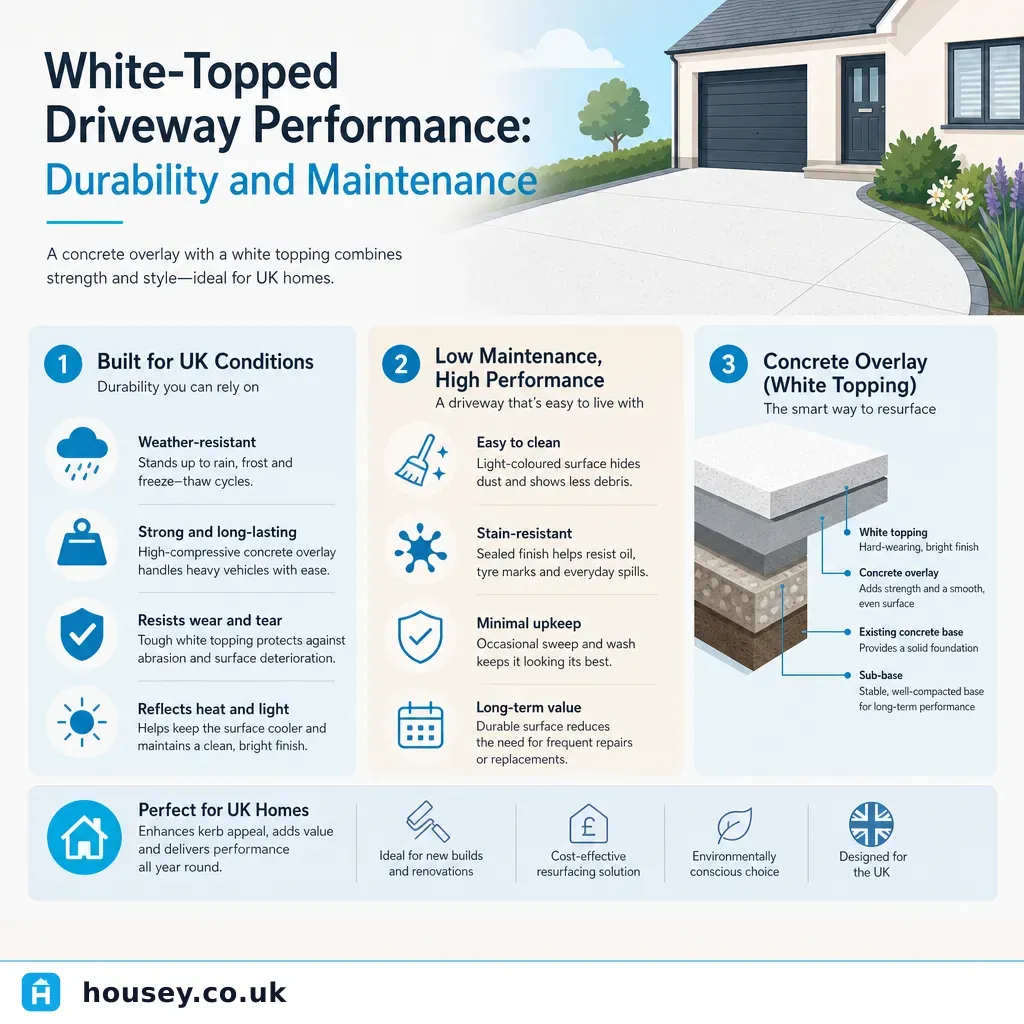
White-Topped Driveway Performance: Durability and Maintenance
A white-topped driveway uses a concrete layer placed over an existing asphalt sub-base, combining the load-spreading of asphalt with the durability of concrete.
 Improvement & Build
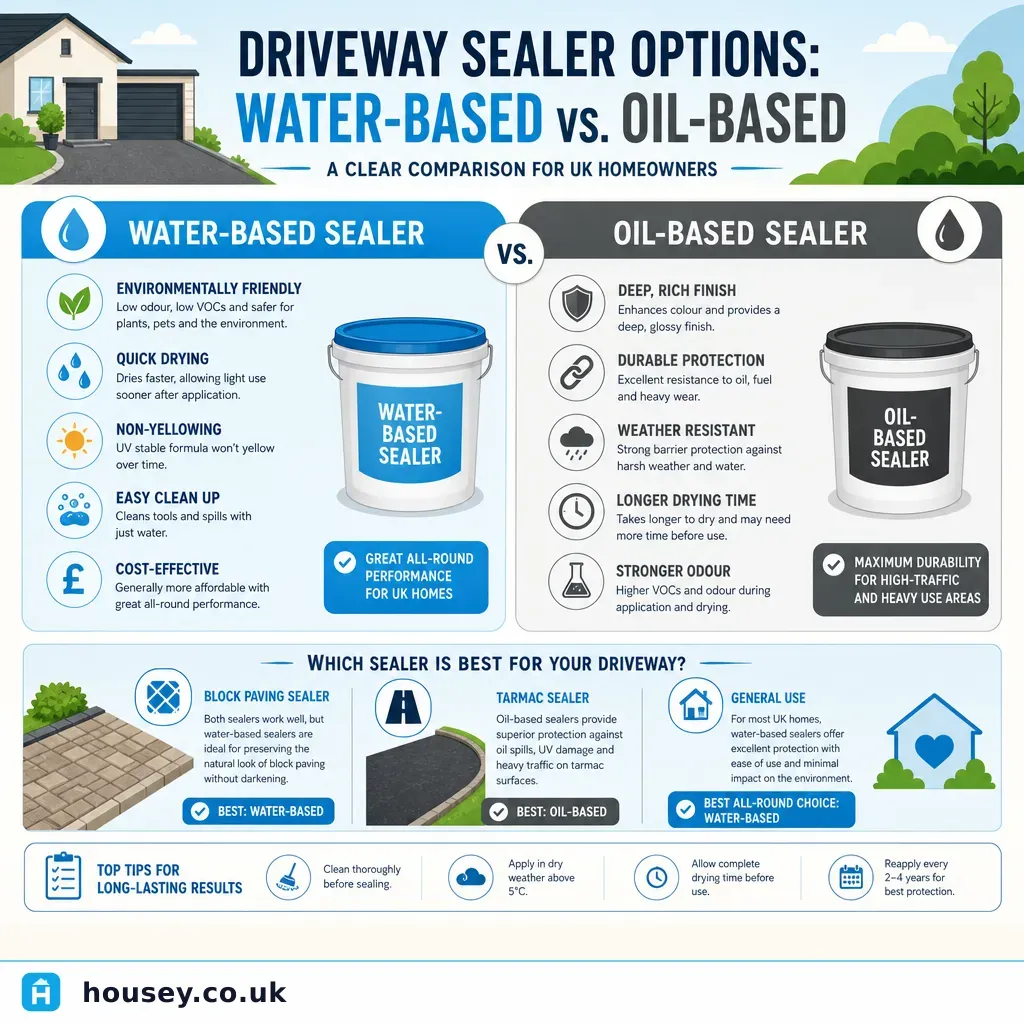
Driveway Sealer Options: Water-Based vs Oil-Based Comparison
Water-based driveway sealers are generally easier to apply, lower in VOCs, and suitable for most block paving and concrete surfaces.
 Improvement & Build
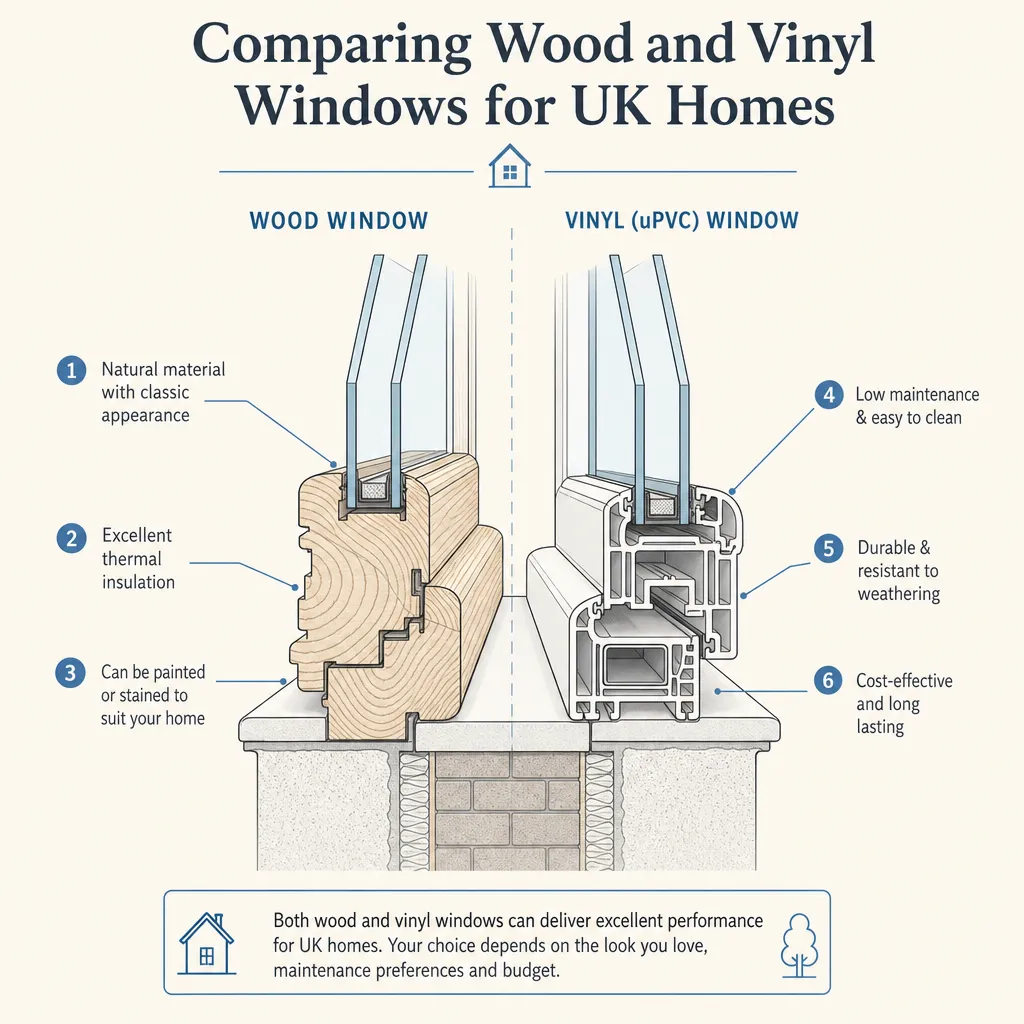
Comparing Wood and Vinyl Windows for UK Homes
Timber windows typically cost more upfront than uPVC but can last twice as long with regular maintenance.
 Improvement & Build
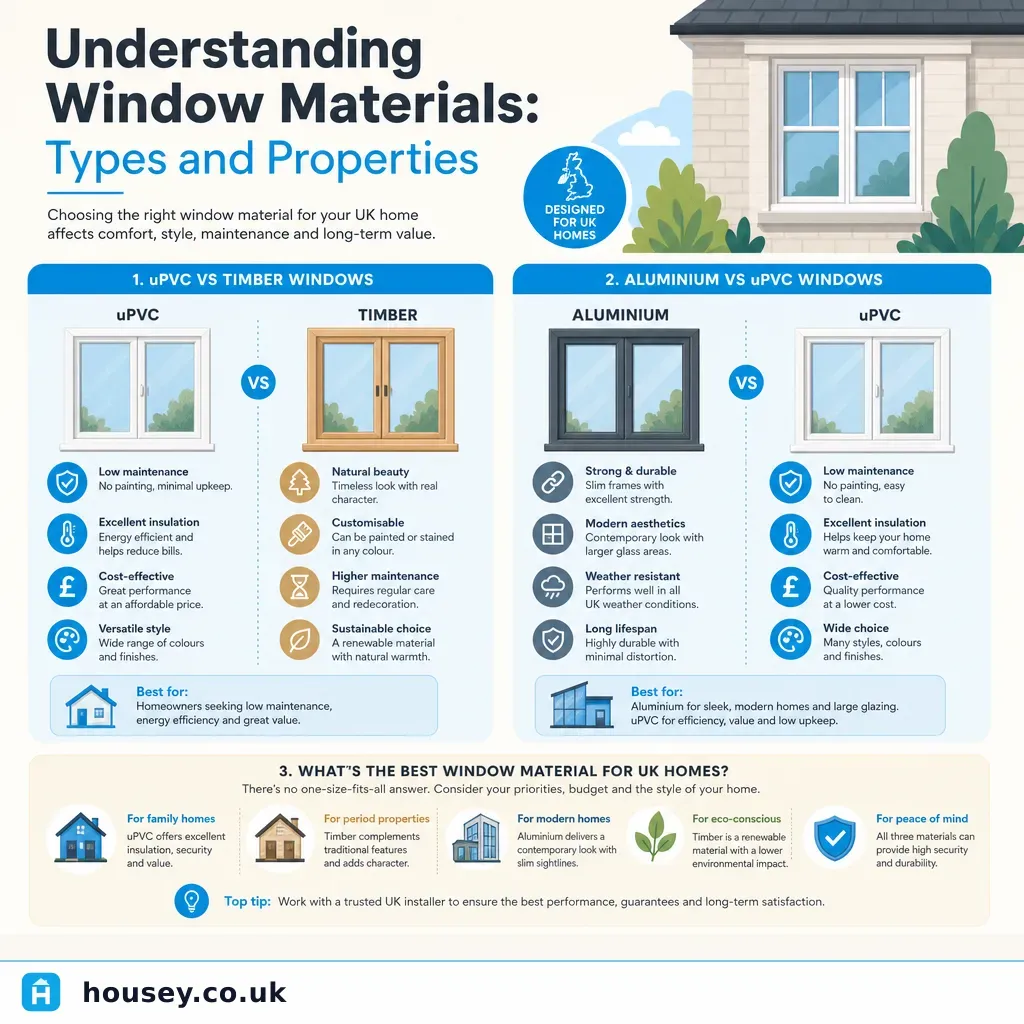
Understanding Window Materials: Types and Properties
uPVC is the most common UK window material, offering low maintenance and adequate thermal performance at a lower cost.
 Improvement & Build
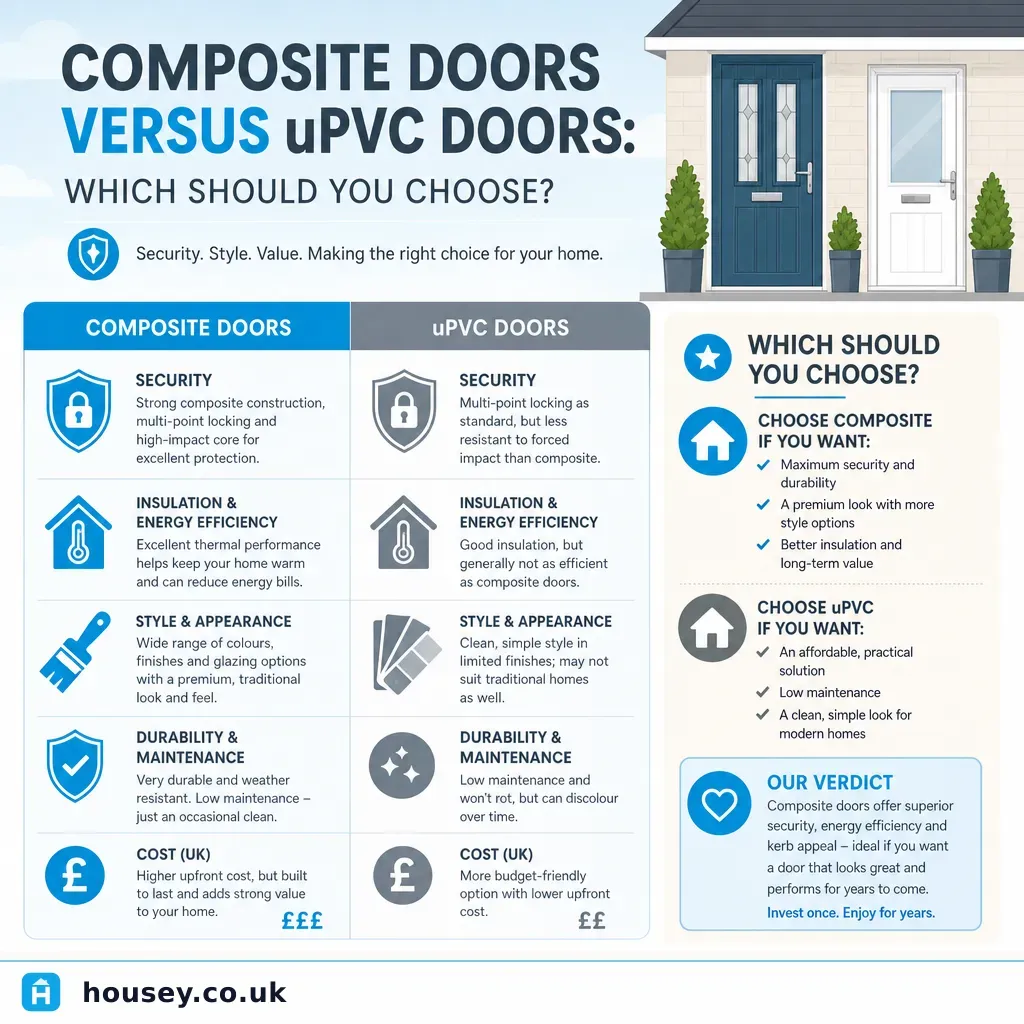
Composite doors versus uPVC doors: which should you choose?
Composite doors have a solid GRP-skinned core, stronger security credentials, and a typical lifespan of 35-plus years, but cost more than uPVC.