Whole-Home Ventilation Systems for Improved Air Circulation and Quality
By Housey · Last reviewed 30th of May 2026
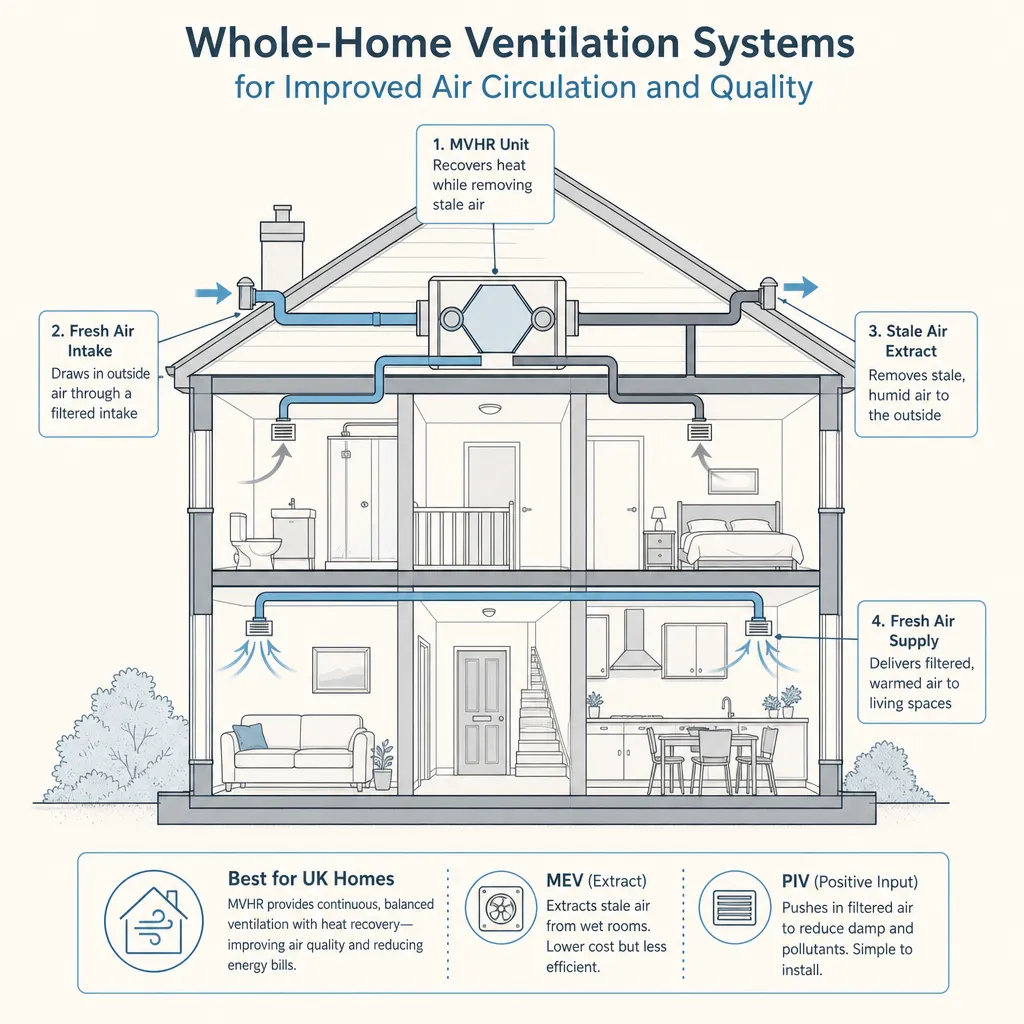
Whole-Home Ventilation Systems for Improved Air Circulation and Quality
Poor indoor air quality, persistent condensation, and inadequate fresh air supply are increasingly common concerns in UK homes — particularly after energy-efficiency upgrades that reduce natural draughts. Choosing and installing the right whole-home ventilation system requires matching the technology to the property's construction, existing heating, and occupancy patterns, and getting the specification wrong can create moisture problems rather than solve them.
Key points
- Building Regulations Approved Document F (Part F) sets minimum ventilation standards for new dwellings and material changes of use in England and Wales.
- Mechanical Ventilation with Heat Recovery (MVHR) is most effective in airtight new-build or highly retrofitted homes; it performs poorly in draughty solid-wall properties.
- Positive Input Ventilation (PIV) is commonly fitted in existing homes to reduce condensation, but should be accompanied by a moisture and airtightness assessment.
- PAS 2035 — the standard governing domestic retrofit — requires a Retrofit Coordinator and ventilation assessment before any ventilation installation that forms part of a funded scheme such as ECO4.
- MVHR units require regular filter maintenance (typically every three to six months) to retain efficiency and indoor air quality benefits.
Types of whole-home ventilation system
There are four main mechanical ventilation strategies used in UK homes:
System | How it works | Best for | Not ideal for | Typical installed cost |
|---|---|---|---|---|
MVHR (Mechanical Ventilation with Heat Recovery) | Balanced supply and extract; recovers up to 90% of exhaust heat | New-build or airtight retrofit homes | Draughty or uninsulated older properties | £3,000–£8,000+ |
MEV (Mechanical Extract Ventilation) | Central extract unit draws stale air from wet rooms; fresh air via background ventilators | Moderately airtight homes | Properties needing heat recovery | £800–£2,500 |
dMEV (Decentralised MEV) | Individual low-rate extract fans in each wet room running continuously | Retrofits where central ducting is impractical | Large open-plan homes needing full fresh-air supply | £600–£2,000 |
PIV (Positive Input Ventilation) | Loft-mounted or wall unit pushes fresh filtered air into the home | Tackling condensation in existing draughty homes | Very airtight homes; may need humidity control | £400–£1,200 |
Indicative UK costs (supply and install), last reviewed 2026-05-30. Costs vary significantly by property size, existing ducting, and installer. Always obtain multiple quotes.
Which ventilation system suits your home?
Use this decision tree as a starting point — a professional ventilation survey should confirm the right specification for your property.
- Choose MVHR if your home is newly built or has been substantially airtightened (air permeability ≤5 m³/h·m² at 50Pa), and you have space for central ducting throughout the property.
- Choose MEV if your home is reasonably airtight, has wet rooms that need extract ventilation, and routing ducting from a central location is practical.
- Choose dMEV if central ducting is not feasible and the home is moderately airtight — individual room fan upgrades are relatively low disruption to existing fabric.
- Choose PIV if your priority is tackling condensation in an existing draughty home, particularly where fitting extract-only systems would be difficult or costly.
- Seek a professional ventilation assessment if your property shows signs of mould, persistent condensation, or unexplained damp; if it has recently been insulated or had windows replaced; or if it is a listed building or has unusual construction such as cob, solid stone, or timber frame.
Building Regulations Part F and what it means for you
Approved Document F of the Building Regulations sets minimum ventilation rates for dwellings in England. It applies when a new dwelling is built or when a material change of use requires building control approval — for example, converting a garage or loft to habitable use.
For existing homes being retrofitted outside of permitted building work, Part F does not automatically apply, but achieving its ventilation rates is considered good practice. When ventilation work forms part of a funded energy-efficiency scheme such as ECO4 or the Great British Insulation Scheme, compliance with PAS 2035 (which includes a ventilation assessment requirement) is mandatory.
Separate regulations apply in Scotland (Section 3 of the Technical Handbooks) and Northern Ireland (Technical Booklet K).
Ventilation and energy efficiency
In an older, draughty home, natural infiltration typically provides more air changes than occupants need — though without control over where or when fresh air enters. As homes become better insulated and draught-proofed, controlled mechanical ventilation becomes necessary to maintain air quality and remove moisture generated by cooking, bathing, and breathing.
MVHR, when properly designed and installed in an airtight home, can recover 75–90% of the heat from extracted stale air and transfer it to incoming fresh air, meaningfully reducing heating demand. A system that is poorly specified — for example, installed in a leaky solid-wall Victorian terrace — may consume more energy than it saves and could cause localised overheating or excessive drying of the air. Energy Saving Trust guidance consistently recommends that ventilation be considered alongside insulation and draught-proofing as part of a coordinated whole-house approach.
Installation and commissioning
A properly installed whole-home ventilation system requires:
- A ventilation design specifying duct routes, grille positions, and target flow rates before any installation begins.
- Installation by a competent person — MVHR installers should hold relevant BPEC or CIBSE-recognised training, and any electrical work must comply with Part P of the Building Regulations.
- Commissioning and balancing: air flow rates at each terminal must be measured and adjusted to match the design specification.
- Handover documentation: a commissioning report, filter replacement schedule, and guidance on how to operate the system.
For systems installed as part of a PAS 2035-governed retrofit, a Retrofit Coordinator must be involved from the assessment stage through to quality assurance sign-off.
Important limitations
The information in this article is general guidance only. Ventilation system performance, suitability, and Building Regulations compliance depend on the specific property — its age, construction type, airtightness, occupancy, and any recent energy-efficiency works. A qualified ventilation engineer or Retrofit Assessor should carry out a property-specific assessment before any whole-home system is specified or installed. Incorrect system selection or installation can worsen damp, condensation, and indoor air quality rather than improve them.
What to ask a qualified professional
Before instructing a ventilation engineer or Retrofit Coordinator, ask:
- What ventilation assessment will be carried out, and will it include an airtightness check or blower door test?
- Which Part F ventilation strategy do you recommend for this property, and why?
- How will the system be designed, commissioned, and balanced to meet the design flow rates?
- What qualifications and accreditations do you hold (for example, BPEC, CIBSE, TrustMark, MCS)?
- If this is part of a retrofit scheme, is a PAS 2035 Retrofit Coordinator involved from the outset?
- What ongoing maintenance does the system require, and how straightforward is it for the homeowner to carry out?
- What happens if condensation or moisture problems are identified during the assessment?
When to get professional help
Always consult a qualified professional if:
- You have visible mould, persistent condensation, or unexplained damp following recent insulation or draught-proofing work.
- You are planning MVHR as part of a retrofit and have not had an airtightness test.
- The property is listed, in a conservation area, or has unusual construction.
- Ventilation work is part of a funded scheme — PAS 2035 compliance is a legal requirement in these cases.
- You are converting a non-habitable space to living accommodation — a ventilation strategy must be submitted to building control.
How Housey can help
Housey can connect you with experienced engineers for a ventilation and condensation assessment, giving you a property-specific ventilation strategy before any installation work begins — helping you choose the right system and avoid the moisture and air quality risks that come with a poorly specified retrofit.
Frequently asked questions
Does MVHR work well in an older UK home?
MVHR is most effective in homes with an air permeability below approximately 5 m³/h·m² at 50Pa. Many older solid-wall or poorly sealed cavity-wall homes are far leakier than this and are not well suited to MVHR without significant airtightness work first. A ventilation assessment and, ideally, a blower door test should be carried out before specifying any system.
Is planning permission needed to install a whole-home ventilation system?
In most cases, no. Ducted ventilation systems installed within the existing building envelope are usually considered permitted development. However, external grilles or units on a listed building, in a conservation area, or on a flat's external wall may require consent. Check with your local planning authority if in doubt.
Does Part F of Building Regulations apply to my home improvement?
Part F applies when a new dwelling is built or when there is a material change of use requiring building control approval. General improvements to existing dwellings typically do not trigger Part F, but if your project requires building control — for example, a garage or loft conversion — a ventilation strategy will need to be submitted.
How often does an MVHR filter need changing?
Most MVHR manufacturers recommend inspecting and replacing filters every three to six months, depending on local air quality and occupancy. Neglecting filters reduces system efficiency and can cause the heat exchanger to clog over time, significantly reducing heat recovery performance and increasing running costs.
Sources and further reading
- Approved Document F — Ventilation — GOV.UK
- PAS 2035: Retrofitting dwellings for improved energy efficiency — BSI
- Ventilation guidance for homes — Energy Saving Trust
- CIBSE: ventilation and indoor air quality guidance — Chartered Institution of Building Services Engineers
- Building Standards Technical Handbook — Domestic (Section 3) — Scottish Government
Useful next reads
 Energy & Retrofit
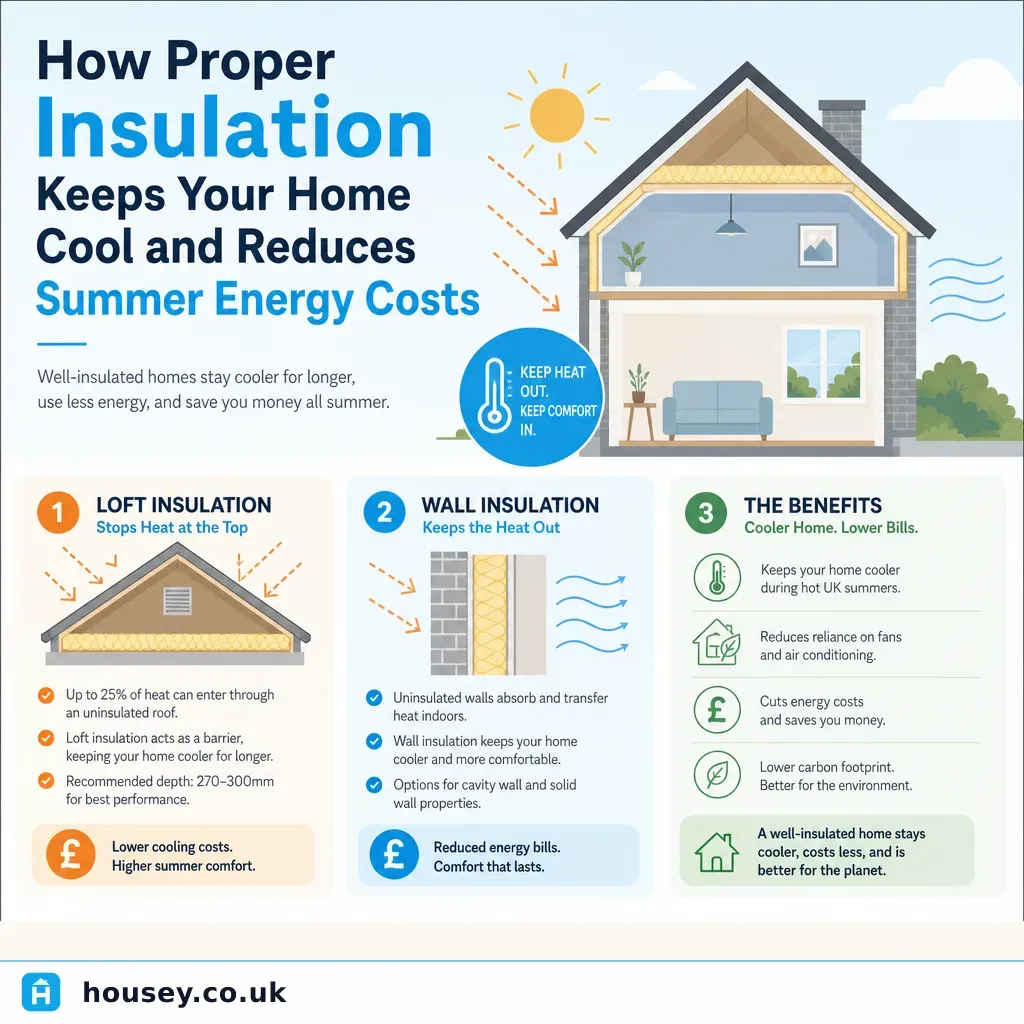
How Proper Insulation Keeps Your Home Cool and Reduces Summer Energy Costs
Insulation slows the flow of heat in both directions — in summer, it reduces how quickly outdoor heat enters your home.
 Energy & Retrofit
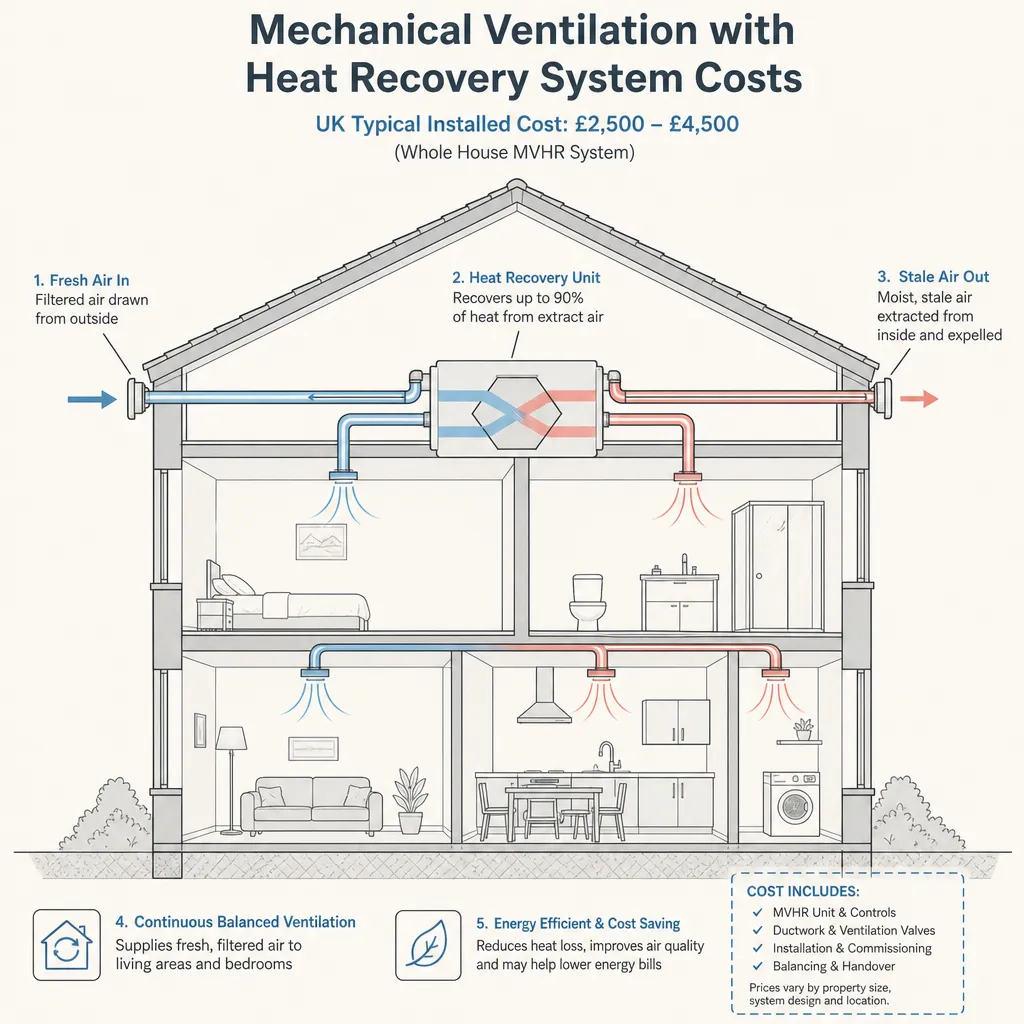
Mechanical Ventilation with Heat Recovery System Costs
A whole-house MVHR system typically costs £3,000–£8,000 supplied and installed in a UK home, rising to £10,000 or more for larger or complex properties.
 Energy & Retrofit
Light-Coloured Roofing: Energy Benefits and Cooling Effectiveness
Light-coloured or reflective roofing reduces the solar heat absorbed by a roof surface, lowering temperatures in the building below during summer.
 Energy & Retrofit
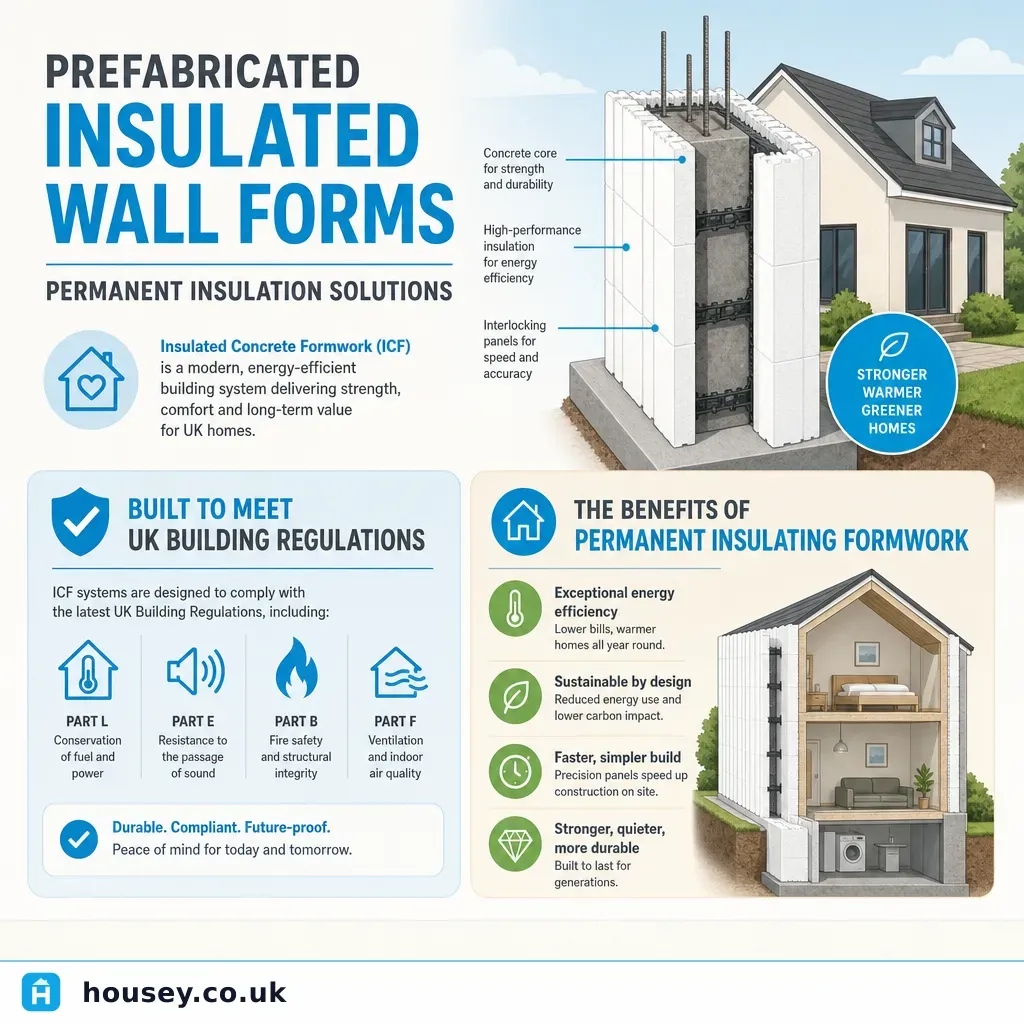
Prefabricated Insulated Wall Forms: Permanent Insulation Solutions
Prefabricated insulated wall forms — including ICF and SIPs systems — deliver high thermal performance by combining permanent insulation with structural concrete or timber in a single wall assembly.
 Energy & Retrofit
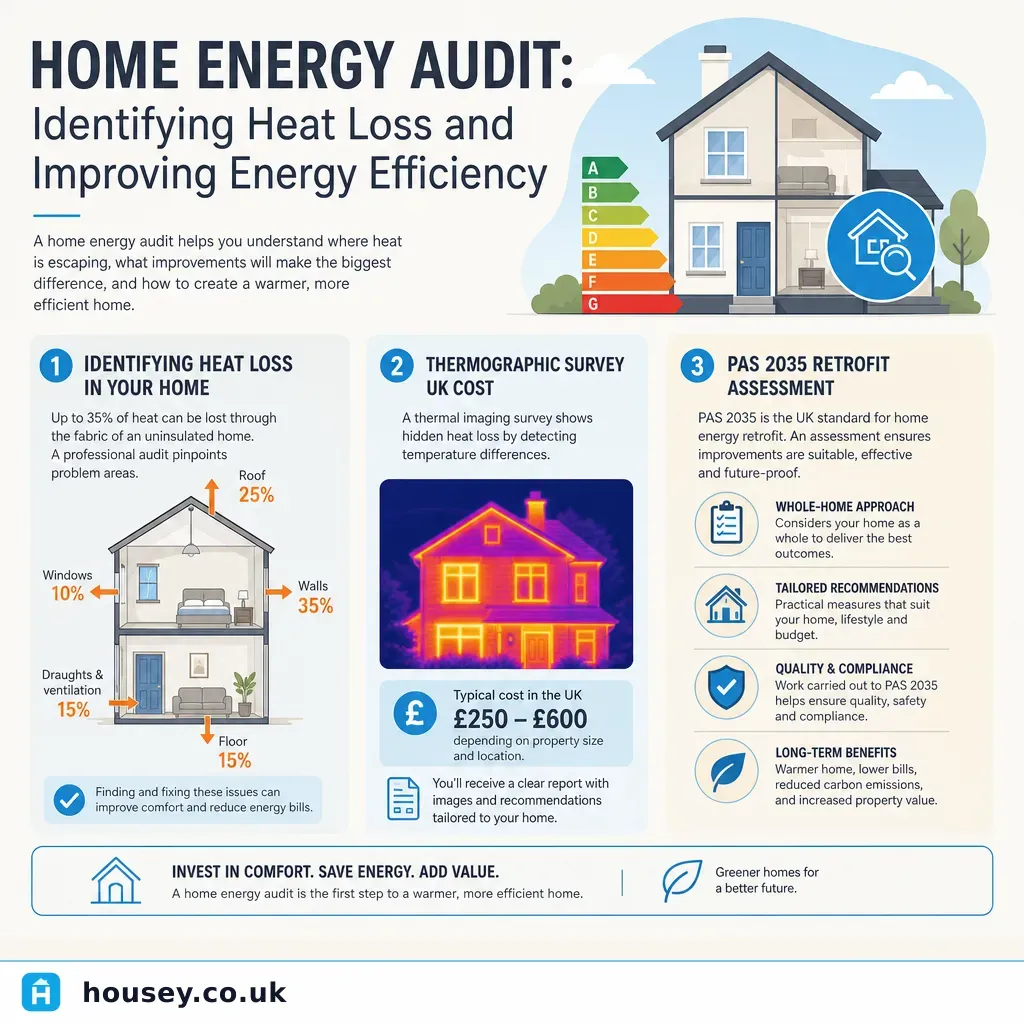
Home Energy Audit: Identifying Heat Loss and Improving Energy Efficiency
A home energy audit is a structured assessment of where your property loses heat and how efficiently it uses energy.