Wind Mitigation Inspection: How to Protect Your UK Home from Storm Damage
By Housey · Last reviewed 19th of May 2026
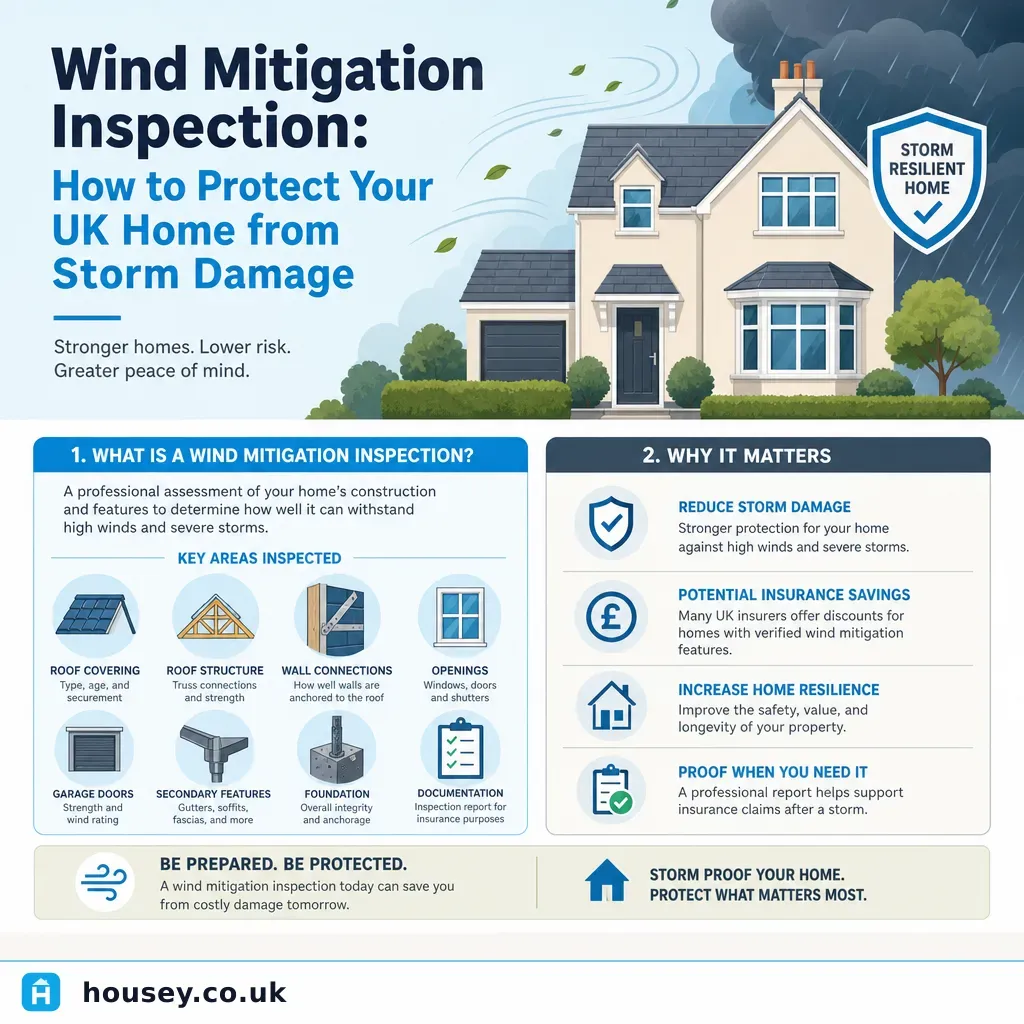
Wind Mitigation Inspection: How to Protect Your UK Home from Storm Damage
The formal 'wind mitigation inspection' is a well-established part of home insurance in some overseas markets — particularly the United States — where it certifies specific structural features that reduce wind damage risk and can qualify a homeowner for reduced premiums. In the UK there is no direct equivalent scheme, but the underlying question it addresses — how resilient is your home to high winds? — is increasingly relevant as Named Storms become more frequent and severe. UK surveyors, structural engineers, and specialist roofers can assess and report on wind vulnerability, and there are practical maintenance steps every homeowner can take to reduce their risk before the storm season begins.
Key points
- There is no formal wind mitigation certificate scheme in the UK; the nearest equivalents are a RICS Level 3 Home Survey and a specialist roof survey, which together assess the structural elements most at risk from wind.
- BS EN 1991-1-4 (Eurocode 1, Part 1-4) is the UK technical standard for wind loading on structures; new builds and significant alterations must comply, but millions of older homes were built to superseded standards.
- The most common causes of residential wind damage in the UK are mortar failure at ridge and hip tiles, lead flashing detachment, and worn tile clips or nibs — all identifiable during a professional roof inspection.
- Building Regulations Approved Document A (Structure) sets minimum wind resistance standards for new and significantly altered residential buildings in England and Wales.
- Simple maintenance — re-pointing vulnerable mortar joints, securing loose flashings, trimming overhanging trees — significantly reduces storm damage risk and is routinely flagged during a RICS Level 2 or Level 3 survey.
What a UK wind resilience assessment looks like
In the US, a wind mitigation inspection certifies specific construction features — roof deck attachment, roof shape, secondary water barrier, opening protection — primarily for insurance premium rating. The UK insurance market does not use this mechanism. For UK homeowners, the practical equivalents are:
Goal | Recommended UK route |
|---|---|
Assess overall structural and roof condition | RICS Level 2 or Level 3 Home Survey |
Detailed roof covering and timber inspection | Specialist roof survey |
Confirm rebuild cost for insurance adequacy | Insurance reinstatement valuation |
Identify specific structural wind-load concerns | Structural engineer's inspection |
Check planning constraints on protective measures | Enquiry to local planning authority |
For most standard UK homes — a 1930s semi-detached, a 1970s estate house, or a modern new-build — a RICS Level 2 survey will identify significant roofing or structural concerns. Older properties (generally pre-1920), exposed coastal or upland locations, or homes with unusual construction warrant a Level 3 survey or targeted structural inspection.
Which UK homes are most vulnerable to wind damage?
Wind vulnerability depends on exposure, construction type, and maintenance history. Higher-risk indicators include:
- Exposed location — coastal, upland, or open moorland settings receive consistently higher wind loading than sheltered urban areas.
- Failed mortar pointing — lime mortar used in pre-1950s ridge and chimney work becomes porous over time; open joints are the leading cause of displaced ridge tiles in UK storms.
- Tall or large chimney stacks — particularly on older properties with unlined or disused flues; these act as wind sails and place lateral load on surrounding masonry.
- Shallow roof pitch — roofs below approximately 17.5 degrees are more vulnerable to wind uplift where tiles rely on gravity rather than mechanical fixings.
- Overhanging trees — branches close to the property present direct impact risk; roots can also affect foundation stability.
- Exposed single-leaf gable ends — on older properties, these can be susceptible to wind-driven rain penetration and suction effects in extreme events.
What a professional storm resilience survey examines
When a UK surveyor or structural engineer assesses a property for wind resilience, they typically examine:
Roof structure and covering
- Condition and security of ridge, hip, and valley tiles, including mortar integrity and mechanical fixings
- State of lead, felt, or EPDM flashings at chimney abutments, rooflights, and parapet walls
- Whether tile clips or nibs are intact and capable of resisting uplift
- Sarking or underlay condition beneath the outer covering
- Roof timber condition, visually where accessible from the loft
External envelope and site
- Chimney stack pointing, flaunching condition, and pot security
- Pointing and wall tie condition in exposed masonry elevations
- Tree proximity, crown condition, and any existing Tree Preservation Orders
- Condition of outbuildings and boundary walls that could cause secondary damage
Homeowner storm resilience checklist
These tasks are best carried out in late summer, before the main UK storm season:
Important limitations
This article provides general guidance for UK homeowners and does not constitute structural, legal, or insurance advice. The UK has no formalised wind mitigation certification scheme. Building performance in high winds depends on many property-specific factors — construction type, age, condition, local topography, and previous alterations — that only a qualified professional can reliably assess. Always instruct a RICS-registered surveyor or chartered structural engineer for a formal inspection and report.
What to ask a qualified professional
Before instructing a surveyor or structural engineer to assess your property's storm resilience, ask:
- What type of survey do you recommend for my property's age and construction, and why?
- Will the report specifically address ridge and hip tile condition, flashing integrity, and roof structure?
- If you identify a concern, will you recommend a roofer, a structural engineer, or both?
- Will chimney stack stability be assessed as part of the inspection?
- What are the limitations of a visual inspection, and when would you recommend a more intrusive investigation?
- Are you a RICS member, and does your professional indemnity insurance cover structural assessments?
- Is VAT included in your fee quote?
When to get professional help
Commission a professional inspection if:
- Your property has not been surveyed in the past 10 years and is in an exposed coastal, upland, or rural location.
- You have experienced a Named Storm or gusts recorded above 60 mph in your area.
- You can see displaced ridge tiles, open mortar joints, or detached flashings from ground level.
- Your home is listed or in a conservation area, where planning consent may be needed for some repair or protective works.
- You are purchasing a property and want to understand its storm exposure before exchange of contracts.
- Your insurer has queried your sum-insured or asked for details of your property's construction.
How Housey can help
Housey connects UK homeowners with vetted professionals who can assess storm resilience and advise on reinstatement costs. A structural survey from a RICS-registered surveyor provides a thorough assessment of wind-vulnerable elements across the structure. A dedicated roof survey focuses specifically on covering condition, flashing integrity, and tile security. For homeowners wanting to confirm their sum-insured reflects current rebuild costs, our professionals also carry out insurance valuations.
Frequently asked questions
Is there a UK equivalent of a wind mitigation inspection certificate?
No. The UK insurance market does not use wind mitigation certificates as a premium-rating tool. The nearest UK equivalents are a RICS Level 3 Home Survey or a targeted structural inspection, documenting the condition of wind-vulnerable elements. UK home insurers typically assess wind risk through construction type, age, location, and claims history rather than a standardised inspection certificate.
Can improving storm resilience reduce my home insurance premium in the UK?
Potentially, but there is no standardised wind mitigation discount mechanism in the UK market. Demonstrating good maintenance, ensuring your sum-insured is accurate, and having a professional survey on file can positively influence your insurer's risk assessment at renewal. Discuss specific measures with your broker or insurer, particularly if your property is in a high-wind exposure zone.
Do Building Regulations require UK homes to resist wind loading?
Yes. Building Regulations Approved Document A (Structure) requires buildings to withstand wind loads, referencing BS EN 1991-1-4 (Eurocode 1). These requirements apply to new builds and significant alterations. Millions of existing UK homes were built to superseded standards and may not meet current wind loading benchmarks — a relevant consideration for older properties in exposed locations.
How much does a structural survey or roof inspection cost for storm resilience purposes?
A RICS Level 3 Home Survey on a typical three-bedroom UK property typically costs £600–£1,500 depending on size and location. A standalone roof inspection by a specialist roofer may cost £150–£400. Indicative UK costs, last reviewed 2026-05-19. Costs vary by complexity, location, and credentials. Always request itemised quotes confirming whether VAT is included.
Sources and further reading
- Approved Document A — Structure — GOV.UK
- BS EN 1991-1-4 Wind Actions on Structures — British Standards Institution
- UK Storm Centre — Met Office
- RICS Home Survey Standard — Royal Institution of Chartered Surveyors
- National Federation of Roofing Contractors — NFRC
Useful next reads
 Surveys & Inspections
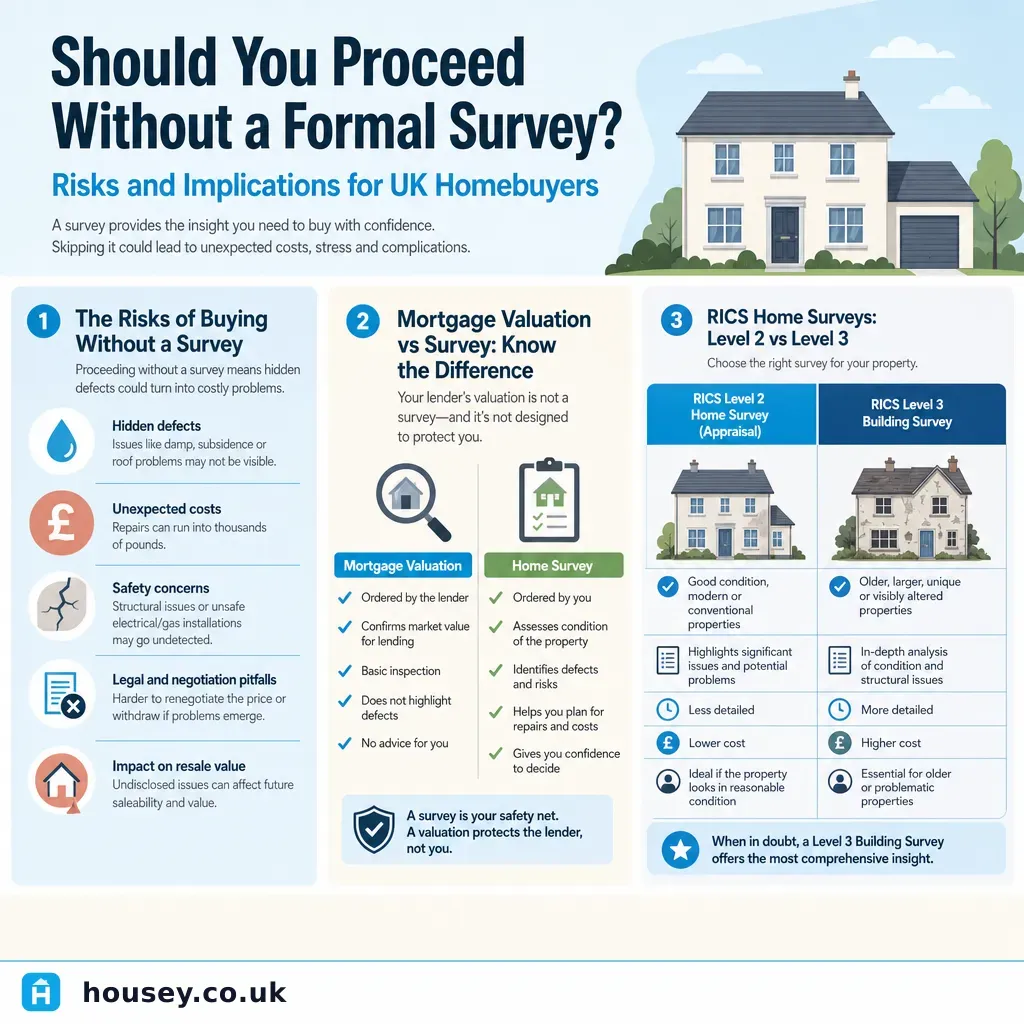
Should You Proceed Without a Formal Survey? Risks and Implications
In England and Wales there is no legal requirement to obtain a survey before exchange, but caveat emptor means any undisclosed defects become your problem the moment contracts are exchanged.
 Surveys & Inspections
How Professional Home Surveys Deliver Real Value For Buyers
A professional home survey by a RICS-registered surveyor can identify defects, legal compliance gaps, and cost liabilities before exchange of contracts, giving buyers an evidence base for negotiation or withdrawal.
 Surveys & Inspections
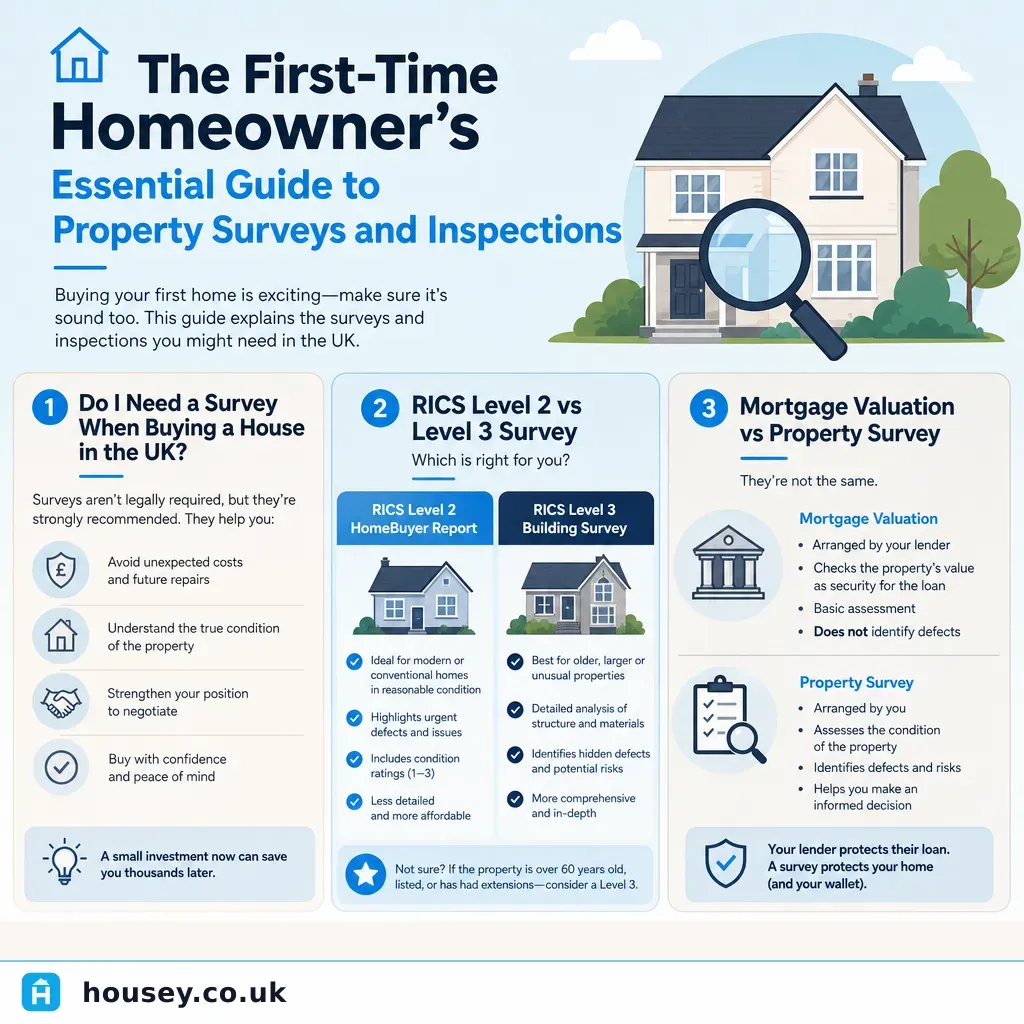
The First-Time Homeowner's Essential Guide to Property Surveys and Inspections
First-time buyers in the UK need more than the mortgage valuation — that report protects the lender, not you.
 Surveys & Inspections
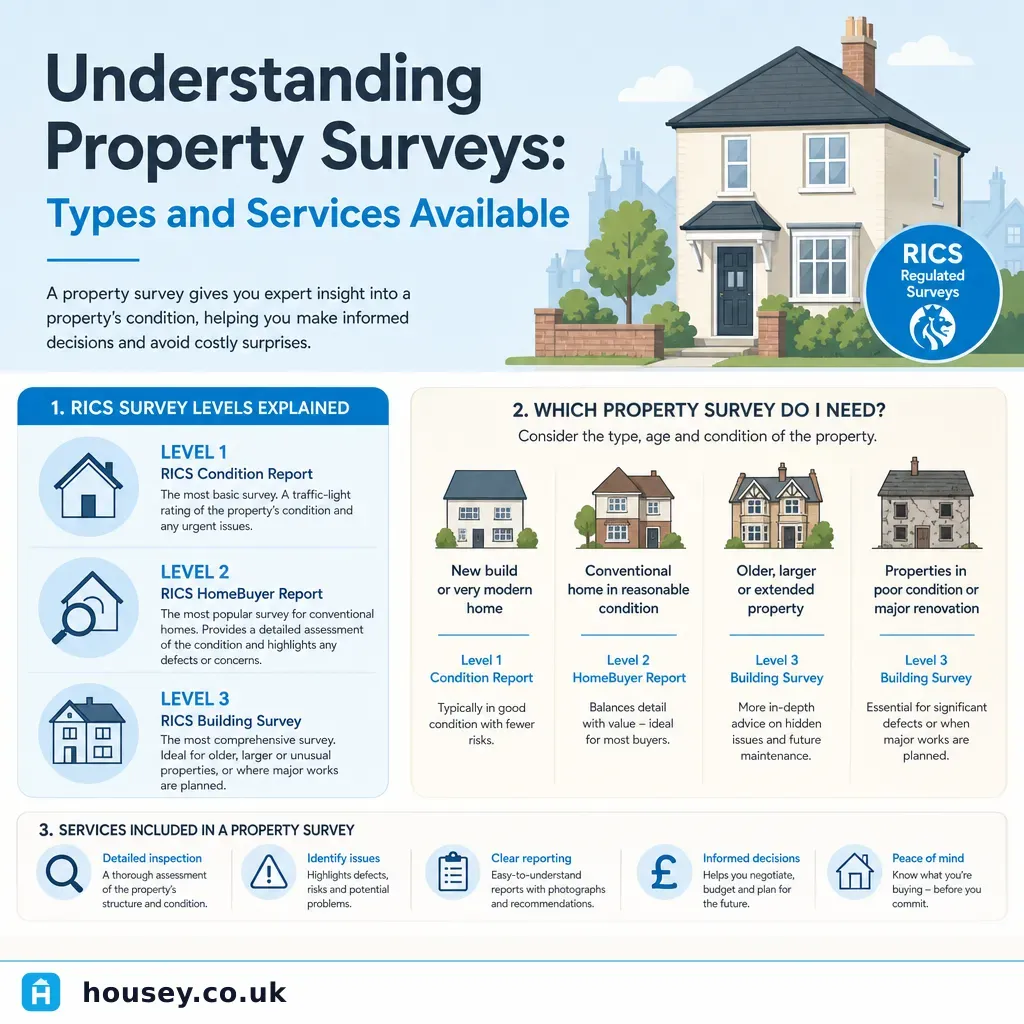
Understanding Property Surveys: Types and Services Available
UK property surveys follow three RICS-defined levels: Level 1 (Condition Report), Level 2 (Home Survey), and Level 3 (Building Survey).
 Surveys & Inspections
Getting a Valuation Survey Before Selling Your Property
Before selling, a free estate agent appraisal gives a market price guide, but only a RICS Red Book valuation carries formal professional standards and legal weight.