Window Replacement Process: What to Expect During Installation
By Housey · Last reviewed 31st of May 2026
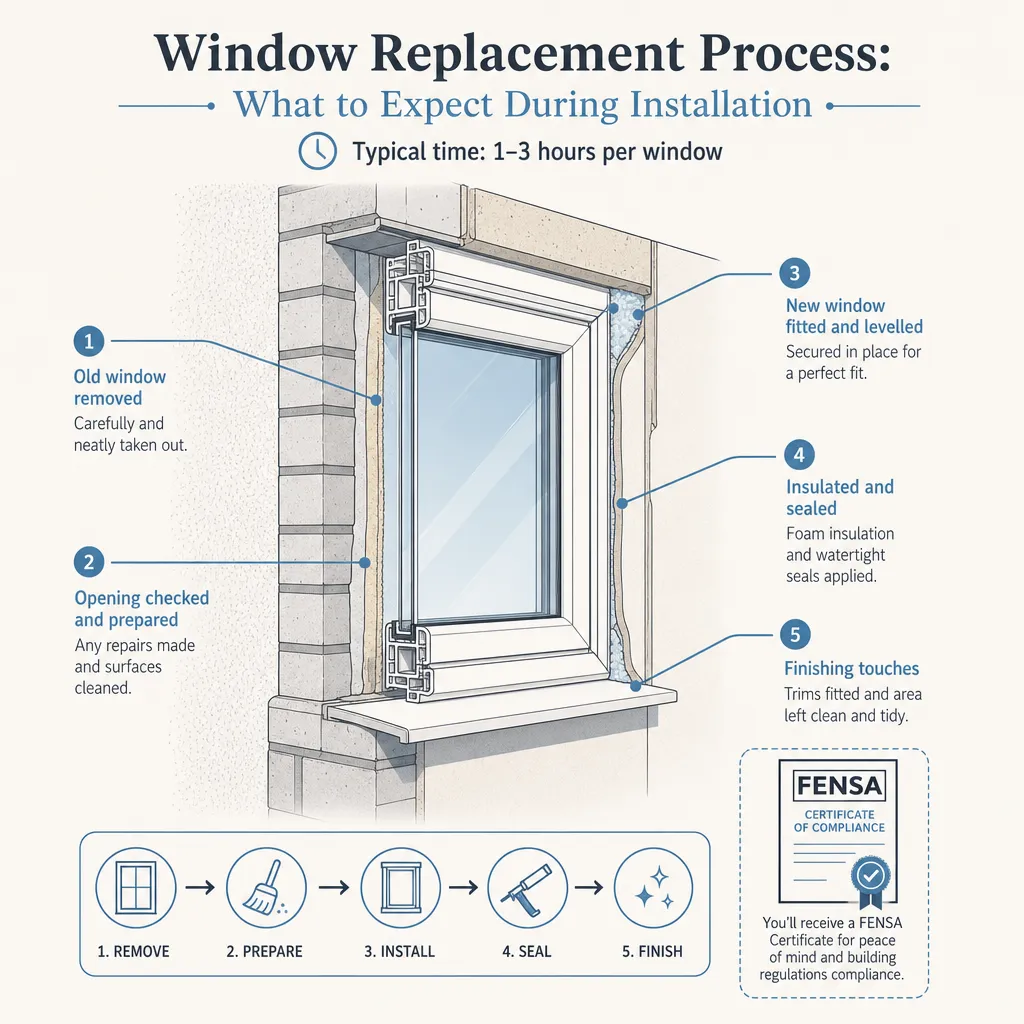
Window Replacement Process: What to Expect During Installation
Window replacement is among the most common home improvement projects carried out each year across the UK, covering everything from single-window upgrades in Victorian terraces to whole-house re-glazing on 1970s and 1980s estates. Despite being a routine process, installation day can feel disruptive if you are unprepared — and the compliance paperwork matters more than many homeowners realise when they come to sell the property years later.
Key points
- Window replacement in England and Wales must be notified under Building Regulations Part L (thermal performance); most installers self-certify compliance through FENSA or CERTASS, which is legally equivalent to local authority building control approval.
- A standard UK home with 6–10 windows typically takes one to two days; bay, bow, or sash windows and upper-floor access requirements may add a day.
- On completion, the installer must issue a FENSA or CERTASS certificate within 30 days — solicitors will require this document when you sell, and its absence can delay exchange.
- Replacement windows must achieve a whole-window U-value of ≤1.4 W/m²K under Approved Document L (2022 edition); ask for this to be confirmed in writing before ordering.
- Conservation areas and listed buildings may require planning permission even for like-for-like window replacement — check with your local planning authority before ordering or starting work.
What happens on installation day?
A professional window installation follows a clear, staged sequence. Understanding each step helps you prepare the house and know what to check before the crew leaves.
Stage 1: Site preparation (first 30–60 minutes)
The crew arrives and lays dust sheets inside each room where windows will be replaced. Furniture near the windows is moved back — ideally you will have cleared a working zone the evening before. For upper-floor windows, a scaffold tower or access platform is set up externally. Before starting, the installer should check the windows on the van against your specification sheet.
Stage 2: Removing existing frames
Old frames are cut free and prised out — typically one window at a time to minimise draught exposure across the property. In older homes such as Victorian terraces or 1930s semis, this stage can reveal problems: rotten lintels, damp reveals, crumbling mortar, or cracking around the opening. Agree in advance what the installer's process is if a defect is found — you want a clear protocol, not a silent patch and proceed.
Stage 3: Fitting the new frame
The new frame is offered into the opening and checked for plumb, level, and square using packers. It is then fixed to the masonry with frame fixings or strap anchors appropriate to the wall construction type. PVC-U frames require expansion gaps to accommodate thermal movement; these are accounted for in the frame sizing at the manufacturing stage.
Stage 4: Sealing and weatherproofing
A foam backing rod and UV-stable silicone mastic are applied around the external frame perimeter. Internal reveals are finished with decoration-grade mastic or render, depending on specification. The quality of this seal is critical for long-term draught-proofing and water resistance — inspect all joints before the crew leaves to confirm they are continuous with no gaps or voids.
Stage 5: Hardware and final checks
Handles, hinges, friction stays, trickle vents, and child safety restrictors are fitted and adjusted. The installer should demonstrate opening and closing of every sash, confirm that locks engage on all modes, and show you how to release child restrictors. Check that obscure glazing has been installed in bathrooms and toilets, and that trickle vent positions comply with ventilation requirements under Approved Document F.
Compliance and certification: what you should receive
Building Regulations require compliance to be demonstrated for replacement windows in England and Wales. There are three standard routes:
Route | How it works | Document you receive |
|---|---|---|
FENSA self-certification | FENSA-registered installer self-certifies compliance and notifies FENSA | FENSA certificate issued within 30 days |
CERTASS self-certification | CERTASS-registered installer self-certifies and notifies CERTASS | CERTASS certificate issued within 30 days |
Local authority building control | Homeowner or installer applies for a building notice; LA inspects the work | Completion certificate from local authority |
Keep your certificate with your property documents. If you cannot produce it when selling, buyers' solicitors will request retrospective building regulations approval or indemnity insurance — both of which take time and can cost money.
Installation day homeowner checklist
Prepare your home before the installers arrive to reduce delays and protect your belongings:
What to ask your installer before work starts
Use these questions when briefing the installation crew on the day or during a pre-installation site visit:
- Are you registered with FENSA or CERTASS, and will the certificate be issued within 30 days of completion?
- What is the whole-window U-value of the glazing units specified, and does this meet Part L 2022 requirements (≤1.4 W/m²K)?
- What is your process if a structural defect, rotten lintel, or significant damp is found when the old frame is removed?
- What silicone sealant are you using externally, and is it UV-stable and compatible with the surrounding finish?
- Are trickle vents included and positioned to meet the background ventilation requirements of Approved Document F?
- Will you remove all old frames, packaging, and offcuts, or is waste disposal my responsibility?
- What are the separate warranty periods for the frame, glazing unit, and hardware, and are they transferable on property sale?
When to get professional help
Window replacement is straightforward in most cases, but pause the project and seek specialist advice if:
- Structural cracking or a damaged or absent lintel is found when an old frame is removed.
- Significant damp, mould, or cavity wall debris is visible in the opening reveal.
- The property is listed or in a conservation area and you have not confirmed planning requirements with your local planning authority.
- The installer cannot provide evidence of FENSA, CERTASS, or equivalent competent person scheme registration.
- You are replacing windows in a habitable room without trickle vents, where background ventilation is required under Part F of the Building Regulations.
How Housey can help
Housey connects homeowners with vetted window and door installers registered with recognised competent person schemes. Installers on the Housey platform provide fully compliant installations with the correct FENSA or CERTASS certification. Request quotes through Housey to compare registered professionals in your area and check credentials before committing.
Frequently asked questions
How long does window replacement take in a UK home?
For a standard UK semi-detached or terraced house with 6–10 windows, most replacements take one to two days. Larger properties, complex window types such as bay, bow, or sash windows, or installations requiring scaffolding may take two to three days. Your installer should give a realistic timeline when scheduling, not just on arrival.
Do I need to be at home during window installation?
Most installers require a responsible adult to be present throughout the installation to provide access, approve any unexpected decisions — such as a defect found behind an old frame — and sign off the completed work. The property will have open apertures during work and cannot be left unsecured while frames are being changed.
What is a FENSA certificate and why does it matter?
A FENSA certificate confirms that replacement windows comply with Part L of the Building Regulations and have been properly notified. It is required as part of the property information pack when you sell. Without it, buyers' solicitors typically request retrospective building regulations approval or indemnity insurance, which can delay or complicate a sale.
Can I replace windows myself without FENSA or CERTASS?
You can replace windows yourself, but you cannot self-certify Building Regulations compliance unless registered with a competent person scheme. A homeowner completing a DIY replacement must apply for building regulations approval via the local authority and arrange an inspection. For most homeowners, using a registered installer is simpler and produces the correct compliance certificate automatically.
Sources and further reading
- Approved Document L (2022) — GOV.UK; U-value requirements for replacement windows in existing dwellings
- FENSA — Fenestration Self-Assessment Scheme; competent person certification for glazing
- CERTASS — alternative glazing competent person scheme
- Planning Portal: listed buildings and conservation areas — planning permission context for window alterations
Useful next reads
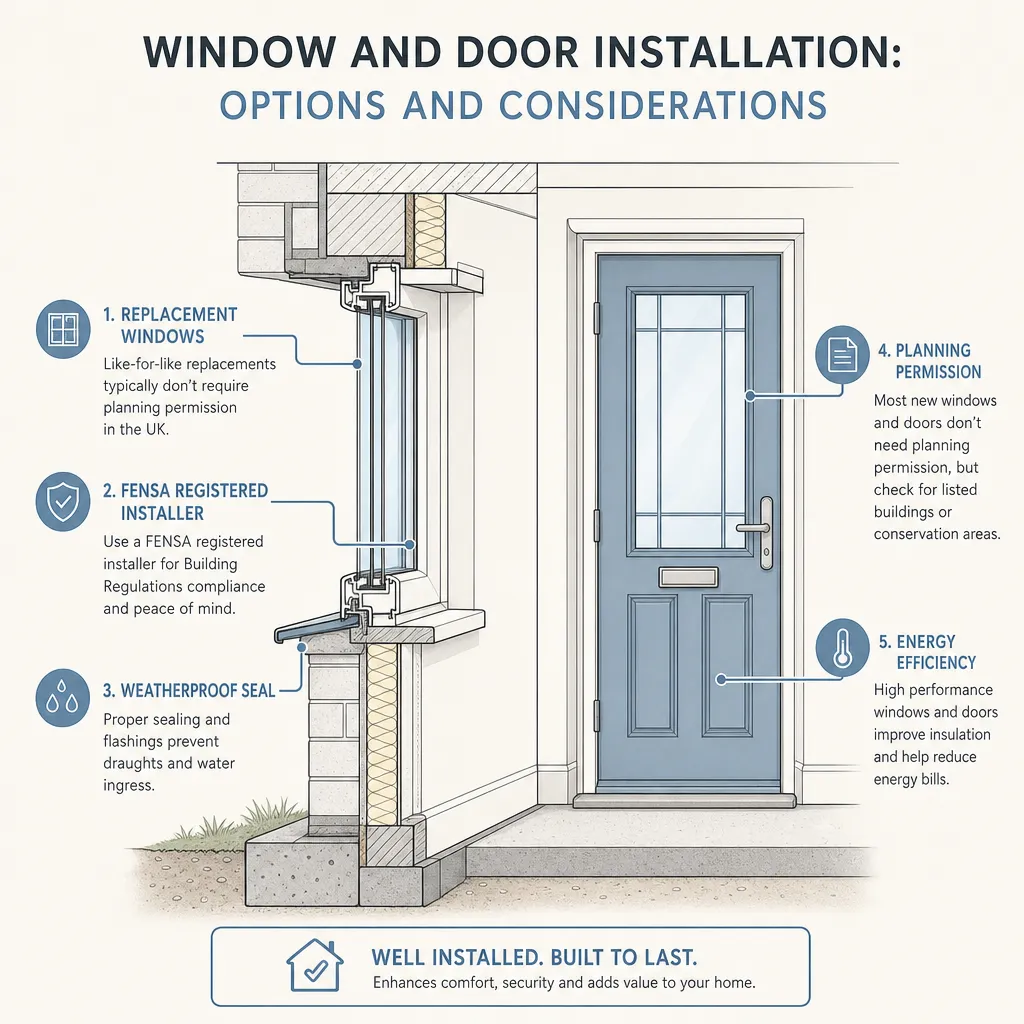 Improvement & Build
Window and Door Installation: Options and Considerations
Replacing windows and external doors in the UK requires compliance with Building Regulations Part L (thermal performance) and Part K (safety glazing).
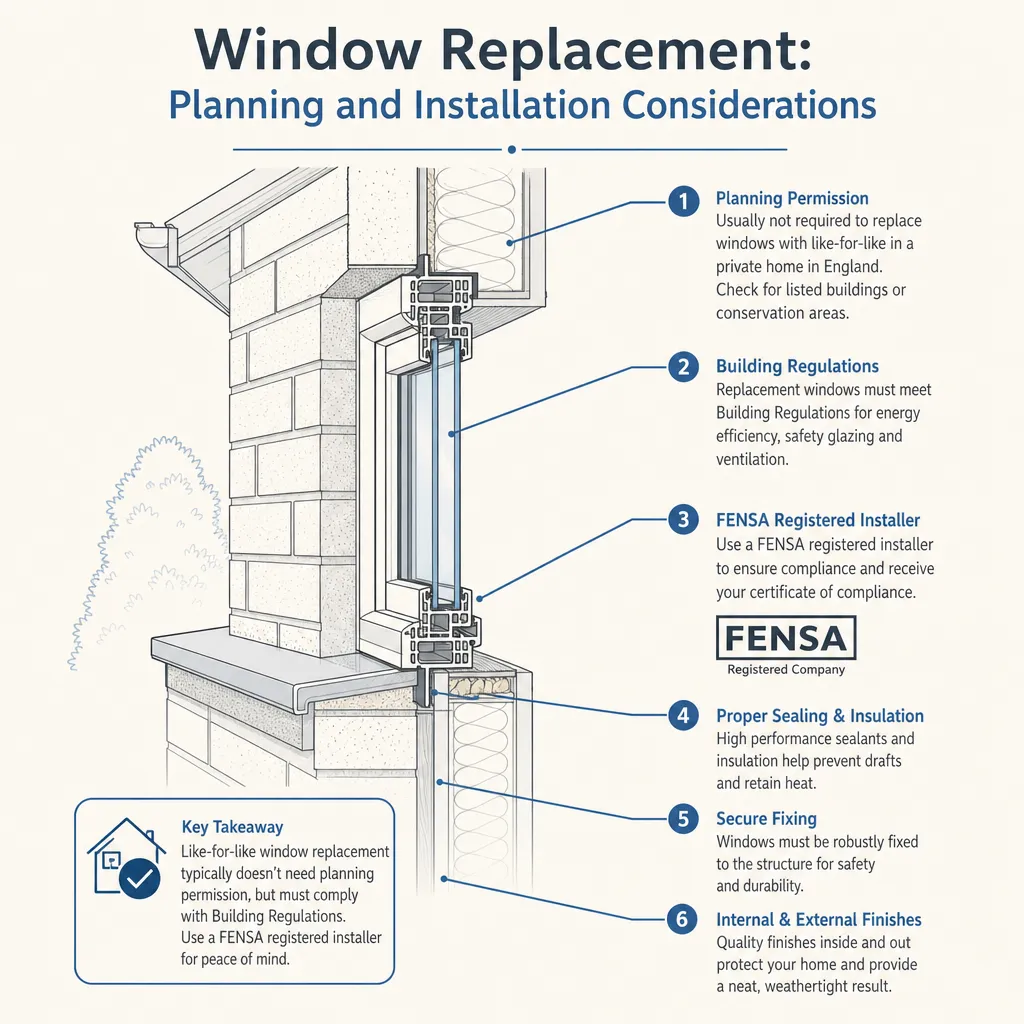 Improvement & Build
Window Replacement: Planning and Installation Considerations
Most window replacements in England fall under permitted development and do not need planning permission, though listed buildings, flats, and conservation areas are exceptions.
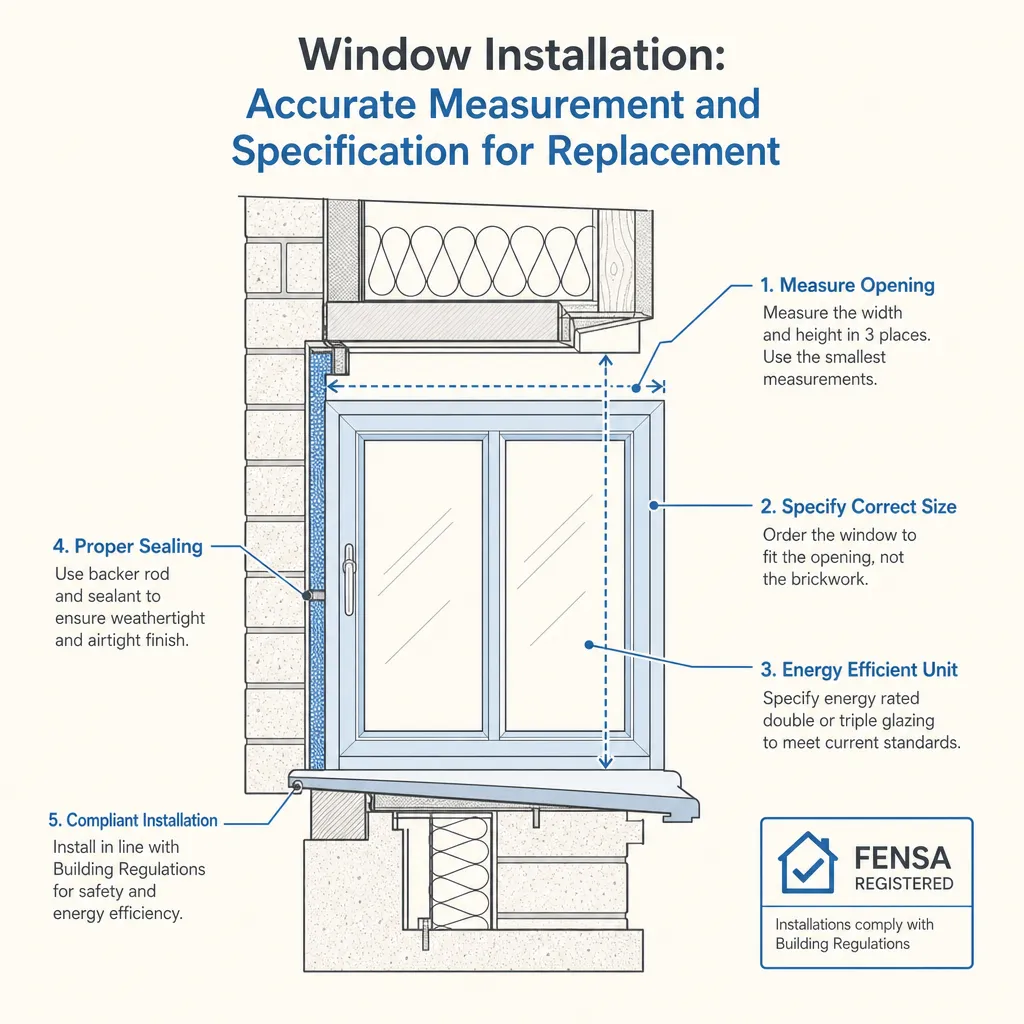 Improvement & Build
Window Installation: Accurate Measurement and Specification for Replacement
Accurate window measurement for replacement means recording the width and height of the existing frame opening in at least three places, noting the smallest dimension, and providing a full specification to your installer — including frame material, glazing type, opening style, and trickle ventilators.
 Improvement & Build
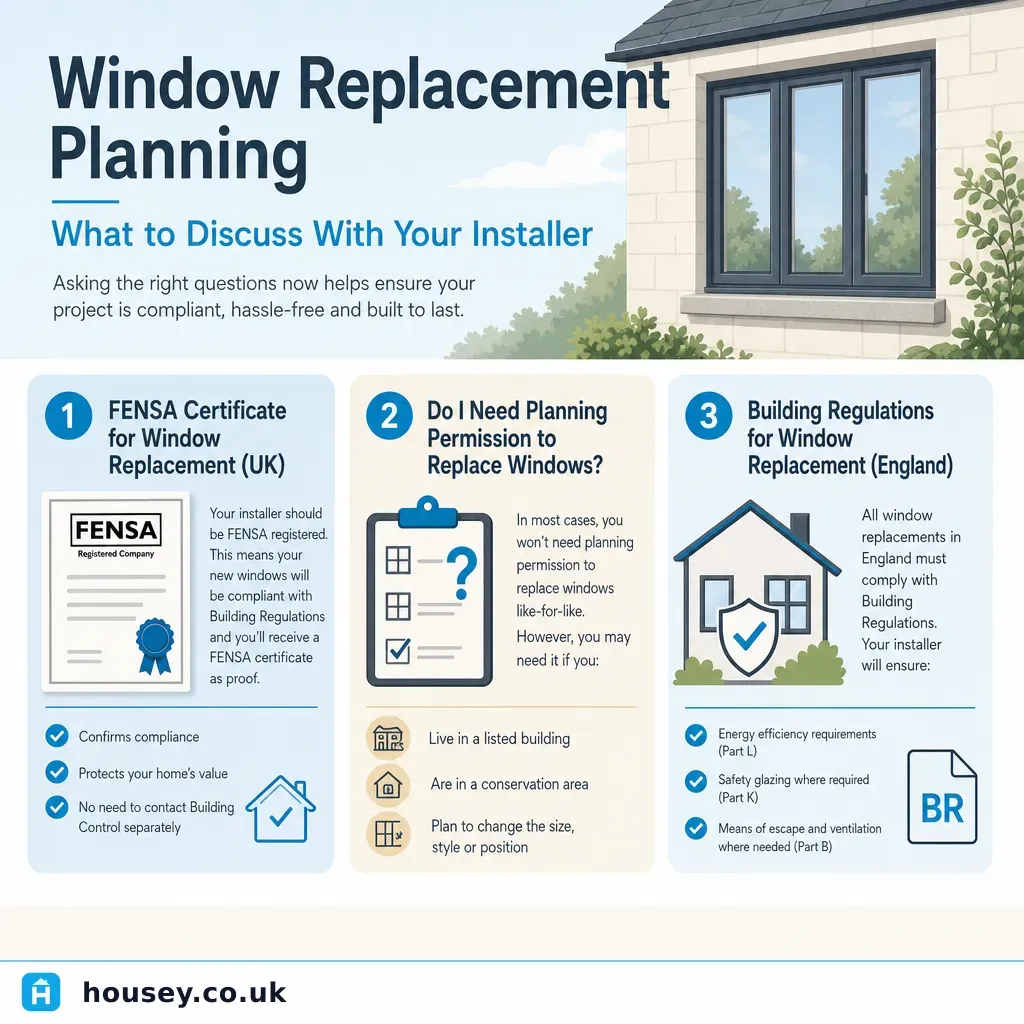
Window Replacement Planning: What to Discuss With Your Installer
Most window replacements in England fall under permitted development rights and do not require planning permission, but they must comply with Building Regulations Part L and Part K.
 Improvement & Build
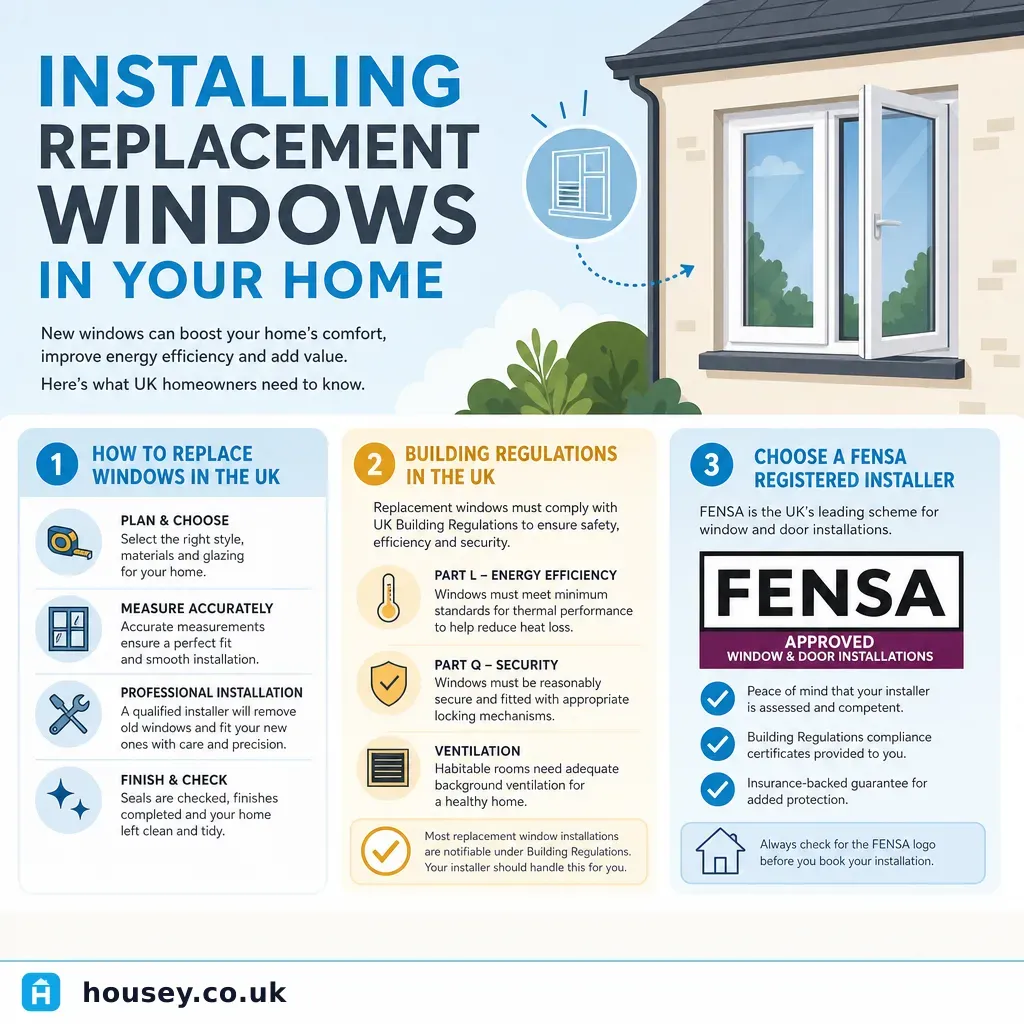
Installing Replacement Windows in Your Home
Replacing windows in the UK requires compliance with Building Regulations Part L — a minimum centre-pane U-value of 1.