Window Locking Mechanisms: Types and Security Features
By Housey · Last reviewed 11th of May 2026
Window Locking Mechanisms: Types and Security Features
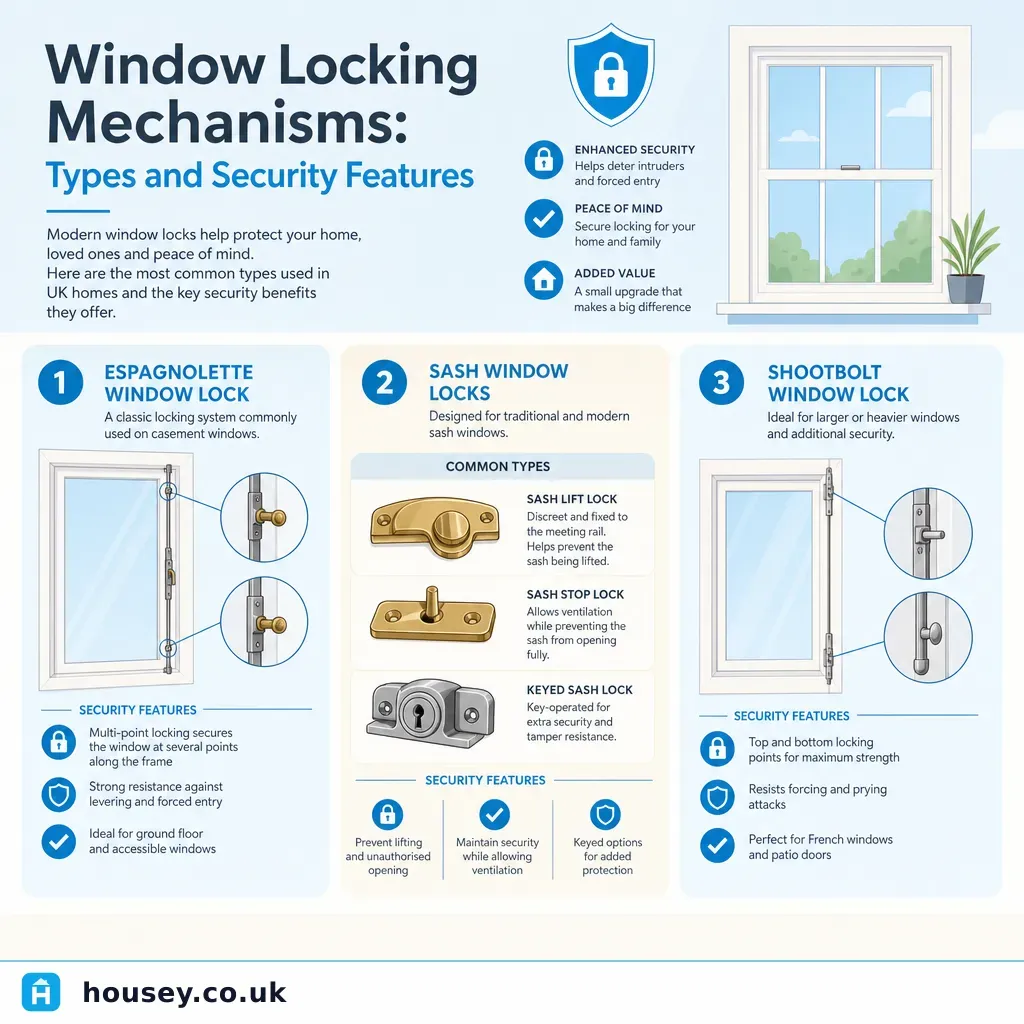
Window security is often overlooked in favour of door locks, yet windows are a common point of entry for opportunistic burglars — particularly at ground and first-floor level. Whether you are specifying new windows, upgrading older frames, or responding to insurer requirements, understanding the different locking mechanisms available helps you choose hardware that genuinely deters entry. The right lock also depends on the window style: the mechanism suited to a casement differs entirely from one designed for a sash.
Key points
- British Standard BS 7950:1997 defines minimum security requirements for enhanced window security in timber windows; PAS 24:2022 covers enhanced security for doors and windows more broadly and is the standard referenced in Building Regulations Part Q for new residential buildings.
- Shootbolt locks — which drive steel bolts into the frame head and sill at multiple points when the handle is operated — are considered more secure than simple espagnolette bolts with limited locking engagement.
- Key-operated window locks are a common home insurance requirement; many policies specify that ground-floor and accessible first-floor windows must have key-operated locks as a condition of cover.
- The Secured by Design (SBD) scheme, operated by the police, accredits window products meeting specific attack-resistance criteria; specifying SBD-accredited windows is standard in social housing and increasingly required by local planning authorities for new residential development.
- Building Regulations require window restrictors limiting opening to 100 mm in dwellings where the sill height is below 800 mm from the floor and the external drop exceeds 600 mm — a fall-prevention requirement that is separate from, but compatible with, security locking hardware.
Espagnolette bolts
An espagnolette bolt is a multi-point locking bar driven by a single handle, typically found on casement windows. Turning the handle drives steel bolts into the frame at the top and bottom of the casement and, in some designs, a central bolt engages a keeper on the frame head. Higher-specification versions add further locking points and are described as multi-point espagnolette locks.
Entry-level espagnolettes may offer only two locking points with a lever mechanism; better units incorporate a key-operated deadlock so the window cannot be opened from outside even if a pane is broken.
Shootbolt locks
Shootbolt locks extend steel rods — typically 10–16 mm in diameter — into receivers set into the frame head and sill when the handle is operated. The rods engage deeply (commonly 10–15 mm) into the frame, making lever or crowbar attack significantly harder than with simple surface bolts. Most modern casement and tilt-and-turn windows use a form of shootbolt mechanism as part of their standard hardware.
For enhanced security, look for:
- A minimum of two shoot-bolt points (top and bottom of the frame)
- Key-operated locking of the handle
- Anti-snap or anti-drill features in the lock cylinder
Sash window locks
Traditional sash windows use several different mechanisms:
Fitch catch (crescent lock): A pivoting crescent-shaped cam that pulls the upper and lower sash together at the meeting rail. Fitch catches are original to many Victorian windows but offer minimal security alone — they can be defeated by vibrating the sash or by passing a thin instrument through the frame gap.
Sash stops: Metal bolts that screw into the upper sash and bear against the lower sash frame, preventing the sashes from sliding more than a ventilation gap. Available in key-operated and non-locking versions.
Sash locks: A more substantial version of the fitch catch, incorporating a key-operated deadbolt alongside the cam to lock both sashes together. These are the minimum recommended level for ground-floor sash windows.
Dual screws / sash bolts: Threaded screws driven through both sashes at the meeting rail — a traditional and effective low-cost solution, though requiring a key or coin to remove.
Tilt-and-turn and pivot window locks
Tilt-and-turn windows use a single handle that moves through several positions — tilt, turn, and locked. Security is largely determined by the quality of multi-point locking hardware embedded in the frame perimeter and whether the handle incorporates a key-operated cylinder. For security-critical applications, specify a key-lockable handle with perimeter shootbolts.
Window stays and restrictors
A casement stay holds a casement open at a fixed position. Modern pin stays often include a lockable pin to prevent the casement being closed and reopened from outside without a key.
Window restrictors limit opening to a safe ventilation gap (typically 100 mm) and, when key-operated, also provide a security function. Under Building Regulations, restrictors are required where sill heights fall below 800 mm from the floor and the external drop exceeds 600 mm — a fall-prevention measure particularly relevant for children in upstairs rooms.
Lock specification by window type
Window type | Typical mechanism | Minimum recommended for security | Key notes |
|---|---|---|---|
Casement (uPVC/aluminium) | Espagnolette or shootbolt | Key-operated multi-point shootbolt | Specify PAS 24 or BS 7950-compliant hardware |
Casement (timber) | Surface or mortice bolt | Mortice deadbolt + key-operated espagnolette | Older frames may need reinforcement |
Sash (timber) | Fitch catch | Dual screws + key-operated sash lock at meeting rail | Fitch catch alone is insufficient |
Tilt-and-turn | Multi-point handle lock | Key-operated handle with perimeter shootbolts | Confirm handle cylinder is key-lockable |
Roof window | Proprietary mechanism | Key-locking handle; consider restrictor | Lower risk unless window is accessible from outside |
Homeowner security checklist
Use this checklist when reviewing window security in your home:
What to ask when specifying or replacing window locks
- Does this lock or window package meet BS 7950 or PAS 24? Can you provide documentation?
- Is the hardware Secured by Design (SBD) accredited?
- What attack-resistance tests has this hardware undergone — manual attack, drilling, snapping?
- For casements: how many locking points does the espagnolette or shootbolt engage?
- For sash windows: is the meeting-rail lock key-operated, and does it also prevent the sashes from being lifted?
- Are the keys standard cut (easily duplicated) or security-cut with controlled distribution?
- Will this hardware be compatible with my existing frame profile, or will the frame need reinforcement?
When to get professional help
Fitting window locks to existing frames is manageable for most competent DIYers for standard hardware. Professional help from a locksmith or window specialist is advisable when:
- Older timber sash frames may be too soft or damaged to hold a mortice lock securely.
- A full window replacement is needed to achieve PAS 24 compliance — hardware alone cannot bring a substandard frame up to the required standard.
- You occupy a leasehold flat where the lease or building manager specifies particular security standards.
- Your insurer has issued a specific recommendation requiring a named standard or product accreditation.
How Housey can help
If you need new windows with fully compliant locking hardware, or your existing frames need upgrading by a qualified installer, Housey connects homeowners with registered window and door installers who can advise on the most appropriate lock specification for your property and ensure the work meets Building Regulations requirements.
Frequently asked questions
Are window locks a requirement for home insurance?
Most home insurers require key-operated locks on ground-floor windows and sometimes first-floor windows as a condition of cover or for competitive premiums. Check your policy schedule carefully — failing to meet stated security requirements may invalidate a claim. Some policies specifically reference BS 7950 or PAS 24 compliance.
What is the difference between BS 7950 and PAS 24?
BS 7950:1997 is a British Standard for enhanced security in timber casement and sash windows. PAS 24:2022 is a broader Publicly Available Specification covering enhanced security for doors and windows across frame materials — timber, uPVC, and aluminium — and is referenced in Building Regulations Part Q for new homes. PAS 24 is the current benchmark for new installations.
Can I fit a window lock myself?
Surface-mounted sash locks, dual screws, and casement stays are within the capability of most competent DIYers with basic tools. Mortice locks require a routed channel in the frame and are better fitted by an experienced carpenter or locksmith. uPVC and aluminium windows with concealed multi-point hardware typically require the window company or a specialist to service and replace the locking mechanism.
Do I need a window restrictor as well as a lock?
Window restrictors and locks serve different purposes. A restrictor limits how far a window can open — required in certain positions under Building Regulations for fall prevention where the sill is below 800 mm and the external drop exceeds 600 mm. A lock prevents unauthorised opening. Key-operated restrictors combine both functions in a single fitting.
Sources and further reading
- Approved Document Q: Security — GOV.UK
- Secured by Design: windows and doorsets — Secured by Design (Police CPI)
- BS 7950 enhanced security for windows — BSI Group
- Safer places: the planning system and crime prevention — GOV.UK
Useful next reads
 Improvement & Build
Front Door Lock Types: Choosing the Right Security Solution
The most common UK front door lock types are mortice deadlocks, cylinder rim locks (nightlatches), multi-point locking systems, and smart locks.
 Improvement & Build
Ensuring Your Home Locks Are Secure Enough
For most UK homes, external door locks should meet British Standard BS 3621 or be part of a PAS 24-certified door set.
 Improvement & Build
Repairing a Broken uPVC Door Lock: Replacement and Solutions
A broken uPVC door lock usually needs a new cylinder, a replacement multipoint mechanism, or both.
 Improvement & Build
uPVC and Steel Doors Compared: Performance, Cost, and Aesthetics
uPVC and steel composite doors can both achieve PAS 24:2022 security certification and similar thermal performance, meeting Building Regulations Part L.
 Improvement & Build
Property Gates and Entrance Features: Design and Installation
Gates on a boundary adjacent to a highway are limited to 1 m in height without planning permission; gates elsewhere on the boundary may be up to 2 m.