Window Seal Failure: Identifying Water Leaks During Heavy Rain
By Housey · Last reviewed 31st of May 2026
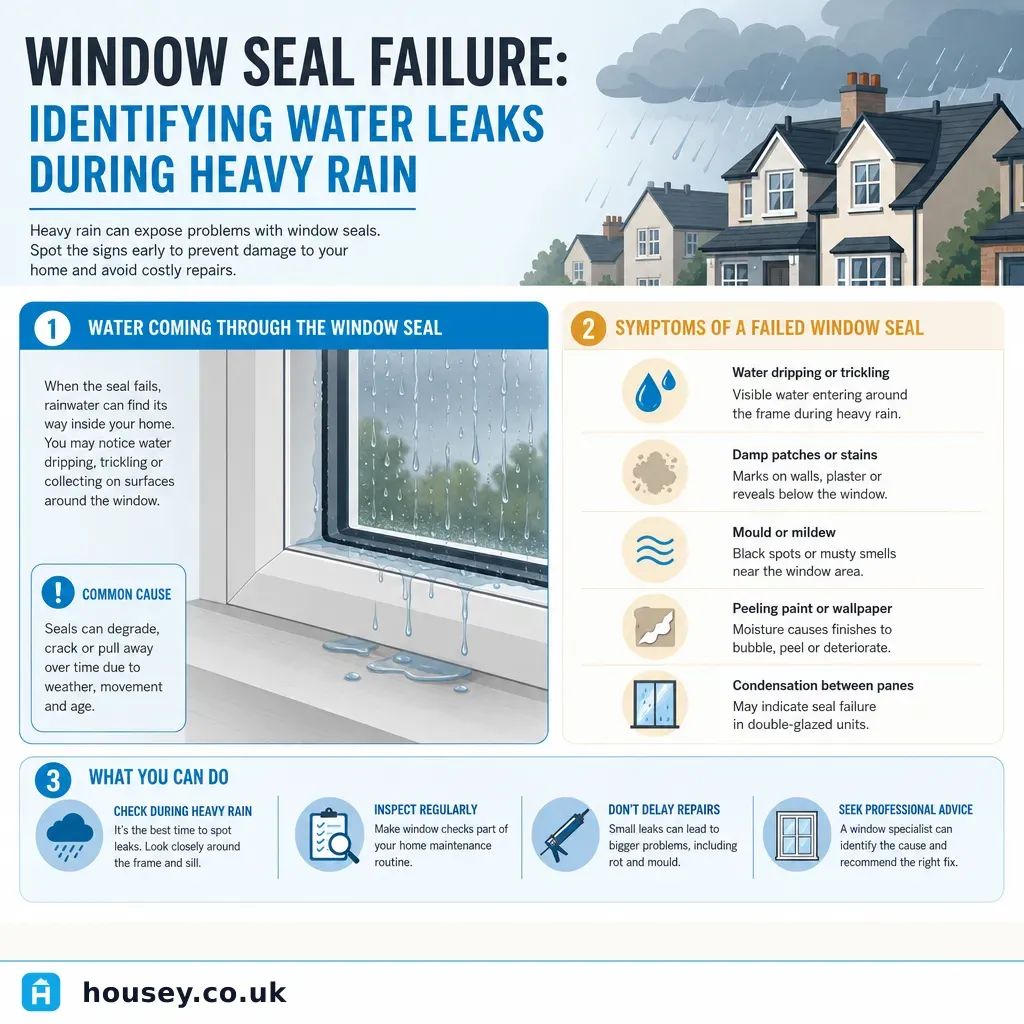
Window Seal Failure: Identifying Water Leaks During Heavy Rain
Water appearing around a window during or after heavy rain is one of the more common defect complaints in UK homes, from Victorian terraces with decades-old timber frames to 2000s new-builds where the original silicone sealant has simply reached the end of its service life. The challenge is that the water does not always enter where it appears—it can travel along a lintel, down a cavity tray, or across a window board before becoming visible, making it easy to misidentify the source and apply the wrong fix.
Key points
- FENSA-registered installers must self-certify window replacements against Building Regulations Part L (energy efficiency) and Part Q (security); a FENSA certificate should be available for any replacement window installed in England and Wales since 2002.
- Failed insulated glass unit (IGU) seals—shown by permanent condensation or clouding between the panes—cannot be repaired; the glazing unit must be replaced, but the frame itself often does not need to be.
- Weep holes in uPVC window frames must remain unblocked; these small drainage slots in the outer lower section of the frame allow trapped water to escape rather than pond inside and leak into the reveal.
- External mastic or silicone sealant around window frames typically lasts 10–20 years; painting over silicone sealant traps moisture and accelerates failure.
- Water appearing at the head of a window—rather than at the sides or sill—may indicate a failed cavity tray, absent vertical DPC, or lintel failure, and requires structural or damp assessment rather than sealant replacement.
What does window seal failure actually look like?
The term "window seal failure" covers several distinct defects, each with a different remedy and cost profile.
Defect | Visible symptoms | Typical remedy | Indicative cost |
|---|---|---|---|
Failed mastic or silicone joint | Water at frame-to-wall junction during rain; staining on window reveal | Remove old sealant fully; re-seal with external-grade neutral-cure silicone | £50–£200 per window (tradesperson) |
Failed IGU seal | Permanent condensation or fogging between the panes (not on surface) | Replace the insulated glass unit | £80–£250 per unit (supply and fit) |
Poorly fitted or settled frame | Water at head or sill; visible gap between frame and masonry | Re-bed and re-seal frame; may require partial removal | £150–£400 per window |
Blocked or absent weep holes | Water pooling inside frame; damp at sill level | Clear or drill weep holes in outer frame section | DIY or minimal tradesperson cost |
Lintel failure or failed cavity tray | Water appears at window head; staining in brickwork above the frame | Structural investigation; possible lintel or DPC replacement | £300–£1,500+ depending on extent |
Indicative UK costs, last reviewed 2026-05-31; quotes vary by window type, size, access, and location.
How to identify where the water is entering
A systematic approach before calling anyone saves both time and money:
- Observe during the next heavy rain from inside—note precisely where water first appears: at the sill, the side frame, the head, or a corner junction.
- Test with a garden hose—run water slowly over the outside, starting at the bottom and working upwards, while someone watches inside. Stop the moment water appears to isolate the entry level.
- Check the weep holes—small slots in the outer lower section of the uPVC frame. Temporarily block them with putty during the hose test to confirm whether entry is through this route.
- Inspect pointing and brickwork above the window—spalling bricks, missing pointing, or cracks in the lintel can direct rainwater directly into the frame junction.
- Check the roof space or ceiling above—what appears to be a window leak is sometimes roof water running down the inner leaf of the cavity wall.
Red flags: when the leak is more than a sealant problem
Some signs indicate the problem requires professional assessment rather than a DIY re-seal:
- Water at the head of the window (above the frame, not at the sides or sill) — possible failed cavity tray, absent vertical DPC, or lintel movement; requires a damp or structural specialist, not a window installer.
- Damp patch spreading outward beyond the window reveal — water is tracking through the wall rather than entering only at the frame joint.
- Crack running through brickwork adjacent to the window — possible lintel failure or differential settlement; structural assessment is needed before any repair work begins.
- Condensation on the inside face of the glass (not between the panes) — a ventilation problem, not a seal failure; additional ventilation rather than window replacement is the solution.
- Multiple windows leaking simultaneously in the same storm — suggests a building-envelope failure (render, parapet, ridge, flashings) rather than individual frame defects.
- Timber frame showing softness, staining, or fungal growth — wet rot may be established; specialist assessment is needed before re-sealing.
Decision tree: who should I call?
- Call a window installer or glazier if: the IGU has fogged between the panes, the sealant joint is visibly cracked or missing, or the frame has a clear gap to the masonry.
- Book a damp and timber survey if: the damp patch extends beyond the window reveal, re-sealing has been tried and the leak persists, or you want to confirm the source before committing to repair costs.
- Instruct a structural surveyor if: there are cracks in the brickwork near the window, the lintel shows rust staining or cracking, or the property is pre-1919 solid-wall construction.
- Check with your building insurer if: the ingress has caused damage to internal finishes, plasterboard, or electrical fittings—storm-related sudden ingress is often covered under building insurance.
- Contact a FENSA-registered installer if: you decide a full window replacement is needed—self-certification under FENSA avoids a separate building control application and ensures Part L and Part Q compliance.
When to get professional help
Most window seal failures are routine maintenance. However, arrange a professional inspection if:
- Re-sealing has been carried out and the leak has returned within two years
- Water is appearing at the head of the window rather than the sides or sill
- There are cracks in the surrounding masonry or signs of lintel rust staining
- The property is a leasehold flat—responsibility for window repairs may lie with the freeholder or management company under the terms of the lease
- The windows were installed in the last 10 years and the defect may be a workmanship or product warranty issue
- Any timber around the frame is soft, stained, or showing signs of fungal growth
How Housey can help
If you are unsure whether your window leak is a straightforward sealant issue or something more serious, Housey can connect you with the right professional. A damp and timber survey can establish whether moisture is tracking through the wall, while experienced window and door installers can assess frame condition, re-seal, replace glazing units, or advise on full window replacement where needed.
Frequently asked questions
Can I re-seal a window frame myself?
Re-sealing a window frame with silicone or mastic is achievable for a competent DIYer, provided the old sealant is fully removed and surfaces are clean, dry, and primed. Use external-grade neutral-cure silicone for most uPVC and aluminium frames. If the leak persists after re-sealing, or originates from the head of the frame rather than the joint, professional assessment is advisable.
Does replacing a window need planning permission?
In most residential properties, window replacement is permitted development and does not require planning permission. Exceptions include listed buildings, properties in conservation areas subject to Article 4 Directions, and flats where the lease restricts alterations. Always confirm with your local planning authority before proceeding if any of these circumstances apply.
How long should window sealant last?
External silicone or mastic sealant around window frames typically lasts 10–20 years, depending on product quality, UV exposure, and whether it was applied to clean, primed surfaces. Sealant applied to damp, painted, or unprimed surfaces will fail significantly sooner. Visual inspection every 3–5 years is reasonable practice, particularly on south- and west-facing elevations.
Who is responsible for window repairs in a leasehold flat?
Responsibility depends on the individual lease. In most leasehold flats the external structure—including window frames—is the freeholder's or management company's responsibility, while the leaseholder is responsible for internal decoration. Review your lease carefully, and if the freeholder is not acting, seek advice from a solicitor or apply to the First-tier Tribunal (Property Chamber) in England.
Sources and further reading
- FENSA: glazing compliance and self-certification — FENSA
- Building Regulations Approved Document L: conservation of fuel and power — GOV.UK
- Building Regulations Approved Document Q: security — GOV.UK
- Windows in traditional buildings — Historic England
- Repairs and maintenance in leasehold properties — Citizens Advice
Useful next reads
 Surveys & Inspections
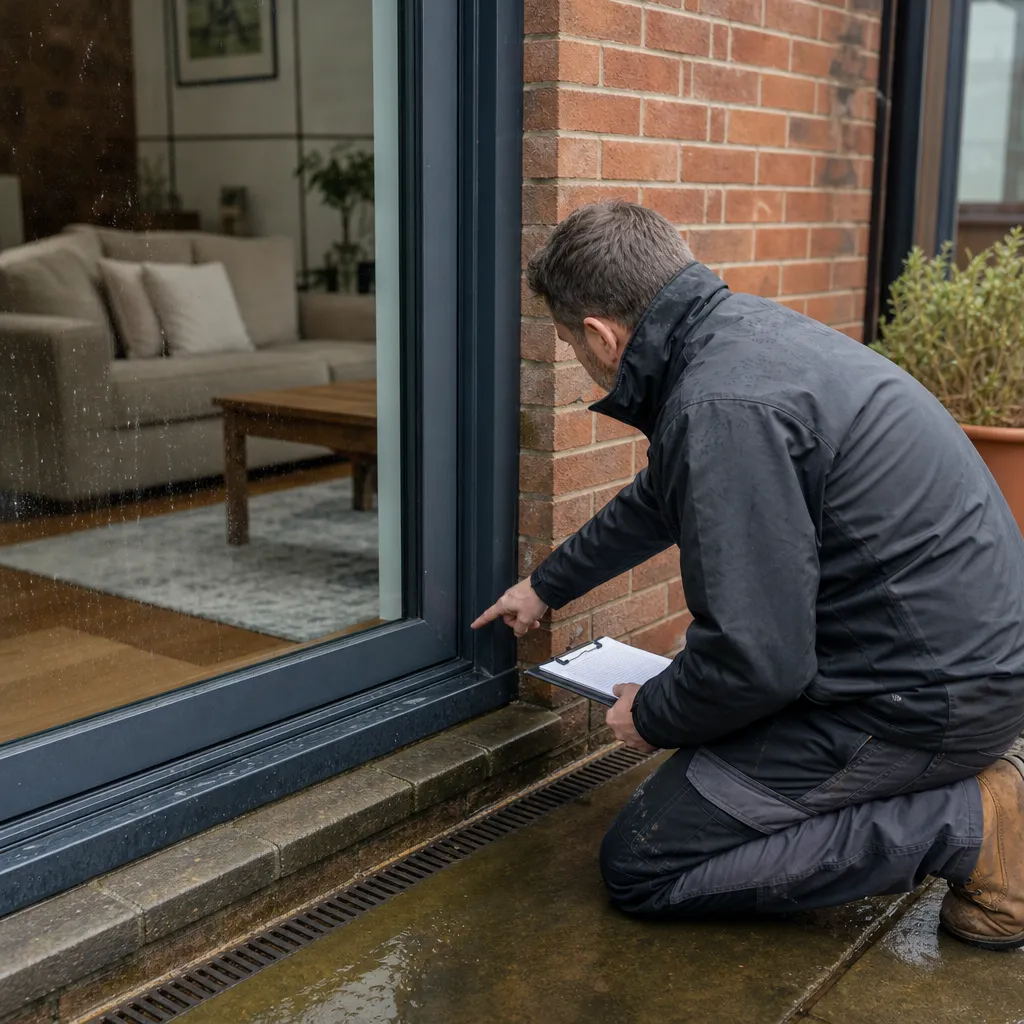
Water Ingress at Patio Doors: Identifying Cause and Prevention
Water ingress at patio doors usually stems from failed threshold seals, damaged compression gaskets, poor original installation, or a blocked drainage channel in the door frame.
 Surveys & Inspections
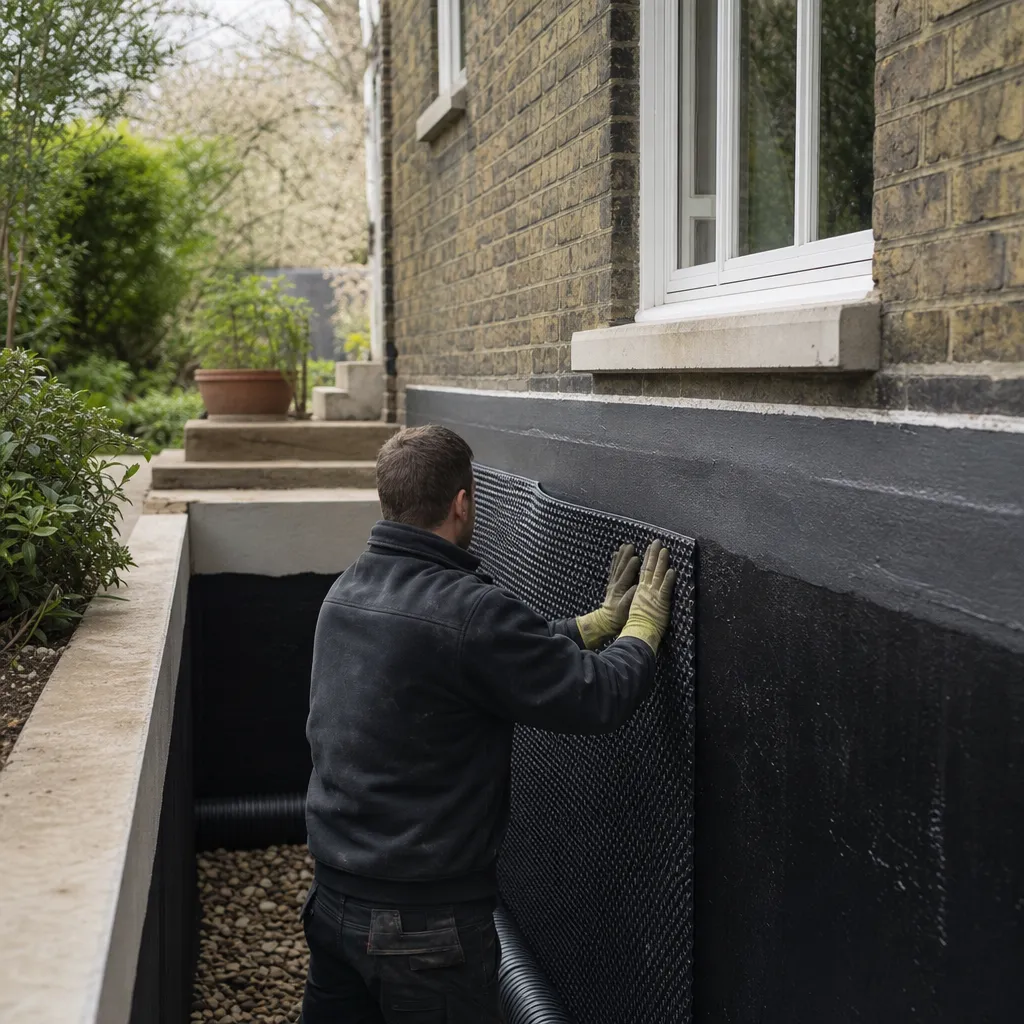
Basement Waterproofing Solutions for Damp Prevention
Basement waterproofing in the UK is governed by BS 8102:2022, which defines three system types: Type A (barrier coatings), Type B (structurally integral concrete), and Type C (cavity drain membrane with sump pump).
 Surveys & Inspections
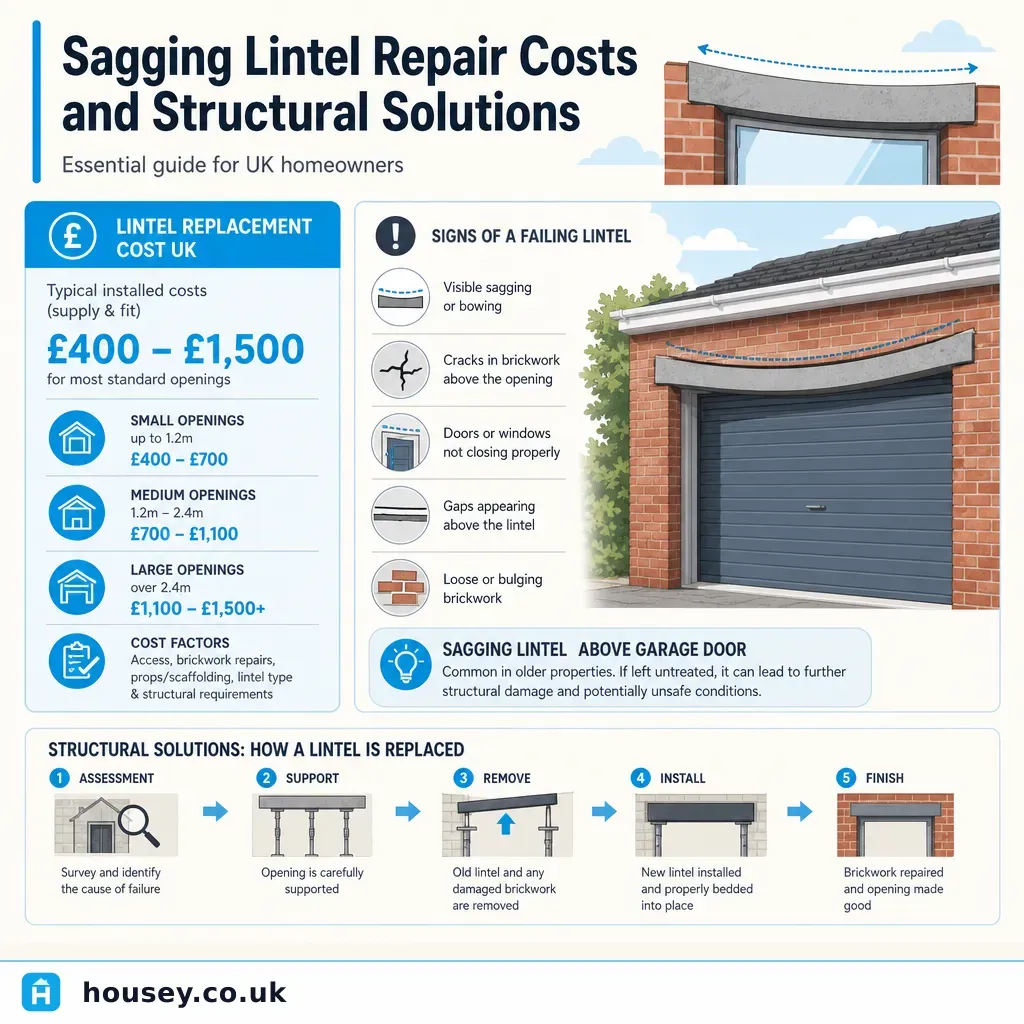
Sagging Lintel Repair Costs and Structural Solutions
A sagging lintel is a structural defect requiring prompt professional assessment.
 Surveys & Inspections
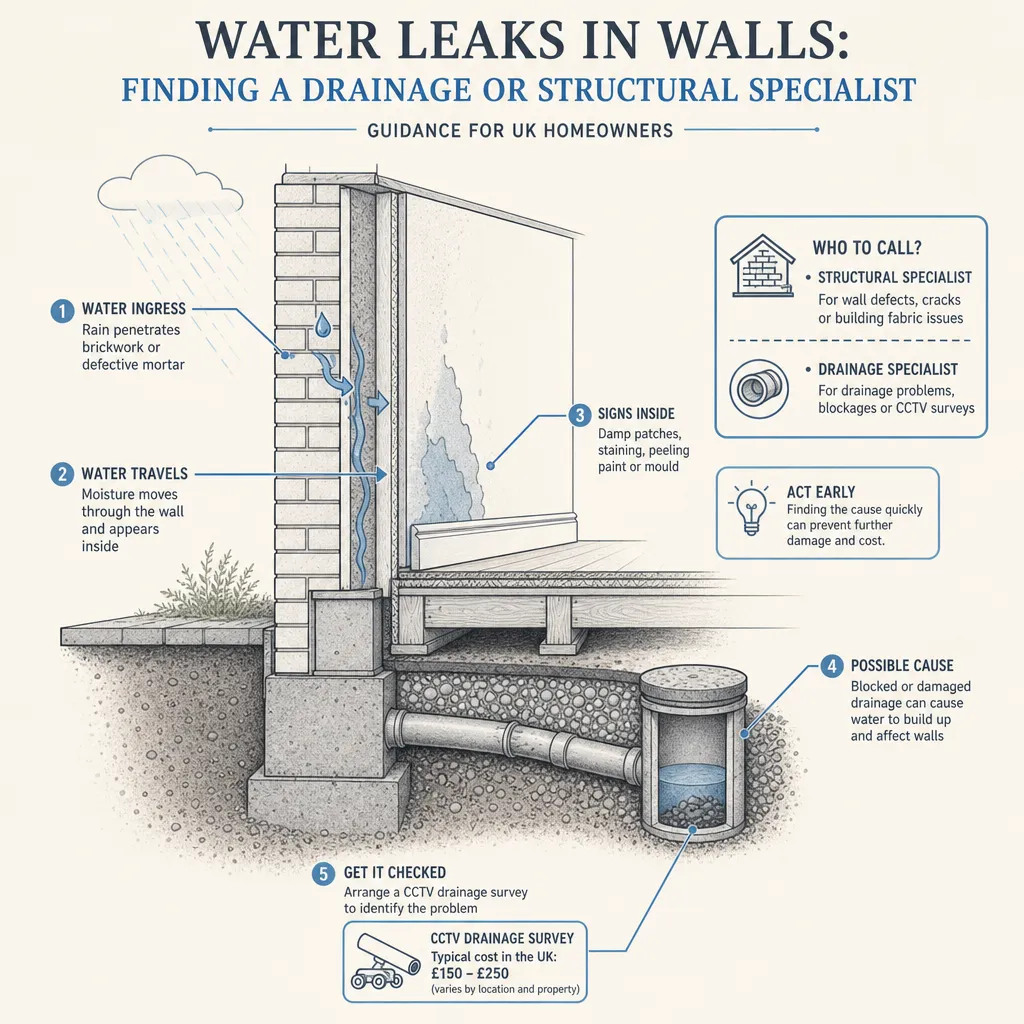
Water Leaks in Walls: Finding a Drainage or Structural Specialist
Water leaking through a wall can originate from a burst or leaking pipe, failed drainage, penetrating damp, a roof defect, or structural cracking.
 Surveys & Inspections
Costs of Damp-Proofing and Waterproofing Solutions for UK Properties
Damp-proofing costs vary by treatment: chemical DPC injection typically costs £300–£800 for a standard terraced house, while internal basement tanking runs £50–£150 per m² and cavity drain membrane systems £30–£80 per m².