Window Styles and Types for UK Properties
By Housey · Last reviewed 11th of May 2026
Window Styles and Types for UK Properties
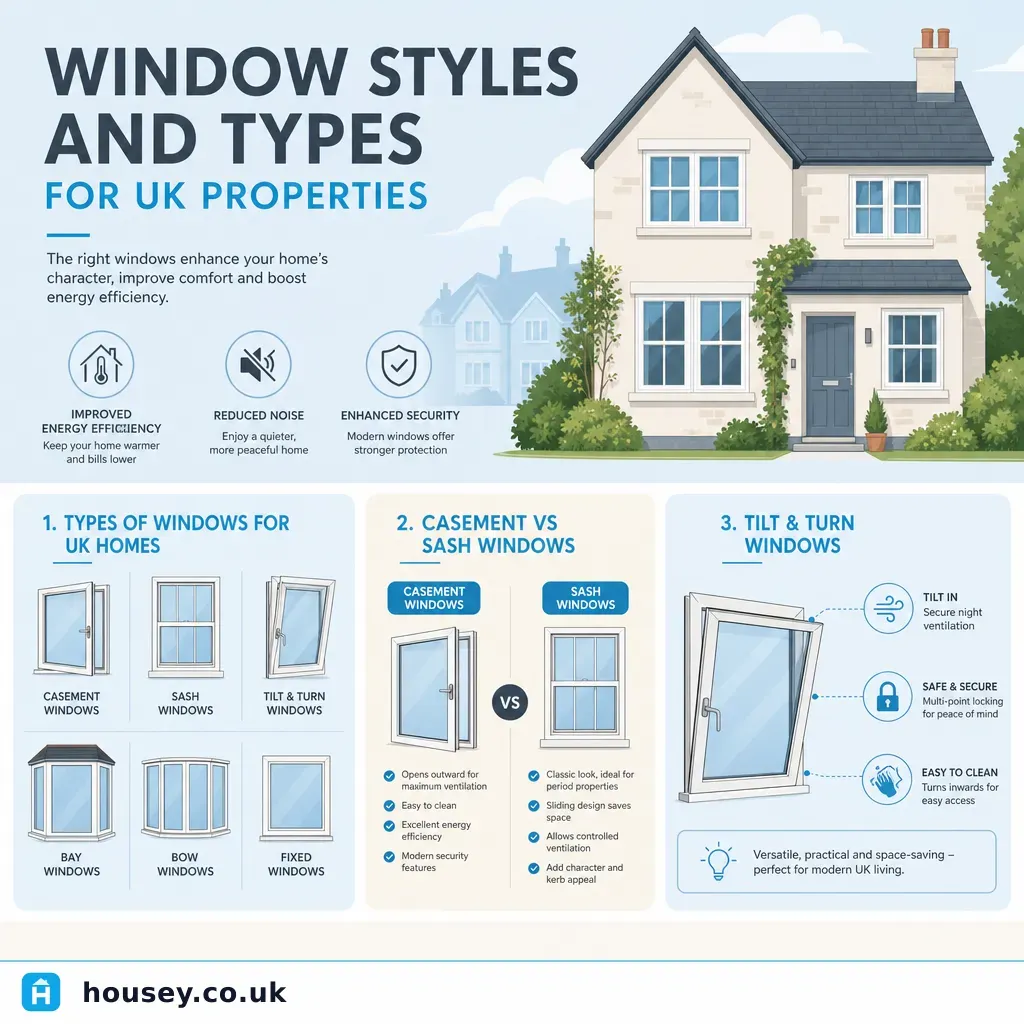
Windows are one of the most visible features of any home — and replacing or adding them involves choices that affect thermal performance, maintenance demands, planning compliance, and how well a property reads in its street or conservation context. UK homeowners face these decisions most often when windows reach the end of their lifespan, during a renovation, or when upgrading to improve energy efficiency. The variety of styles, materials, and glazing specifications available makes the decision more complex than it first appears.
Key points
- Casement windows are the most widely installed type in the UK, suited to most modern and post-war properties; replacement windows in England must achieve a whole-window U-value of no worse than 1.6 W/m²K under Approved Document L (2021 edition).
- Sash windows — vertically sliding box sash or spring-balance sliding sash — are the characteristic style of Georgian (pre-1840) and Victorian (1840–1901) terraces; replacing them in a conservation area or listed building often requires planning consent or listed building consent.
- Tilt-and-turn windows open inward on a tilt for background ventilation and swing fully open on a vertical axis, making them popular in new-build flats and modern homes where external cleaning access is difficult.
- FENSA or CERTASS registration is required for replacement window installations in England and Wales; registered installers self-certify Building Regulations compliance and issue a compliance certificate that conveyancers require on resale.
- Building Regulations Part Q requires windows in new residential buildings to resist physical attack to PAS 24 standard; many home insurers also require PAS 24-compliant windows for competitive premiums.
Casement windows
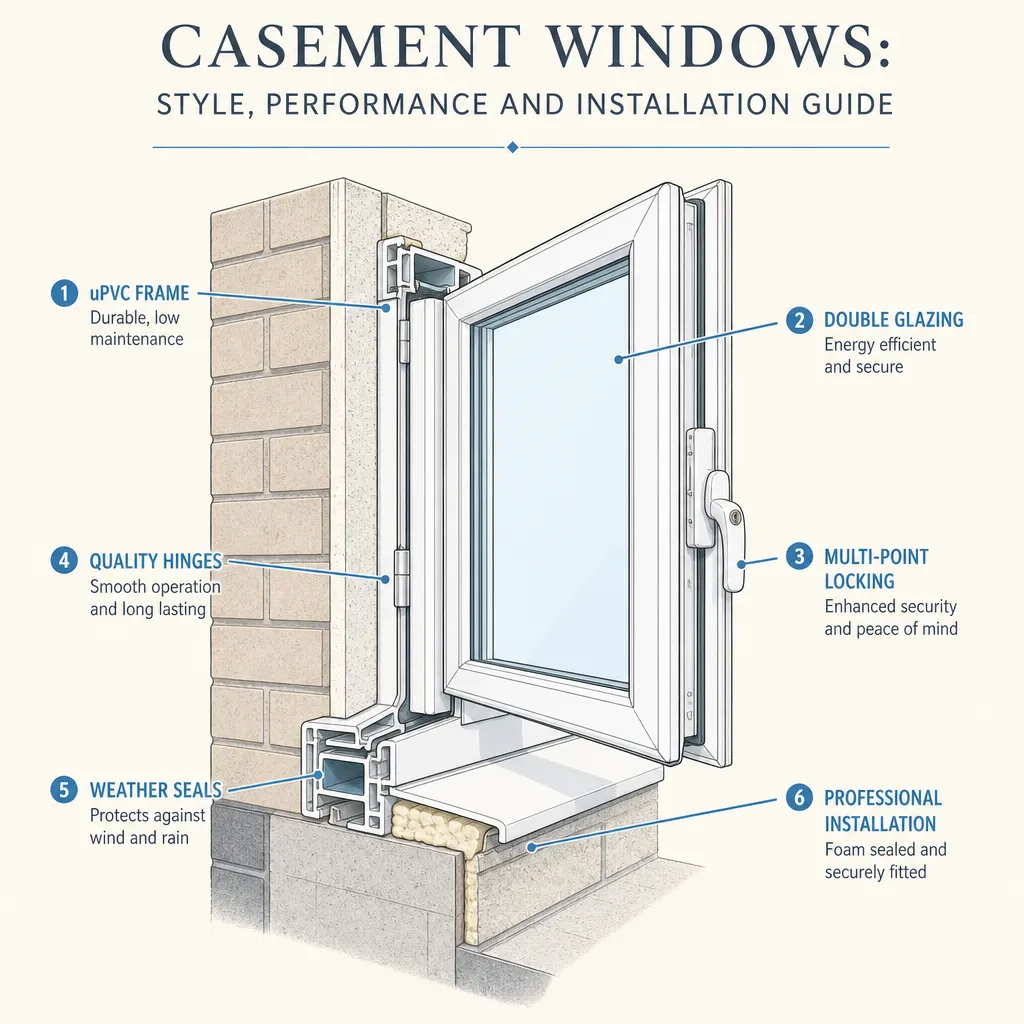
Casement windows are hinged on one side and open outward — or occasionally inward. They are the default choice in most UK post-war and new-build properties and are available in uPVC, timber, and aluminium. Side-hung casements are the most common; top-hung casements (also called hoppers or awning windows when opening outward from the top) are often used as ventilation lights above fixed panes.
Casements are compatible with all levels of double and triple glazing, and manufacturers offer a range of bar and frame profiles that can approximate traditional timber detailing where a more period-appropriate appearance is needed.
Sash windows
Traditional box sash windows use weighted cords within hollow box frames to counterbalance upper and lower sashes. Modern spring-balance sash windows replace weights with internal springs, reducing frame depth and simplifying maintenance. Both types slide vertically.
When replacing sash windows in a conservation area or listed building, like-for-like timber replacement is usually required by the local planning authority (LPA), and full planning permission or listed building consent may be needed. Secondary glazing — a second pane fitted inside the existing frame — is often a planning-friendly alternative that improves thermal performance without altering the external appearance.
Tilt-and-turn windows
Tilt-and-turn windows operate in two modes: tilting inward from the top for background ventilation, and turning inward on a side hinge for full cleaning access. They are especially useful in higher-storey situations where external cleaning is impractical. The visible frame profile is typically bulkier than a traditional casement, making them less suited to period properties.
Bay and bow windows
Bay windows project outward from the main wall, creating an alcove inside. A three-section bay has flat sides set at an angle; a bow window curves across multiple smaller sections. Both are characteristic of Victorian and Edwardian terraces and 1930s semis.
Replacing a bay window like-for-like generally does not require planning permission, but altering the projection profile, changing materials, or modifying the overall size may require a planning application in conservation areas.
Fixed lights
A fixed light is a glazed pane that does not open. Fixed lights are used where ventilation is provided by an adjacent opening vent, or to admit light in stairwells, corridors, or above doors. Because their sealed perimeter is simpler, they can achieve marginally better thermal and acoustic performance than equivalently specified opening units.
Comparison table: window styles by property type
Window style | Most common property match | Key advantage | Key limitation |
|---|---|---|---|
Casement | Post-war, modern, new-build | Versatile; available in all frame materials | Less authentic on Georgian or Victorian properties |
Box sash | Georgian, Victorian, Edwardian | Authentic appearance; planning-friendly | More costly to maintain; cord replacement required |
Spring sash | Victorian reproduction, period refurb | Lower maintenance than box sash | Slightly less authentic frame profile |
Tilt-and-turn | Modern flats, new-build, conversion | Easy cleaning; good draught seal | Bulkier frame; out of place on period properties |
Bay/bow | Victorian terrace, 1930s semi | Adds internal space and period character | Complex installation; glazing bars must match |
Fixed light | All types (as a secondary light) | Best thermal and acoustic performance | No ventilation function |
Material choices
Frame material affects thermal performance, maintenance burden, cost, and visual character.
Material | Thermal performance | Maintenance | Typical lifespan | Relative cost |
|---|---|---|---|---|
uPVC | Good (quality profiles) | Very low | 20–35 years | £ |
Timber softwood | Moderate (needs draught sealing) | Higher — periodic painting or staining | 30–60+ years | ££ |
Timber hardwood | Moderate–good | Moderate | 50–100+ years | £££ |
Aluminium with thermal break | Good | Low | 30–45+ years | £££ |
Composite timber-aluminium | Good | Low externally | 30–50 years | £££ |
Indicative relative costs only; prices vary by supplier, window size, specification, and location. Indicative UK costs, last reviewed 2026-05-11.
Which window style suits your property?
- Choose casements for most post-war or modern homes where period accuracy is not a concern — they offer the widest specification range and are generally the most cost-effective option.
- Choose box or spring sash for a Georgian, Victorian, or Edwardian terrace where the street facade must be preserved, or where your LPA or conservation officer expects like-for-like replacement.
- Choose tilt-and-turn for upper-floor flats or new-build homes where cleaning access is difficult and a modern frame profile is acceptable.
- Choose timber frames if the property is listed or in a conservation area, or if you want the longest possible lifespan and are prepared to commit to regular maintenance.
- Choose aluminium with a thermal break for slim profiles, high durability, and low maintenance in a contemporary renovation.
- Check with your LPA before committing to any style or material change if the property is listed, in a conservation area, or covered by an Article 4 Direction.
What to ask your window installer before accepting a quote
- Are you registered with FENSA or CERTASS, and can you self-certify Building Regulations compliance?
- What whole-window U-value and centre-pane U-value will the units achieve?
- Do the windows comply with PAS 24 for security?
- What frame profile, bar dimensions, and ironmongery options are available?
- What is the warranty period on frames, glass seals, and hardware?
- Is the quote inclusive of all associated building work — lintels, window reveals, and plasterwork — or are these charged separately?
- Is VAT included in the quoted price?
When to get professional help
Most window installations are straightforward, but professional assessment is important when:
- The property is listed or in a conservation area — a conservation officer's input may be needed before any order is placed.
- Structural openings are being widened or new openings created — structural engineering input and Building Regulations approval are required.
- There is damp around the existing frame — this may indicate lintel failure or a cavity-closer issue that requires investigation before new windows are fitted.
- Existing timber frames contain lead paint (likely in pre-1960s properties) — safe removal procedures apply under the Control of Lead at Work Regulations 2002.
How Housey can help
Housey connects homeowners with trusted, FENSA-registered window and door installers who can advise on the most appropriate style, material, and specification for your property — including period homes in conservation areas.
Frequently asked questions
Do I need planning permission to replace my windows?
In most cases, replacing windows with similar-looking units is permitted development in England and Wales. If the property is listed, in a conservation area, or subject to an Article 4 Direction, you will likely need planning consent or listed building consent. Always check with your local planning authority before ordering new windows.
What does FENSA registration mean for homeowners?
FENSA (Fenestration Self-Assessment Scheme) allows registered installers to self-certify that replacement glazing work complies with Building Regulations, removing the need for a separate local authority Building Control notification. You receive a FENSA certificate after installation — important evidence for your conveyancer when you come to sell the property.
What U-value should replacement windows achieve?
Under Approved Document L (2021), replacement windows in England must achieve a whole-window U-value of no worse than 1.6 W/m²K, or a centre-pane U-value of 1.2 W/m²K. Many modern double-glazed units comfortably exceed this requirement. Triple-glazed units typically achieve whole-window U-values of 0.7–1.0 W/m²K.
How long do uPVC windows last?
Quality uPVC windows typically last 20–35 years, though frame and sealed-unit quality vary between manufacturers. Misted or condensation-filled glass indicates a failed sealed unit — not the frame itself — and the glass unit can usually be replaced without changing the whole window.
Sources and further reading
- Approved Document L: Conservation of fuel and power — GOV.UK
- Windows: planning permission — Planning Portal
- FENSA: for homeowners — FENSA
- Energy efficiency in historic buildings — Historic England
- Approved Document Q: Security — GOV.UK
Useful next reads
 Improvement & Build
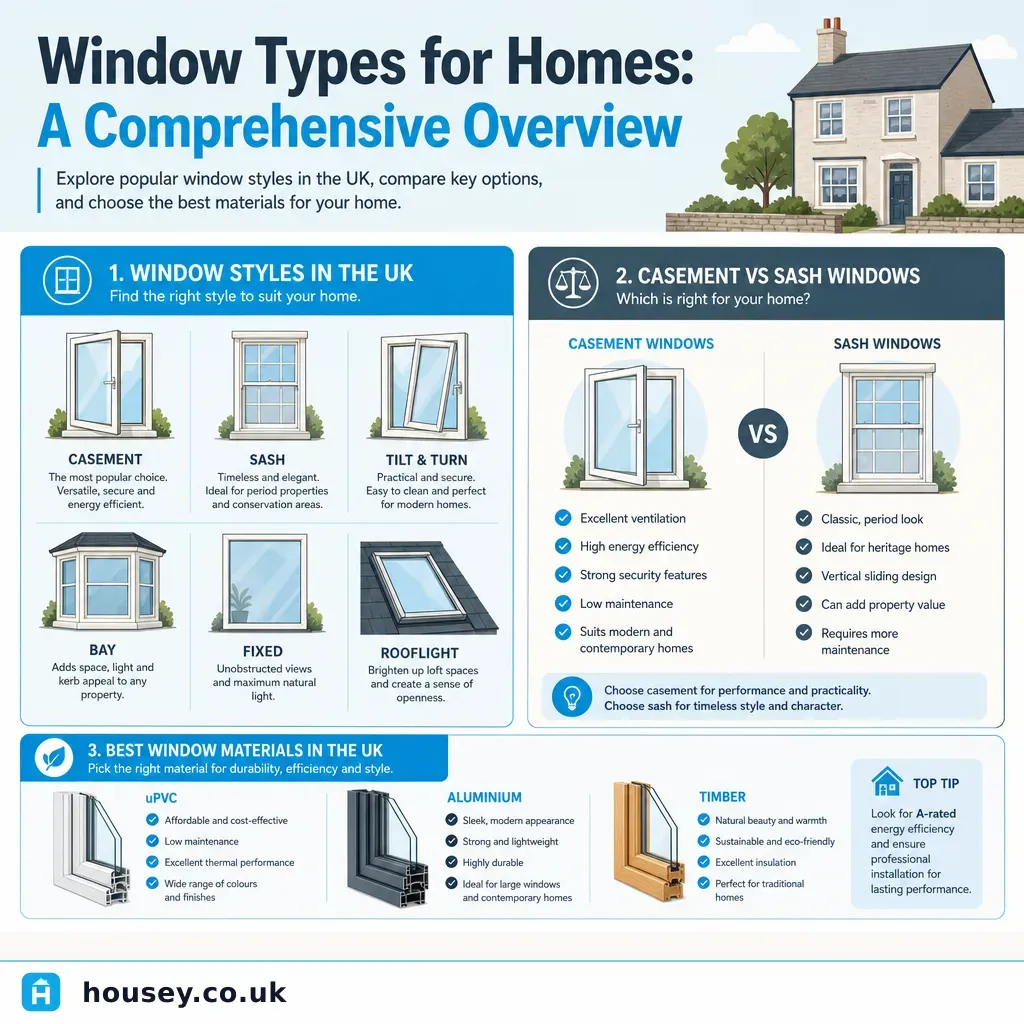
Window Types for Homes: A Comprehensive Overview
UK homes use several main window styles: casement (outward-swinging), sash (vertically sliding), tilt-and-turn, fixed light, and bay or bow.
 Improvement & Build
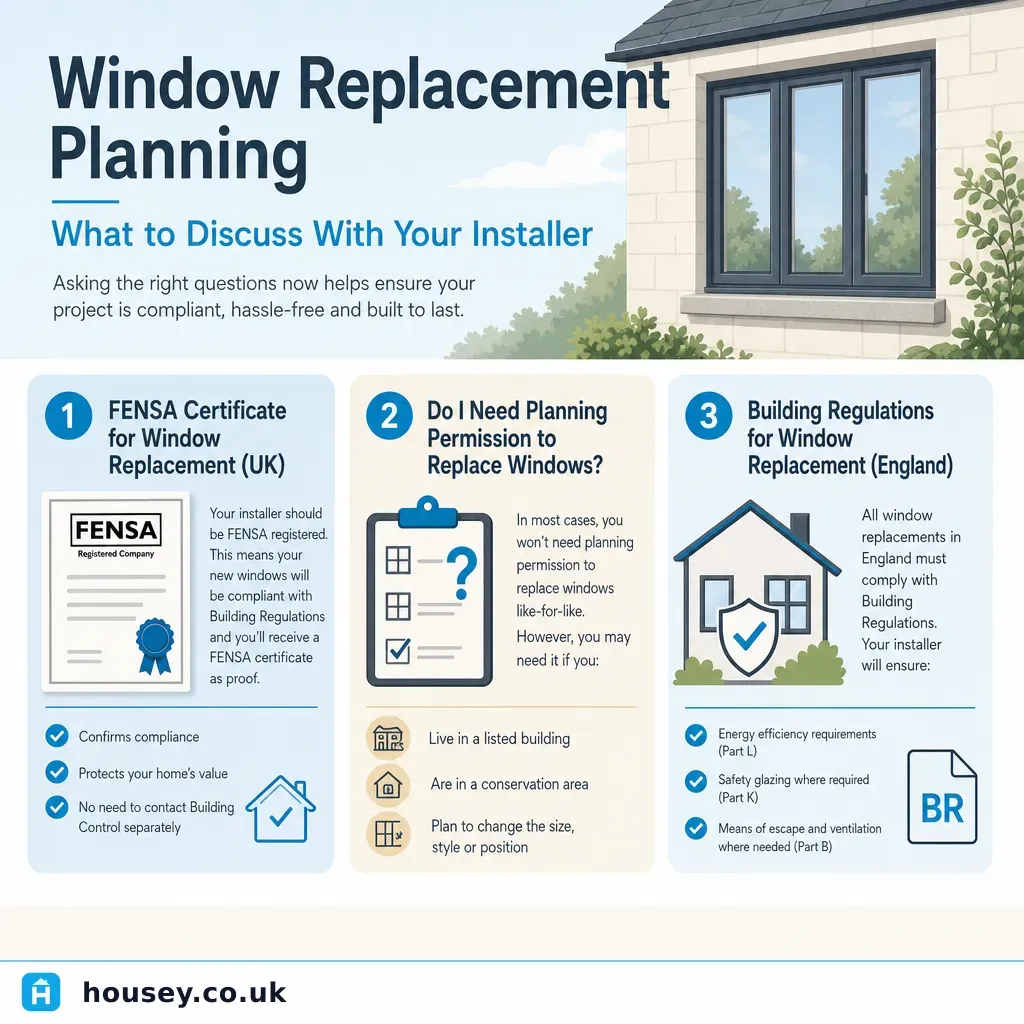
Window Replacement Planning: What to Discuss With Your Installer
Most window replacements in England fall under permitted development rights and do not require planning permission, but they must comply with Building Regulations Part L and Part K.
 Improvement & Build
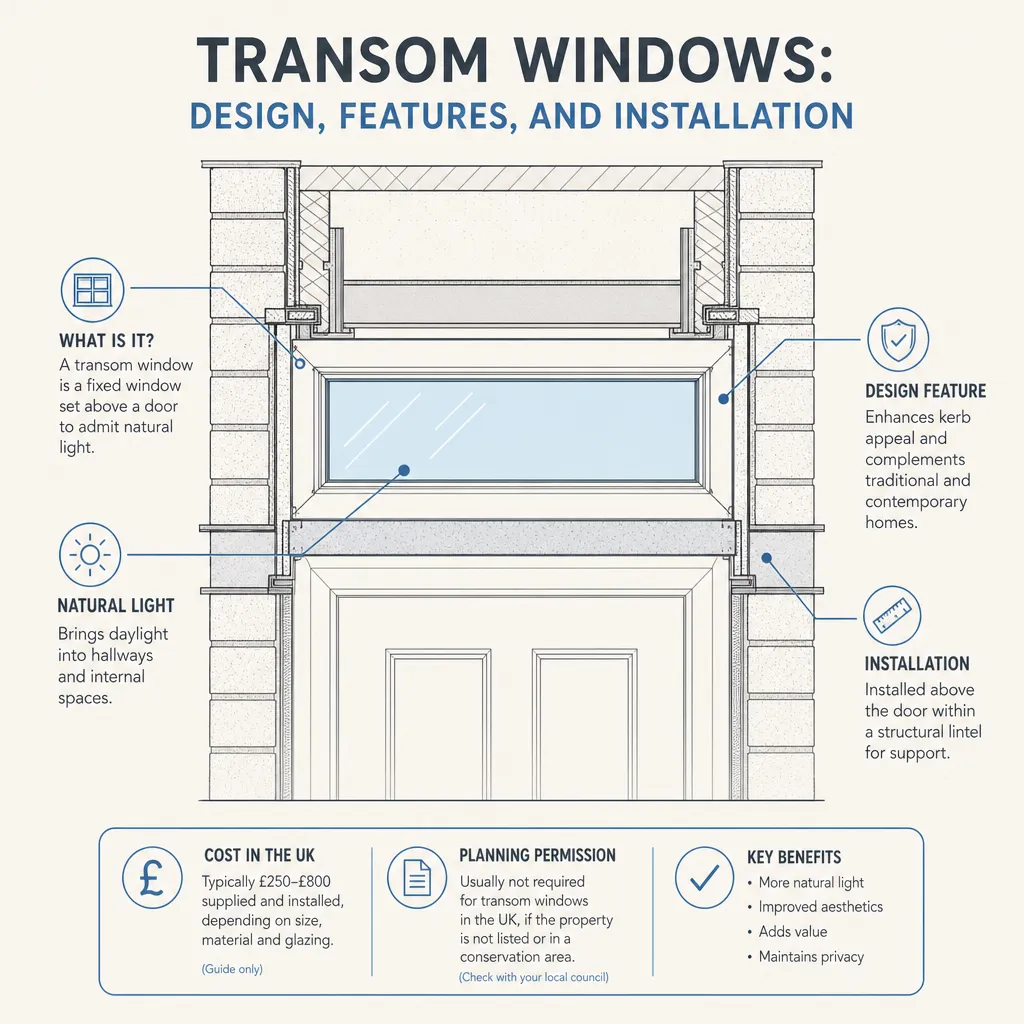
Transom Windows: Design, Features, and Installation
A transom window is a fixed or opening window positioned above a door or another window, separated by a horizontal bar called the transom.
 Improvement & Build
Casement Windows: Style, Performance and Installation Guide
Casement windows are hinged on one side and open outward, making them the most widely fitted window type in UK homes.
 Improvement & Build
Window and Door Installation: Options and Considerations
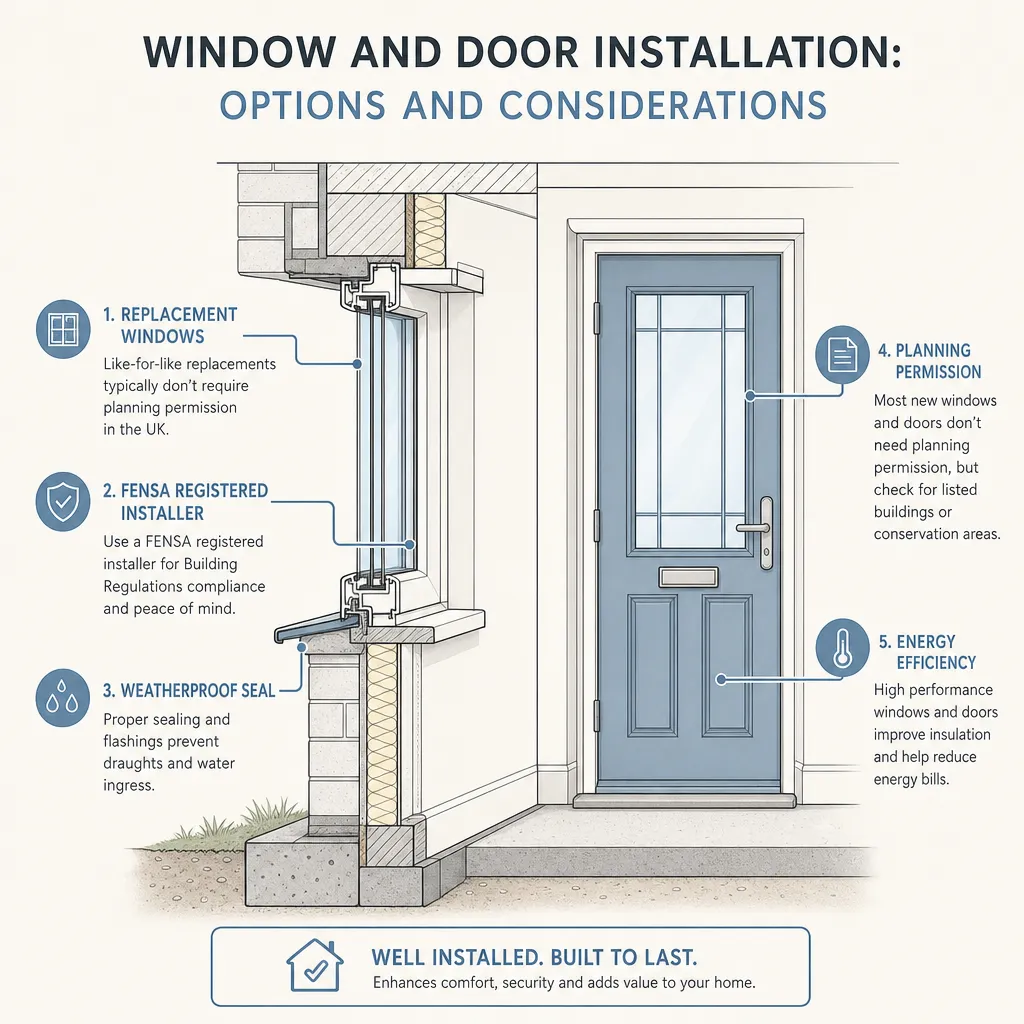
Replacing windows and external doors in the UK requires compliance with Building Regulations Part L (thermal performance) and Part K (safety glazing).