Winterizing Plumbing in Holiday Homes and Vacation Properties
By Housey · Last reviewed 19th of May 2026
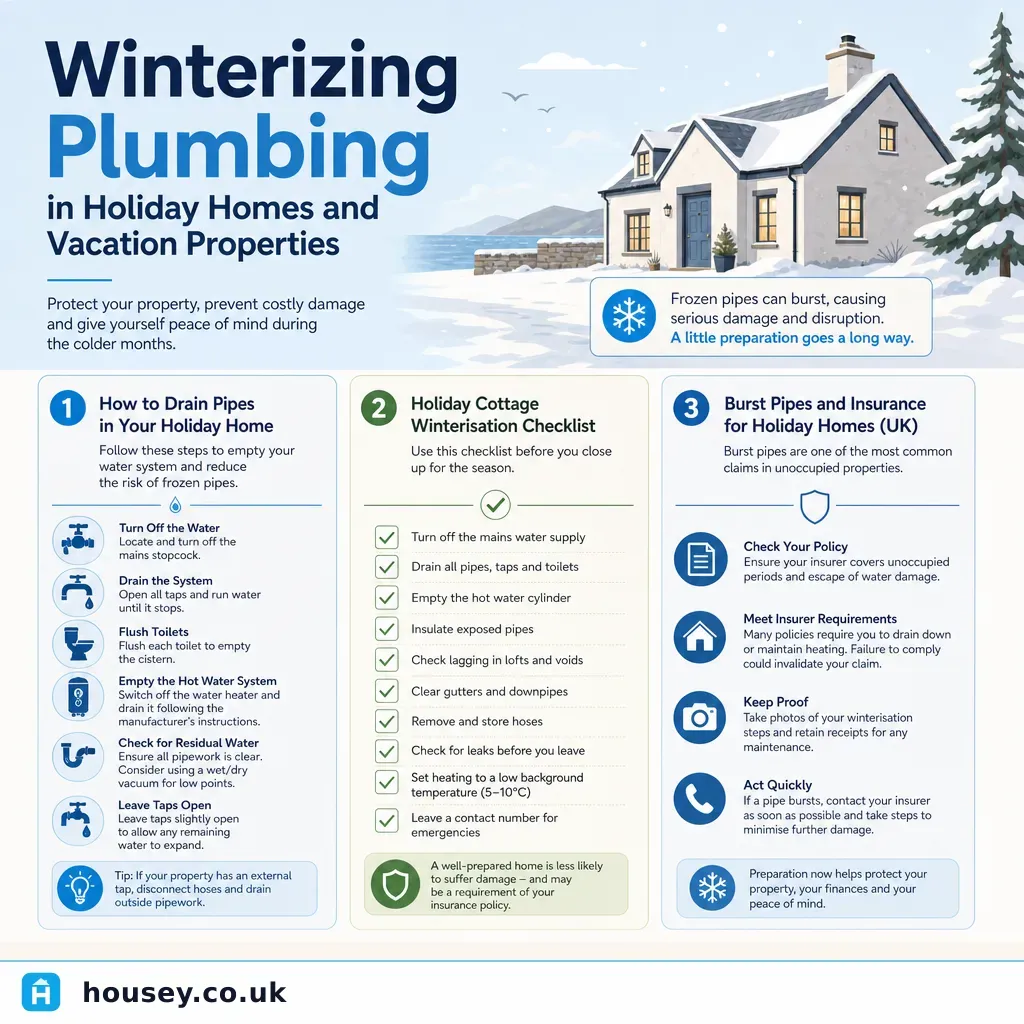
Winterizing Plumbing in Holiday Homes and Vacation Properties
Unoccupied holiday homes are among the most common settings for burst pipes in the UK: no one is there to notice a dripping tap, nudge the heating, or isolate the supply when temperatures drop. The combination of empty rooms, switched-off boilers, and weeks of sub-zero nights can turn a £50 repair into a bill running into thousands. Getting this right before each winter departure — whether the property is a Cornish cottage, a Scottish lodge, or a lakeside let — will protect the fabric of the building, preserve your insurance position, and spare you a costly emergency call-out in February.
Key points
- The Water Supply (Water Fittings) Regulations 1999 require all water fittings to be protected from freezing, including pipes in unheated loft spaces and outbuildings.
- The Association of British Insurers (ABI) advises maintaining a minimum temperature of 13°C in an unoccupied property, or draining the system completely, to qualify for full winter-damage cover.
- Pipes typically begin to freeze when sustained internal air temperatures fall below 0°C; damage is most common after 48–72 hours of temperatures below −5°C.
- Pipe lagging in unheated spaces should be at least 25mm thick; polyethylene foam products compliant with BS EN ISO 10508 are rated for potable water supply use.
- Burst-pipe insurance claims in unoccupied properties can range from £8,000 to £30,000 or more when flooding affects multiple rooms, according to published insurer estimates (indicative, last reviewed 2026-05-19).
What happens when pipes freeze in a holiday home
Water expands by roughly 9% as it freezes. In a sealed copper or plastic pipe, that expansion has nowhere to go, and the pipe splits — usually at a joint or bend rather than a straight run. The freeze itself causes no immediate flooding; the damage happens when the property warms up and the ice melts. If no one is in the building, water can run for hours or days before anyone notices.
In a holiday home left unheated, the entire system is at risk: the rising main from the stopcock, the cold-water storage tank (if present), the hot-water cylinder pipes, and any pipework running through a loft, garage, or uninsulated outbuilding. Underfloor heating pipework in screed is less vulnerable because the thermal mass of the screed buffers temperature changes, but it is not immune.
Tenanted holiday lets carry an additional consideration: if the property is let on short-term licences, the obligation to maintain it in a habitable condition continues through winter. A burst pipe during a changeover could expose the owner to claims from guests and regulatory attention from the local authority if the property is registered under a holiday let licence scheme.
Drain-down versus frost thermostat: which approach should you choose?
Two principal strategies exist for protecting a holiday home's plumbing through winter. The right one depends on how long the property will be empty, your heating system's reliability, and what your insurer requires.
Strategy 1: Drain down the system
Draining removes all water from the pipework so there is nothing to freeze. This is the most reliable protection for a property that will be empty for weeks or months.
Strategy 2: Frost thermostat and trace heating
A frost thermostat (set to 4–7°C) triggers the boiler or an electric heating element only when the internal temperature approaches freezing. Trace heating tape — installed to BS 6351 — can be applied to individual vulnerable pipe runs.
Which approach should you choose?
- Choose drain-down if: the property will be empty for more than three weeks; the heating system is unreliable or old; you cannot check on it remotely; your insurer specifically requires it; or there is no mains electricity supply in winter.
- Choose frost thermostat or trace heating if: you need the property available at short notice; the heating is modern and reliable; you have remote monitoring via a smart thermostat with alerts; or the property is occupied at least monthly.
- Combine both approaches if: there is pipework in an unheated outbuilding or detached garage that central heating cannot reach.
- Consult a Gas Safe–registered engineer or qualified plumber if: the heating system is more than 15 years old, has a history of failures, or you are unsure whether the drain-down covers all pipe runs.
How to drain down a holiday home plumbing system
A thorough drain-down covers mains-fed pipework, storage tanks, hot-water cylinders, and connected appliances. The sequence matters — draining out of order can leave water trapped in pipe loops.
- Turn off the mains cold-water supply at the internal stopcock (usually under the kitchen sink or where the service pipe enters the building).
- Turn off the boiler or immersion heater before draining.
- Open all cold taps in the property, starting on the ground floor, and leave them open until flow stops. Flush all toilets.
- Open all hot taps. For a vented cylinder system, open the drain cock at the base of the cylinder and direct a hosepipe to an outside drain.
- Use a compressor or bicycle pump to blow remaining water from low-flow sections such as washing machine supply pipes.
- Disconnect the washing machine, dishwasher, and condensate pipe and drain those components per the manufacturer's instructions.
- Pour a small amount of plumber's propylene glycol (BS EN 17071) into toilet pans and trap seals to prevent U-bends from freezing. Standard automotive antifreeze is not safe for sanitary drainage.
- Label the stopcock and leave a note on-site so any emergency responder, cleaner, or letting agent knows the system is drained.
Note: If you are unsure of the pipework layout — particularly if the property has been extended or altered — have a qualified plumber produce a schematic before the first drain-down. Incorrect procedure can leave trapped pockets of water in dead legs or pipe loops that freeze and split regardless.
Which pipes to lag and what to use
Even if you drain down, pipework that cannot be fully emptied or that carries water into a frost-free zone should be lagged.
Locations most at risk:
- Loft spaces — even insulated lofts can reach −10°C in severe UK winters
- Unheated garages and outbuildings
- Under suspended timber floors with inadequate underfloor insulation
- Any pipe run within 600mm of an exterior wall without cavity insulation
Lagging materials:
- Polyethylene foam tube lagging (most common; available in 15mm, 22mm, and 28mm bore sizes): minimum 25mm thickness for unheated spaces.
- Mineral wool pipe wrap: better thermal performance; used where fire resistance is also needed near a boiler flue.
- Self-regulating trace heating tape (BS 6351): electric element that activates at low temperatures; used for long exposed external pipe runs. Requires a correctly rated circuit breaker on the consumer unit.
Holiday home winterisation checklist
Work through this before leaving for any extended winter period:
When to get professional help
Most seasonal drain-downs are within the reach of competent DIYers or property managers. Call a qualified plumber when:
- The property has never been formally drained and the pipework layout is unknown.
- The boiler is a pressurised (sealed) system — refilling and represurising after drain-down should be verified by a Gas Safe engineer if there is any doubt.
- Trace heating tape installation is required — this needs correct electrical isolation and a suitably rated circuit breaker.
- Pipes have already burst or shown signs of previous freeze damage — have all joints inspected before the next winter, not simply re-lagged.
- The property is a listed building with original lead or early copper pipework that may not tolerate pressure changes during drain-down.
How Housey can help
If you need professional assistance with pipe lagging, drain-down procedures, or emergency repair at a holiday property, Housey's drainage contractors can connect you with qualified local tradespeople. Comparing multiple quotes before winter arrives is particularly valuable when the property is at a distance from your main home.
Frequently asked questions
Do I need to tell my insurer if I leave my holiday home unoccupied over winter?
Yes. Most UK holiday home insurance policies define unoccupancy as more than 30 consecutive days. You are usually required to notify your insurer, who may impose conditions such as maintaining a minimum temperature or draining the system. Failure to comply can invalidate frost-damage claims.
Can I use ordinary car antifreeze in toilet traps?
No. Standard automotive antifreeze (ethylene glycol) is toxic and must not be used in drainage systems connected to the public sewer. Only plumber's grade propylene glycol meeting BS EN 17071 is appropriate for toilet traps and U-bends. Always check the product label before use.
How do I refill the system in spring after a drain-down?
Open the mains stopcock slowly, allow the cold-water system to fill, and check for leaks at every visible joint before turning on the hot water. For a vented cylinder, ensure the cistern has filled before switching on the immersion or boiler. For pressurised systems, verify the expansion vessel pressure — typically 1–1.5 bar cold — before firing the boiler.
Does drain-down affect a combi boiler?
Yes. Combi boilers contain a heat exchanger and expansion vessel that require water to function. After drain-down, the system must be represurised via the filling loop before recommissioning. Consult the manufacturer's instructions or a Gas Safe–registered engineer if you are unsure of the correct refill procedure.
Sources and further reading
- The Water Supply (Water Fittings) Regulations 1999 — legislation.gov.uk
- ABI: Flooding and Frozen Pipes — Association of British Insurers
- Energy Saving Trust: Insulating Your Home — Energy Saving Trust
- GOV.UK: Building Regulations Technical Guidance — GOV.UK
Useful next reads
 Improvement & Build
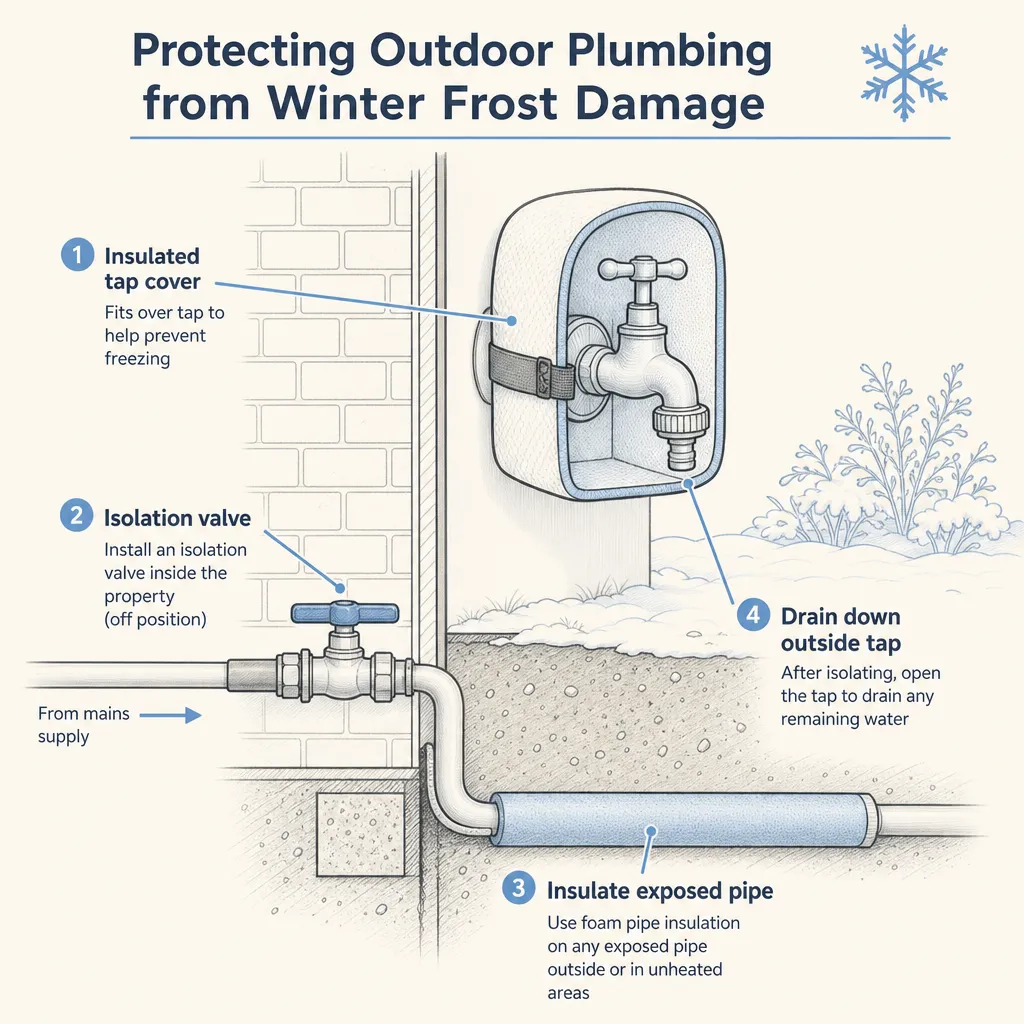
Protecting Outdoor Plumbing from Winter Frost Damage
The most reliable way to protect an outdoor tap from frost is to turn off its dedicated indoor isolation valve, drain the connecting pipe, and leave the tap open over winter so any remaining water can escape without building pressure.
 Improvement & Build
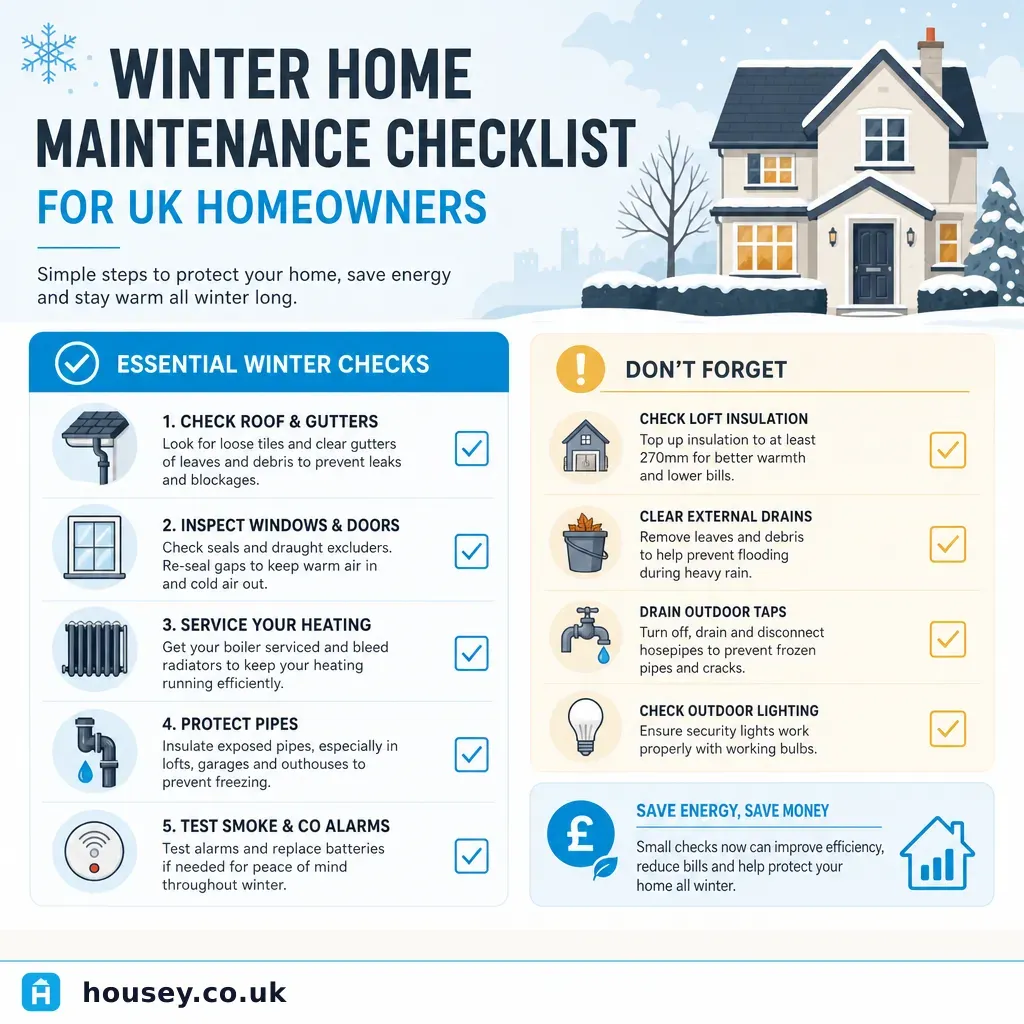
Winter home maintenance checklist for UK homeowners
UK homeowners should carry out winter maintenance in October and November, before the first frost.
 Improvement & Build
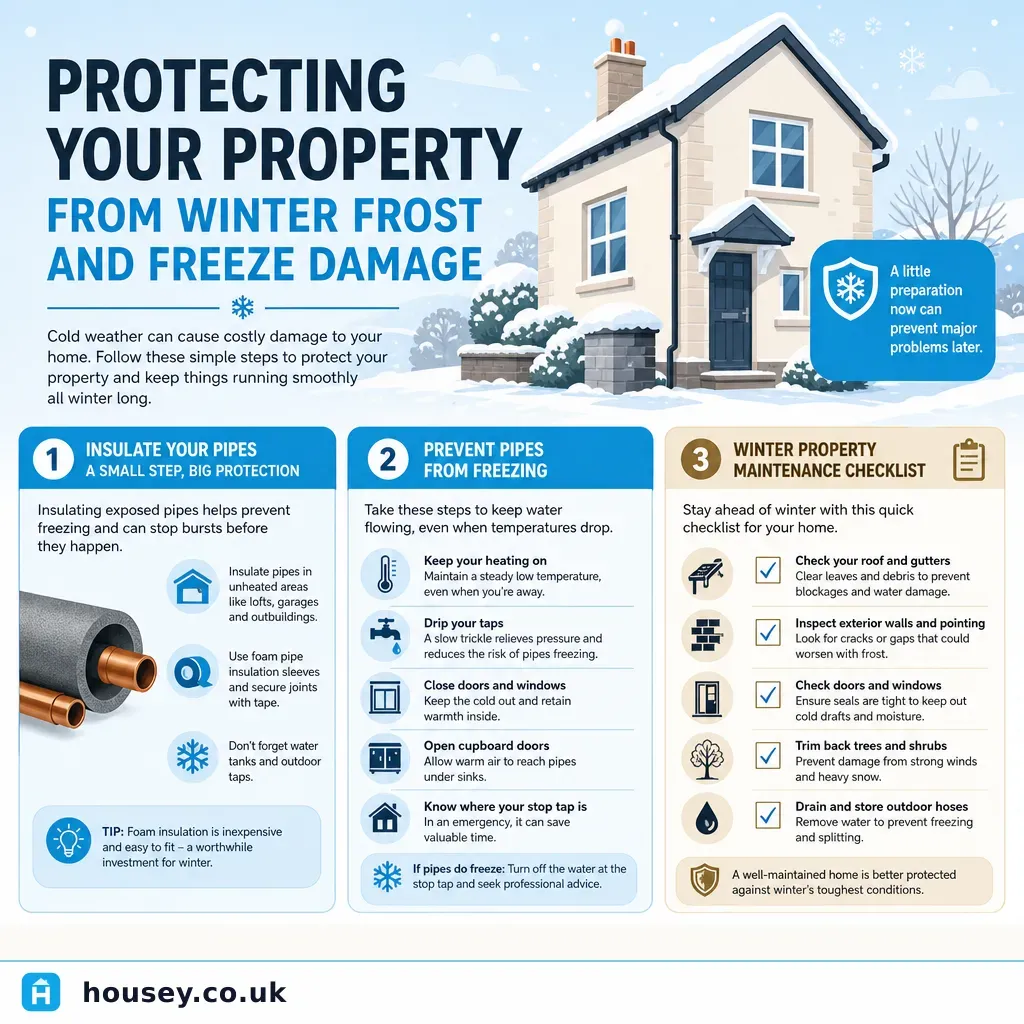
Protecting Your Property from Winter Frost and Freeze Damage
Protecting your home from winter frost damage mainly involves insulating exposed pipes, lagging outdoor taps, maintaining a minimum indoor temperature in unoccupied properties, and clearing drains before cold spells.
 Improvement & Build
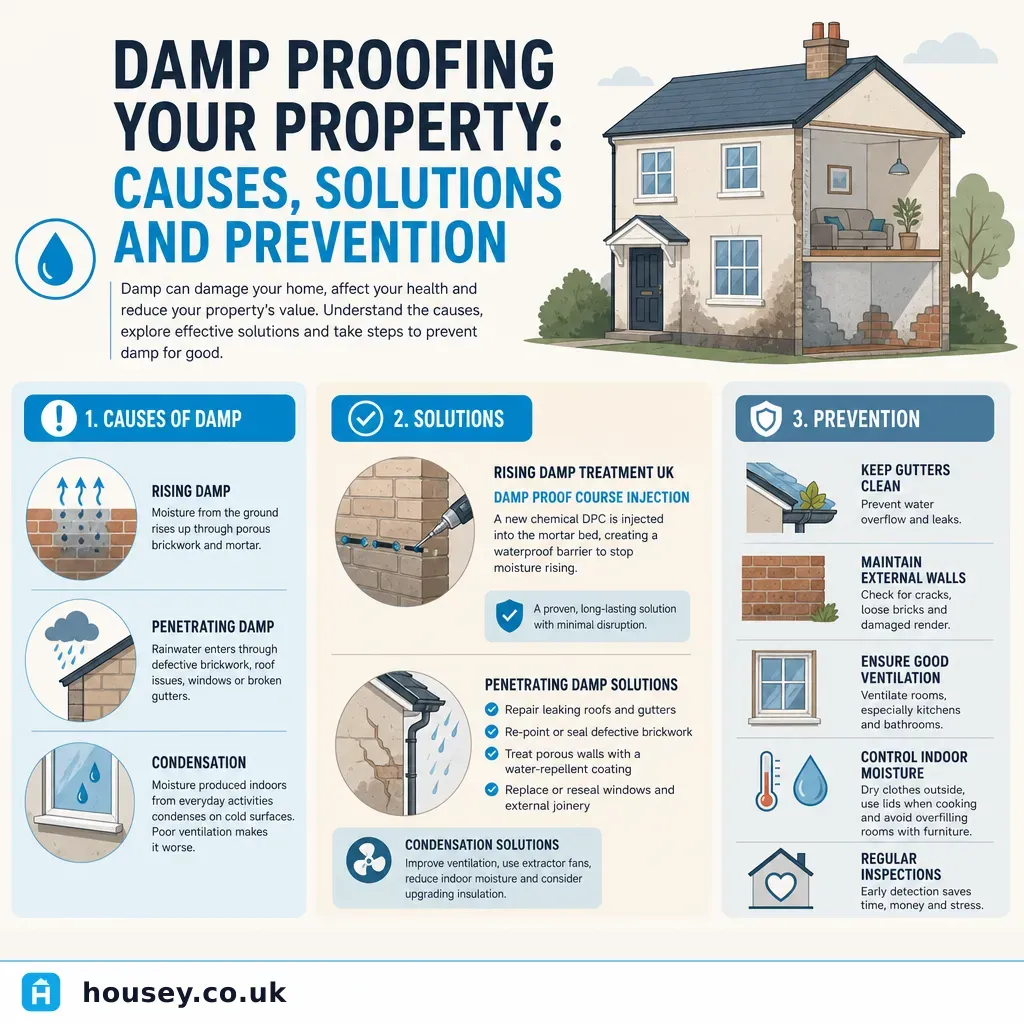
Damp Proofing Your Property: Causes, Solutions and Prevention
Damp in UK properties falls into three main types: rising damp caused by a failed damp proof course, penetrating damp from defects such as failed flashings or cracked render, and condensation from poor ventilation.
 Improvement & Build
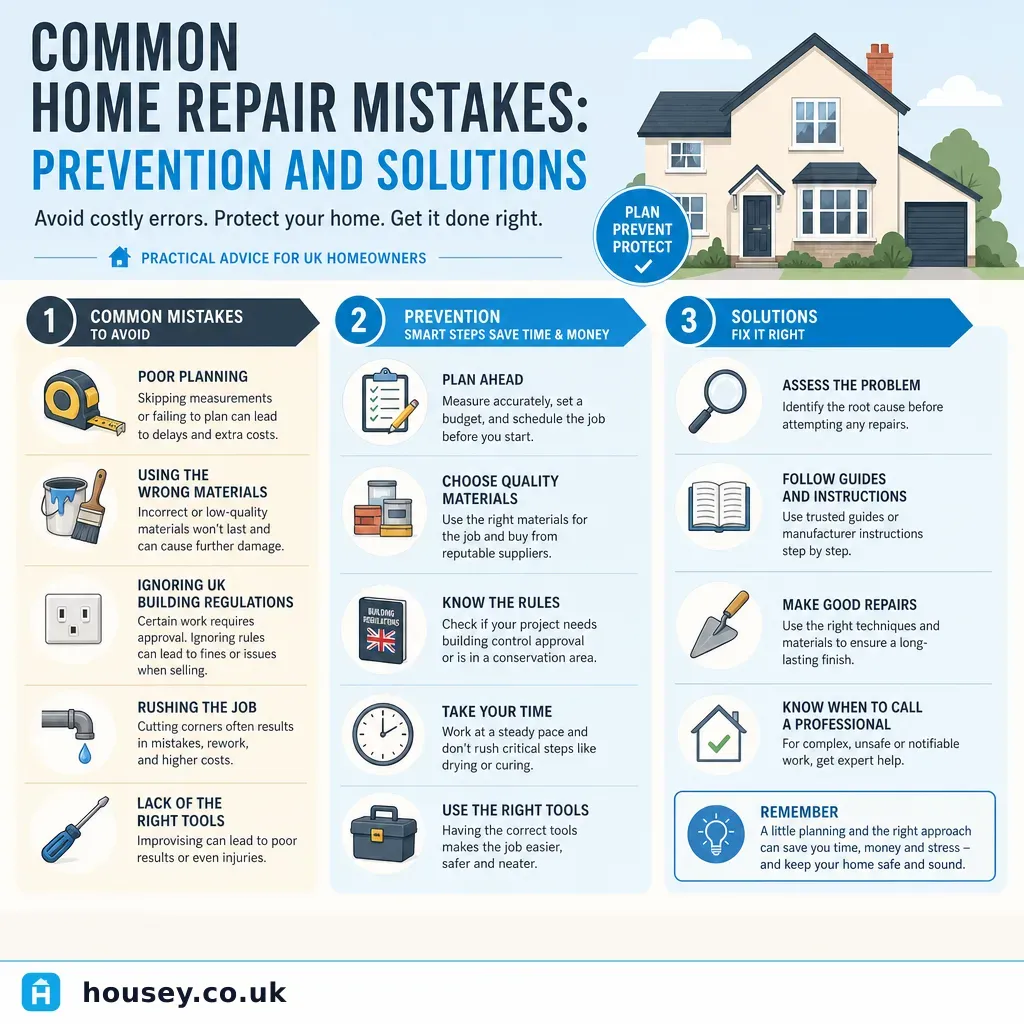
Common Home Repair Mistakes: Prevention and Solutions
The most frequent home repair mistakes in the UK include starting notifiable work without building regulations approval, engaging contractors without a written contract, misdiagnosing damp in solid-wall properties, and disturbing materials that may contain asbestos without a prior survey.